

In Poland, archaeologists discovered a complete skeleton, with its limbs curled up like a fetus, and remarkably well-preserved.
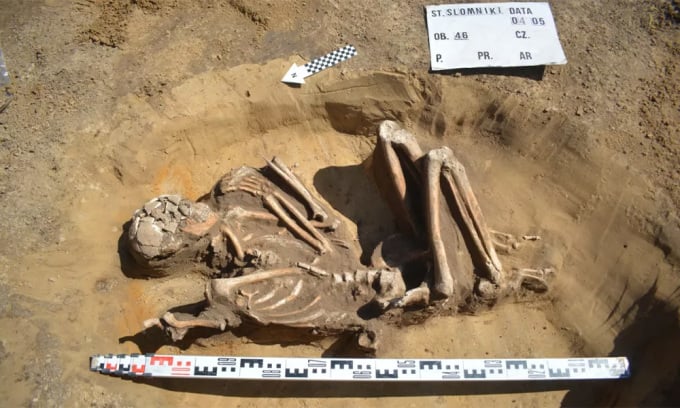
The tomb contains remains dating back approximately 7,000 years. Photo: Pawel Micyk/Lukasz Szarek
The remains were unearthed along with some pottery during renovations of the town square in Slomniki, Krakow, Ancient Origins reported on May 22. Based on the pottery's style, which belongs to the Linear Pottery Culture (LBK), the remains may date back 7,000 years, according to Paweł Micyk, an archaeologist at Galty Earth and Engineering Services, who excavated the site in Slomniki.
Thanks to being buried in loose soil with a non-acidic chemical composition, the skeleton was exceptionally well preserved, according to Micyk.
"Currently, we cannot identify the person buried here, but upcoming analysis by an anthropologist may reveal more information," Micyk said. Additionally, the archaeological team plans to use carbon dating to more accurately determine the time period in which this person lived.
Experts also found fragments of flint next to the remains. Some of the burial artifacts were damaged because the upper part of the tomb had been leveled.
"This is a truly exciting and very important discovery . The tomb belongs to some of the earliest Neolithic peasants who crossed the Carpathian Mountains from the south and arrived in Poland in the 6th millennium," said Małgorzata Kot, professor of archaeology at the University of Warsaw.
"We still know very little about the culture of these ancient farmers, especially about their burial customs. They buried their dead in settlements or in separate cemeteries, but cemeteries were rarer," Kot said. The newly discovered skeleton may shed more light on these people.
Thu Thao (According to Ancient Origins )
Source link


















































































Comment (0)