

In a speech at the China Bridge Partner Summit 2024, Song Zhiping, chairman of the China Association of Listed Companies, said that currently only two new energy vehicle (NEV) manufacturers are profitable: BYD and Li Auto.
According to Mr. Song, many manufacturers have to produce both internal combustion engine vehicles and new energy vehicles, but most large automakers have not yet made a profit from electric vehicles.
"But if you don't make electric vehicles, you won't have a future. It's a dilemma for those pursuing innovation," Song said.
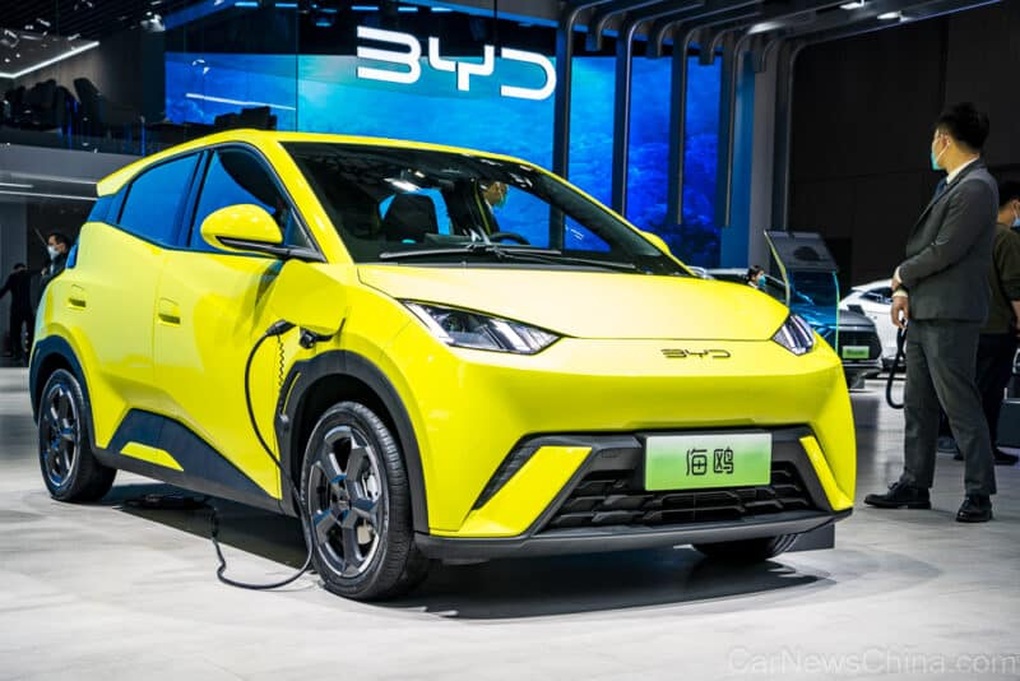
The BYD Seagull electric vehicle model at the 2023 Shanghai Auto Show (Photo: CNC).
Li Auto, along with BYD, are two of the rare companies that Mr. Song said are profitable in China's new energy vehicle manufacturing industry.
In 2023, Li Auto's total revenue reached 123.85 billion yuan (US$17 billion), a 173.5% increase compared to 2022. Of this, Li Auto earned a net profit of 11.81 billion yuan (US$1.6 billion), representing a profit margin of approximately 9.5%.
The situation for electric vehicle startups is not very bright. Although Nio's revenue increased by 12.9% in 2023, reaching 55.6 billion yuan (US$7.6 billion), it incurred a loss of 20.72 billion yuan (US$2.85 billion), equivalent to more than 45%, meaning an average loss of 100,000 yuan (US$13,750) per vehicle sold.
In 2023, Xpeng's sales increased, but its losses also increased. Revenue reached 30.68 billion yuan (US$4.2 billion) but the net loss was 10.38 billion yuan (US$1.4 billion).
What many Chinese automakers are pursuing is trying to gain market share, rather than profit. For companies that produce both gasoline and electric vehicles, losses from electric vehicles are partially offset by sales of gasoline vehicles, but for startups that only make electric vehicles, the situation is more difficult because they don't have a similar profit margin.
The price war is now spreading to suppliers, who are forced to sell below cost in order to secure volume.
According to GlobalData , there were 150 car brands operating in the Chinese market in 2023; of which 97 were Chinese-owned and 43 were joint ventures (the rest were likely imported). Factory capacity utilization in 2023 was 59%, but there was a significant difference between manufacturers.
For BYD, the factory utilization rate is around 80%, while Tesla's is 92%. However, many foreign brands have very low factory utilization rates, such as Hyundai at only 23%. The majority of Chinese production comes from the 15% of factories with utilization rates above 95%, and their total output accounted for 47% of total sales in China in 2023.
On the other hand, 20% of car factories in China produced fewer than 1,000 vehicles in 2023, and 17% produced fewer than 10,000 vehicles. It should be noted that these figures are for cars in general, not specifically for new energy vehicles.
Source: https://dantri.com.vn/o-to-xe-may/hau-het-cac-hang-xe-dien-trung-quoc-deu-dang-lo-20240712005629802.htm




















![[Photo] Prime Minister Pham Minh Chinh holds a phone call with the CEO of Russia's Rosatom Corporation.](/_next/image?url=https%3A%2F%2Fvphoto.vietnam.vn%2Fthumb%2F1200x675%2Fvietnam%2Fresource%2FIMAGE%2F2025%2F12%2F11%2F1765464552365_dsc-5295-jpg.webp&w=3840&q=75)














































Comment (0)