

According to the International Air Transport Association (IATA), Vietnam’s aviation industry is holding a great advantage as the Asia- Pacific region becomes the new growth center of global aviation. Over the past 10 years, passenger traffic to and from this region has increased by more than 50%, opening up a large space for Vietnamese airlines to consolidate their position.
Asia- Pacific : The world's new growth hub.

Mr. Sheldon Hee, Vice President for Asia-Pacific, IATA
At the "Platinum Partner Summit 2025" Global Customer Conference organized by Vietnam Airlines , Mr. Sheldon Hee, Vice President of Asia - Pacific, IATA, commented that this region has not only recovered but also entered the strongest development period in the history of the industry. The shift of the world aviation industry's focus from the Atlantic to the Pacific is taking place clearly, opening up great opportunities for airlines, including Vietnam Airlines, to increase their competitiveness and reach international standards.
IATA cited data showing that, over the past 10 years, the number of passengers traveling to and from the Asia-Pacific region has increased by more than 50%, the highest level compared to any other region. The main driving force comes from demographic factors as this region owns four of the six most populous countries in the world (India, China, Indonesia, Pakistan). In the context of many developed economies experiencing a sharp decline in population growth, India and Pakistan are forecast to continue to have a population explosion, meaning hundreds of millions of potential passengers will enter the market, from personal travel needs, tourism to labor and trade. The economic foundation is also growing solidly, as the International Monetary Fund (IMF) forecasts that the GDP of major economies in Asia-Pacific will continue to grow significantly faster than the US and Europe.
Vietnam: A bright spot and breakthrough in Southeast Asia.
IATA has rated Vietnam as one of the most impressive growth markets in Southeast Asia. Over the past decade, Vietnam’s position has changed significantly, from 11th in 2014 to 8th in 2024 on the regional aviation map. This reflects not only the growth in scale but also the level of deep integration into the international aviation flow.

IATA suggests that airlines need to clearly define their target segments and key markets to optimize resources and improve investment efficiency.
In the top 10 largest international markets to Vietnam, 7 markets have doubled in just 10 years. Notably, visitors from India increased 10 times, while those from Korea increased 5 times. IATA experts believe that this achievement is a combination of open-door policies, strong investment in aviation infrastructure and systematic route opening strategies of domestic airlines. Vietnam is currently the fourth largest international market in ASEAN, only behind Thailand, Singapore and Malaysia, and this development is affirmed by IATA to contribute directly and indirectly to the economy, from GDP, employment to promoting tourism and international trade.
IATA recommends that Vietnamese airlines, especially Vietnam Airlines, need to clearly identify target segments and key markets to optimize resources instead of spreading them out. A focused strategy, building specialized products and services will be more effective in the context of fierce competition. At the same time, deeper cooperation in the tourism ecosystem, from travel, hotels to ground services, is considered an important direction to create attractive all-inclusive product packages, increasing the competitiveness of Vietnamese destinations.
Digital transformation and green aviation: Pillars of sustainable growth.
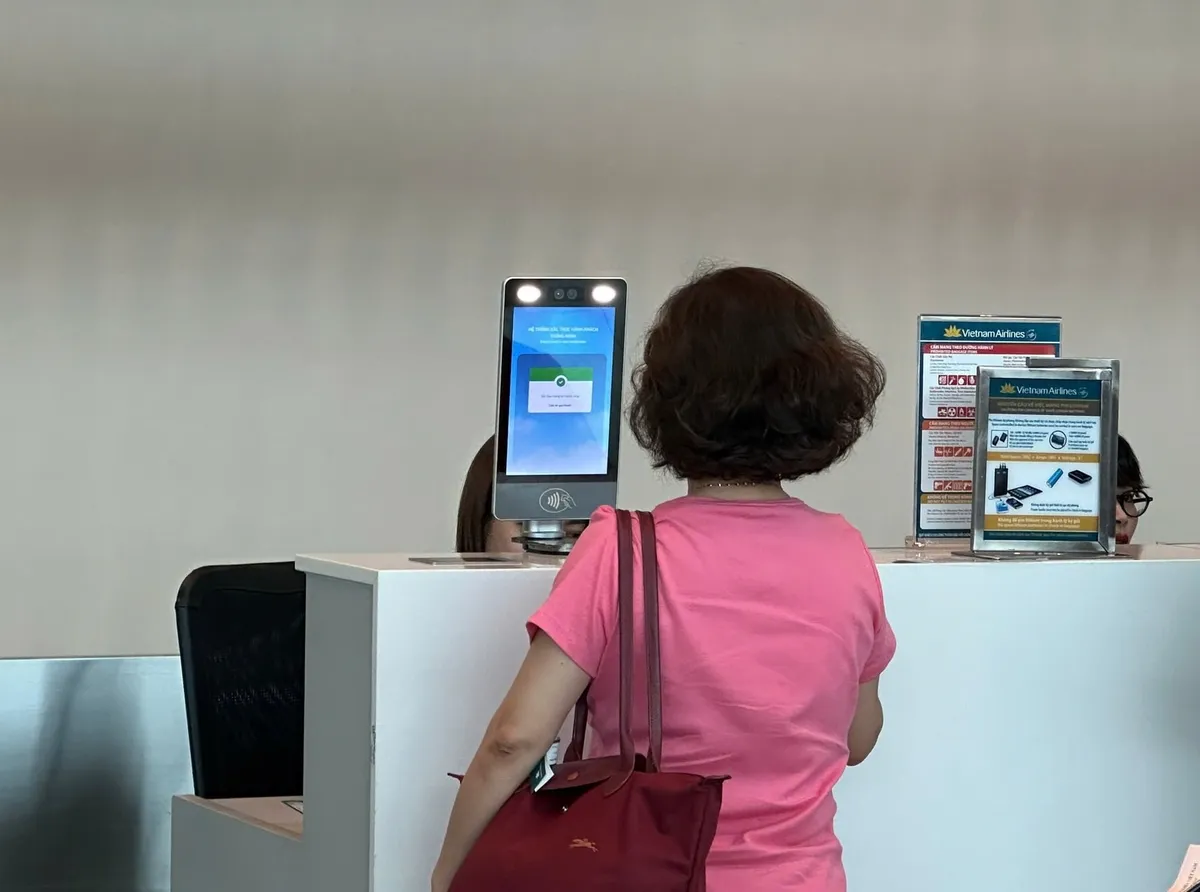
Checking in for flights using biometric technology saves time and is more convenient for passengers as they do not have to use identification documents.
Mr. Sheldon Hee particularly emphasized that digital transformation is the "backbone" that helps airlines increase productivity and improve the passenger experience during the hot growth period. The One ID model, which uses biometrics to authenticate identity and deploy the entire check-in process in a contactless manner, is considered the inevitable future of the industry.
Along with digital transformation is the issue of sustainable development, associated with the Net Zero commitment by 2050 of the entire aviation industry. In this roadmap, Sustainable Aviation Fuel (SAF) plays a key role. Global renewable fuel capacity is expected to reach 55 million tons by 2030, with 170 SAF agreements signed. Vietnam is assessed to possess abundant biological materials, from agricultural by-products to biomass, creating great potential to participate in the SAF production chain. However, to turn the potential into reality, Vietnam needs to have attractive enough policy mechanisms to attract investment and form a green fuel ecosystem.
In addition to SAF, solutions such as route optimization, aircraft weight reduction, and airport energy savings are also important "links" in the emission reduction strategy. According to IATA, sustainable development is not only an environmental responsibility but also a cost-effective solution, helping to directly improve the profits of airlines.
Source: https://vtv.vn/hiep-hoi-van-tai-hang-khong-quoc-te-iata-nganh-hang-khong-viet-nam-dang-dung-truoc-co-hoi-phat-trien-rong-lon-100251209160941471.htm


![[Photo] Explore the US Navy's USS Robert Smalls warship](/_next/image?url=https%3A%2F%2Fvphoto.vietnam.vn%2Fthumb%2F1200x675%2Fvietnam%2Fresource%2FIMAGE%2F2025%2F12%2F10%2F1765341533272_11212121-8303-jpg.webp&w=3840&q=75)

















![[Video] The craft of making Dong Ho folk paintings has been inscribed by UNESCO on the List of Crafts in Need of Urgent Safeguarding.](https://vphoto.vietnam.vn/thumb/402x226/vietnam/resource/IMAGE/2025/12/10/1765350246533_tranh-dong-ho-734-jpg.webp)























































Comment (0)