

According to the new law, the national education diploma system includes high school diplomas, vocational high school diplomas, intermediate diplomas, college diplomas, bachelor's degrees, master's degrees, doctorates, and diplomas from specialized training programs in certain specific fields and disciplines.
Compared to current regulations, the law has abolished the issuance of junior high school diplomas. Instead, students who have completed the primary and junior high school education programs and meet the requirements set by the Minister of Education and Training will have their completion confirmed by the school principal on their academic transcript.
Junior high school diplomas issued before the law came into effect remain legally valid.
Students who complete the high school program, meet the eligibility requirements, and pass the exam will be awarded a high school diploma. If they do not take the exam or fail, they will be issued a certificate of completion of the general education program, which can be used to register for a high school diploma exam later or to pursue vocational education.
The newly passed law also stipulates several important new points: tuition fees will be waived for all general education students in public educational institutions nationwide; textbooks will be free for students; a single set of general education textbooks will be used uniformly nationwide; and a national council will be established to evaluate textbooks for each subject and educational activity.
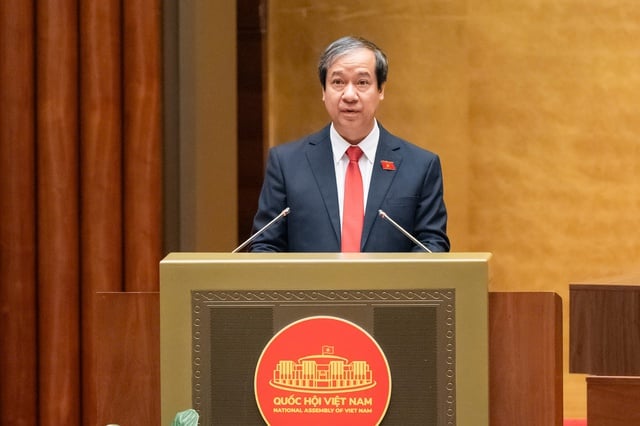
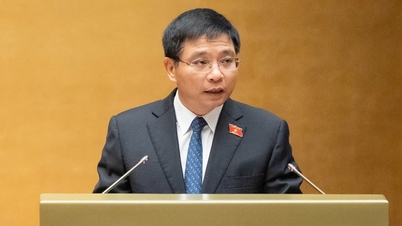
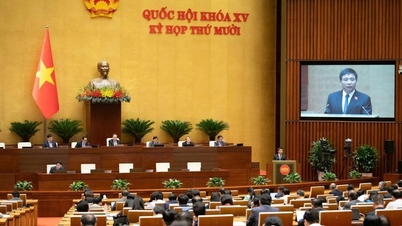
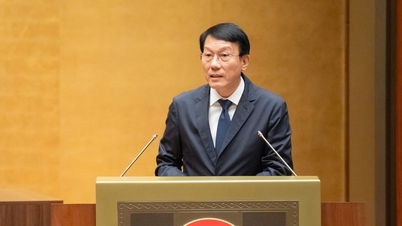
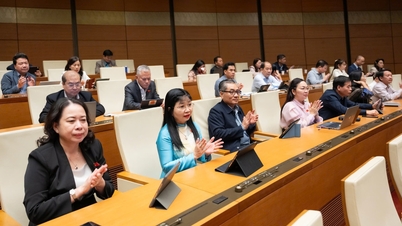
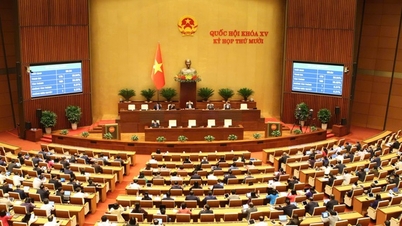
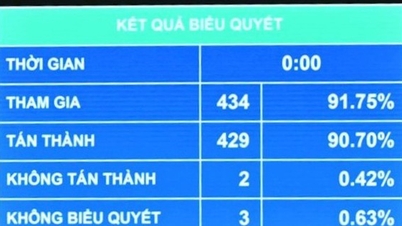
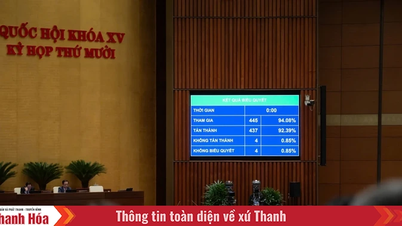
Minister of Education and Training Nguyen Kim Son presented the report on the feedback and explanations before the National Assembly passed the Law on the morning of December 10th.
A free set of shared textbooks will be available, to be completed by 2030.
The content of textbooks is also mentioned in the National Assembly 's Resolution on a number of specific and outstanding mechanisms and policies to make breakthroughs in education and training development, which was passed that same morning.
Presenting the report on the acceptance and explanation of this content, Minister Nguyen Kim Son said that many delegates agreed with the regulation that the Ministry of Education and Training should decide on a single set of textbooks for unified use nationwide, to be applied from the 2026-2027 school year, with the State providing the common textbooks free of charge, to be completed by 2030.
According to the Minister, the resolution has stipulated more specifically the timeframe for implementing a unified set of textbooks for nationwide use starting from the 2026-2027 school year, and the State will provide the common textbooks free of charge, to be completed by 2030, to ensure clarity and transparency in accordance with the directives in Resolution 71.
The government has taken note of the opinions of the National Assembly deputies and will study them to specify in regulations, guidelines for laws, resolutions, and other documents under its authority to clarify the criteria for selecting textbooks, define the scope of free textbooks, and manage accompanying books to ensure efficient use of the budget.
Teachers will receive a minimum 70% increase in allowances.
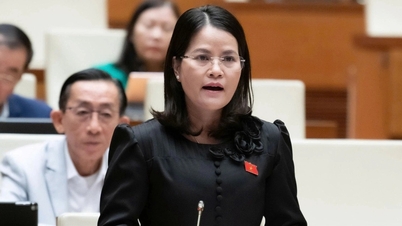
On the same day, the National Assembly passed a Resolution on a number of specific and outstanding mechanisms and policies to make breakthroughs in education and training development. This Resolution takes effect from January 1, 2026.
With its unique and superior policies regarding benefits for human resources in the education sector, the Resolution stipulates that preferential professional allowances will be implemented according to a roadmap prescribed by the Government for public preschool and general education institutions, with a minimum rate of 70% for teachers, a minimum rate of 30% for staff, and 100% for teachers working in areas with particularly difficult socio-economic conditions, ethnic minority areas, border areas, and islands.
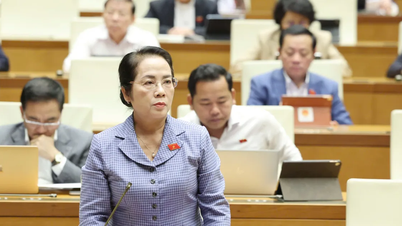
The Director of the Department of Education and Training is responsible for recruiting, appointing, and managing teachers, administrators, and staff of public preschools, primary and secondary schools, continuing education centers, special schools, and vocational high schools within the province. The Chairman of the commune/ward is responsible for assigning, transferring, seconding, appointing, dismissing, and changing the job positions of teachers, administrators, and staff of public schools under their management.
Notably, students have access to preferential credit from the Social Policy Bank to cover their study and living expenses. Postgraduate students participating in key training programs commissioned by the State and linked to national priority science and technology tasks are granted scholarships and living expenses.
In addition, the National Assembly also passed a Resolution approving the investment plan for the National Target Program on Modernizing and Improving the Quality of Education and Training for the period 2026-2035. The estimated budget for the program during the 2026-2030 period is 174,600 billion VND, including 100,000 billion VND from the central budget, 45,100 billion VND from local counterpart funds, 20,400 billion VND from universities and colleges, and 9,100 billion VND from other mobilized funds.
Accordingly, by 2030, the whole country will complete compulsory education up to the end of junior high school, solidify all classrooms; 30% of kindergartens and general schools will have equipment to teach and learn some subjects in English, gradually making English the second language.
18 key colleges are invested in training highly skilled human resources in technical and technological fields to serve key national programs and projects. Half of the universities meet standards, of which at least 30 are invested in modern facilities equivalent to those in developed Asian countries; 8 schools are in the top 200 schools in Asia; 1 school is in the top 100 schools in the world in a number of fields and industries.
By 2035, Vietnam strives to have 60 colleges reaching the level of ASEAN-4 countries; 6 schools reaching the level of developed countries in the Group of 20 leading economies. At least 12 universities are among the top groups in Asia and 2 schools are among the top 100 universities in the world.
Source: https://phunuvietnam.vn/thong-nhat-mot-bo-sach-giao-khoa-toan-quoc-tu-nam-hoc-2026-2027-bo-cap-bang-tot-nghiep-thcs-238251210135825473.htm


![[Photo] Explore the US Navy's USS Robert Smalls warship](/_next/image?url=https%3A%2F%2Fvphoto.vietnam.vn%2Fthumb%2F1200x675%2Fvietnam%2Fresource%2FIMAGE%2F2025%2F12%2F10%2F1765341533272_11212121-8303-jpg.webp&w=3840&q=75)





















![[Video] The craft of making Dong Ho folk paintings has been inscribed by UNESCO on the List of Crafts in Need of Urgent Safeguarding.](https://vphoto.vietnam.vn/thumb/402x226/vietnam/resource/IMAGE/2025/12/10/1765350246533_tranh-dong-ho-734-jpg.webp)



















































Comment (0)