

Aquaculture is the main strength of Tan Phu Dong commune. The commune has developed traditional and high-tech industrial shrimp farming models, including extensive shrimp farming combined with rice cultivation.
Accordingly, in the downstream hamlets of Tan Phu Dong islet, including Phao Dai, Phu Huu, Con Cong, etc., saltwater intrusion occurs for up to 6 months each year.
To adapt to these natural conditions, the local people have recently taken advantage of the six months of saltwater to raise shrimp extensively, and the months of freshwater to grow rice.
The "harmonious with nature" production model, following the seasonal water levels, not only creates year-round jobs but also helps farmers increase their income.
According to Le Thanh Dang, Chairman of the People's Committee of Tan Phu Dong commune, in order to help reduce costs for rice-shrimp production, the commune recently proposed and received approval from the Department of Science and Technology to implement a project on applying mechanization to the rice-shrimp farming model. This aims to mechanize harvesting, thereby reducing harvesting costs and helping people increase their income. |
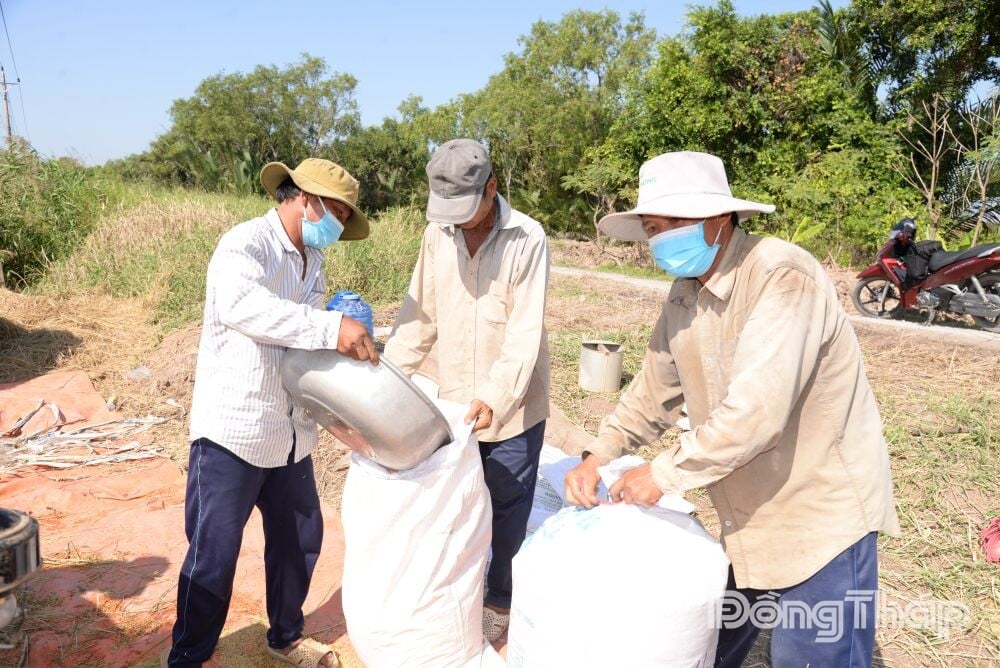
Ms. Nguyen Thi Nhanh's household (Phu Huu hamlet, Tan Phu Dong commune) is one of the households practicing the rice-shrimp farming model. According to Ms. Nhanh, in the past, local farmers only grew rice or raised shrimp, and were unaware of the rice-shrimp farming model.
Later, after receiving training and learning, farmers found this model effective and adopted it. Thanks to the appropriate arrangement of farming activities, each year, her family harvests about 17 tons of rice and 4 tons of commercial shrimp, earning a higher income than before.
Ms. Nhanh shared: "This model yields both rice and shrimp, whereas before, raising only shrimp resulted in low profits. Having both rice and shrimp helps the shrimp in the pond to multiply, so we earn even higher profits."
The advantage of the rice-shrimp farming model is that it utilizes the natural ecosystem of the rice paddies as food for the shrimp.
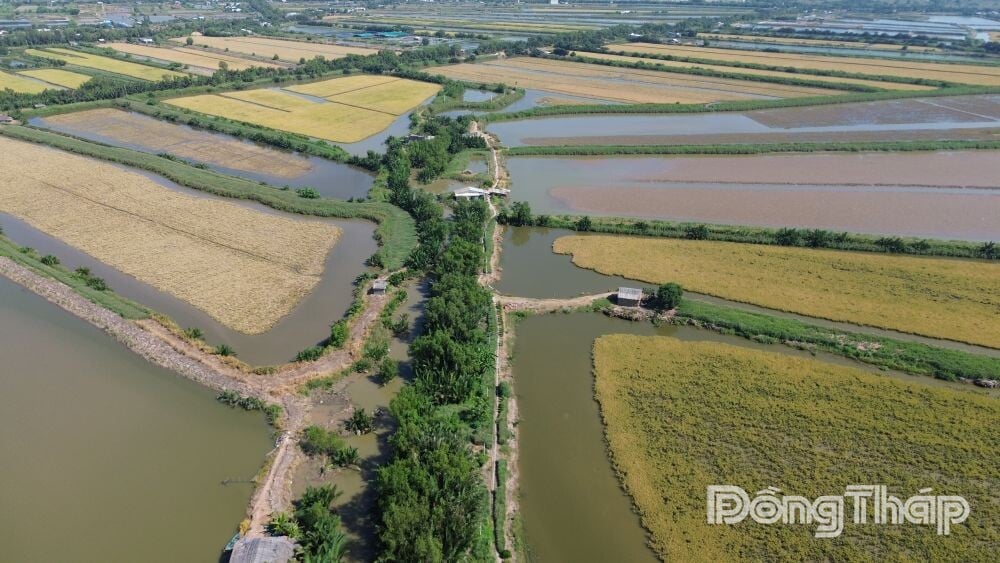
Therefore, shrimp farming does not use industrial feed or antibiotics. As for the rice plants, they absorb nutrients from the soil after the shrimp harvest, so no chemical fertilizers are used.
This helps reduce production costs and yields clean shrimp and rice that meet organic standards, contributing to increasing the value of agricultural products. In particular, rice-shrimp rotation also forms a closed-loop circular production process, helping to optimize production profits.
Mr. Truong Hoai Phong (Tan Phu Dong commune) said: "Farming according to this model, farmers only use organic fertilizer and do not use pesticides. Shrimp do not need to be fed and no antibiotics are used, so the product is guaranteed to be clean and safe."
From just a few initial households, Tan Phu Dong commune has now developed a rice-shrimp farming area covering approximately 140 hectares. Along with implementing various preferential policies to encourage farmers to continue developing the rice-shrimp farming model, the commune has established the Phu Tan Agricultural and Aquatic Products Service Cooperative to facilitate farmers' transition from small-scale production to collective economic activities , linking the production-to-consumption chain and gradually establishing a brand for its specialty products.
Mr. Ha Van Hai, head of the Phu Tan Agricultural and Aquatic Products Service Cooperative, said that the cooperative currently has 10 members with 42 hectares of land cultivated under the rice-shrimp farming model. To create a stable market and increase income for members, the cooperative has established a contract with a business to purchase all of its products.
The company is committed to purchasing 100% of THT's rice at a price approximately 200 VND/kg higher than the market price. To ensure the sustainable development of the model, in addition to linking output, THT is currently collaborating with input suppliers to provide materials to its members at competitive prices.
“Currently, THT has discussed with its members and will invite local authorities to guide the production of the most suitable and key rice varieties for the rice-shrimp farming area. From there, we will focus on building a rice-shrimp brand for Tan Phu Dong commune,” Mr. Hai added.
According to Mr. Nguyen Trung Kien, Head of the Economic Department of Tan Phu Dong commune, the rice-shrimp farming model in Tan Phu Dong commune is currently highly effective, generating income for the people and, importantly, adapting to climate change.
Local authorities continue to invite investment in collaboration with cooperatives to implement better models in the future.
By rotating rice and shrimp crops, farmers in Tan Phu Dong commune have proactively engaged in agricultural production in a way that is in harmony with nature.
This success is spreading the spirit of innovation and turning challenges into opportunities, opening up strategies for sustainable agricultural production in localities affected by climate change.
T.DAT
Source: https://baodongthap.vn/hieu-qua-tu-mo-hinh-san-xuat-nong-nghiep-thuan-thien--a233897.html
![[Photo] Prime Minister Pham Minh Chinh holds a phone call with the CEO of Russia's Rosatom Corporation.](/_next/image?url=https%3A%2F%2Fvphoto.vietnam.vn%2Fthumb%2F1200x675%2Fvietnam%2Fresource%2FIMAGE%2F2025%2F12%2F11%2F1765464552365_dsc-5295-jpg.webp&w=3840&q=75)


![[Photo] Closing Ceremony of the 10th Session of the 15th National Assembly](/_next/image?url=https%3A%2F%2Fvphoto.vietnam.vn%2Fthumb%2F1200x675%2Fvietnam%2Fresource%2FIMAGE%2F2025%2F12%2F11%2F1765448959967_image-1437-jpg.webp&w=3840&q=75)









![[Infographic] Many activities at the 96th anniversary commemoration of the death of Deputy Scholar Nguyen Sinh Sac](https://vphoto.vietnam.vn/thumb/402x226/vietnam/resource/IMAGE/2025/12/11/1765441454787_infographic-nhieu-hoat-dong-tai-le-gio-lan-thu-96-cua-cu-pho-bang-nguyen-sinh-sac20251211010322.webp)






















![[OFFICIAL] MISA GROUP ANNOUNCES ITS PIONEERING BRAND POSITIONING IN BUILDING AGENTIC AI FOR BUSINESSES, HOUSEHOLDS, AND THE GOVERNMENT](https://vphoto.vietnam.vn/thumb/402x226/vietnam/resource/IMAGE/2025/12/11/1765444754256_agentic-ai_postfb-scaled.png)








































Comment (0)