

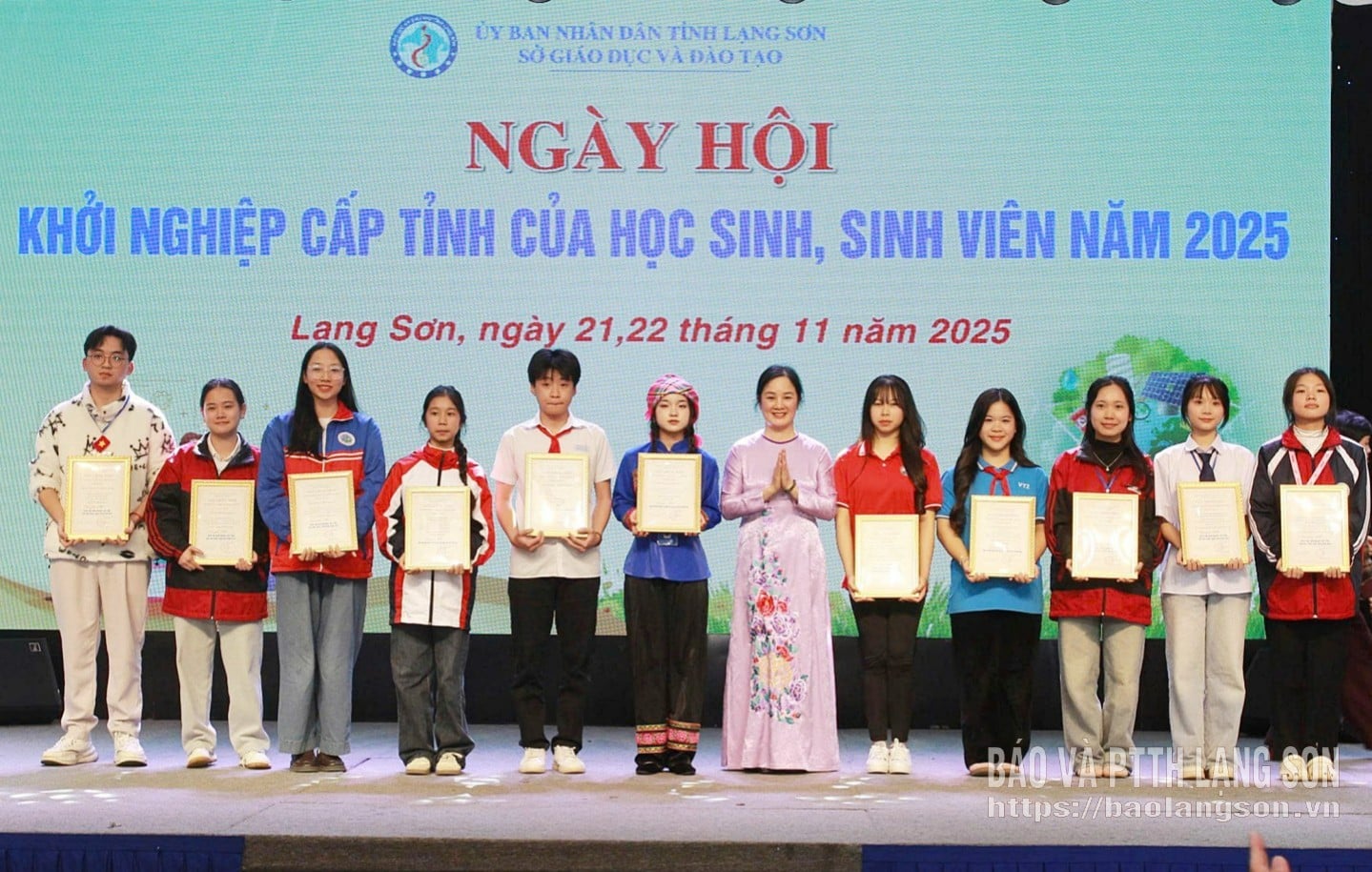
Current development practices pose new requirements for education, students must not only be good at cultural knowledge but also have scientific thinking, creativity and the ability to adapt quickly to changes in technology. From that requirement, the provincial education sector identified science, technology and innovation as the key to improving the quality of teaching and learning, and at the same time concretized by bringing STEM activities and creative startups into the direction, becoming an important goal in the 2018 General Education Program.
With that orientation, schools have built a practical learning model, teachers have shifted from imparting to leading and inspiring, and students proactively "learn to do" and learn to solve problems.
In particular, technology playgrounds such as robot programming competitions, scientific research or startup ideas have become environments for students to apply interdisciplinary knowledge to specific products. From the 2024-2025 school year to now, schools have implemented 5,045 STEM topics; 4,779 students participated in programming and controlling robots; 797 creative clubs were established in secondary schools. Not only that, the annual innovation festival with the participation of a large number of students has created more space for them to introduce products, exchange ideas, receive comments from experts and expand their creative thinking. STEM has therefore not only stopped at classroom lessons but has become a driving force for students to explore knowledge and apply it to life.
One of the outstanding results is that the spirit of creativity has spread to preschool education. Currently, 100% of preschools in the province have implemented STEM lessons, with 24,191 lessons conducted in the last school year. Of these, 22 facilities were selected as provincial-level points and 70 schools organized STEM festivals, creating a useful playground for children.
Ms. Phung Thi Hong Loan, a teacher at Khanh Khe Kindergarten, said: When teaching STEM, we teachers take advantage of available materials such as cardboard, seeds, nuts, etc. to help children think, explore, and develop observation and problem-solving skills through simple scientific experiments. Thanks to that, children develop logical thinking and confidence from an early age, in the right spirit of learning to be creative.
Innovation is also enhanced when the education sector strengthens its connection with businesses, production facilities and technology experts. Students visit modern working environments, receive advice on product improvement and suggestions on how to bring ideas to market. Many projects exploiting local strengths such as medicinal herbs, clean agricultural products, experiential tourism, etc. have been researched and initially created effectiveness. Such projects are clear evidence of the philosophy of learning through creativity and practical experience.
A typical example is the project to develop the value chain of wind-dried persimmons by a group of students from Na Sam Secondary School participating in the provincial "Students with Startup Ideas" competition this year. From the hometown specialty, which is mainly consumed fresh fruit, the students researched appropriate processing methods to increase economic value and preservation time, creating typical local products. Hoang Minh Khang, class 8A1, Na Sam Secondary School, a member of the wind-dried persimmons project group, shared: We want to turn our hometown specialty into a competitive product in the market, contributing to increasing people's income and promoting the local image.
At the same time, the teaching staff is an important factor in promoting change in each classroom. Many teachers proactively learn more technology, innovate methods, and participate in online training to keep up with the pace of scientific and technological development. Currently, the whole province has 1,484 teachers qualified to teach STEM subjects; 622 teachers are capable of instructing robot programming. When teachers innovate their thinking, students are given open opportunities to express their creativity.
The effectiveness is clearly recorded through the maturity of students, in practice they have boldly presented ideas, cooperated well in groups, analyzed problems with scientific thinking and oriented their careers early through practical experience. In 2025 alone, students from schools in the province won 34 national excellent student awards, 3 national science and technology awards and 2 national start-up awards, affirming that the quality of education is shifting positively towards developing creative capacity.
It can be affirmed that STEM education has been promoting innovation in the entire industry, gradually shifting from theoretical education to comprehensive development of learners' capacity. When each classroom is a creative space, each teacher is an inspiration and each student is given the opportunity to master knowledge, the spirit of "learning to create" will continue to spread strongly, contributing to building a future generation of citizens who are confident and adaptable to the digital age.
From the 2024-2025 school year up to now, schools have implemented 5,045 STEM topics; 4,779 students have participated in programming and controlling robots; 797 creative clubs have been established in secondary schools. Currently, 100% of kindergartens in the province have implemented STEM lessons, with 24,191 lessons conducted in the last school year. Of these, 22 facilities were selected as provincial-level points and 70 schools organized STEM festivals, creating a useful playground for children. |
Source: https://baolangson.vn/stem-hoc-de-sang-tao-5066704.html

![[Photo] Cat Ba - Green island paradise](/_next/image?url=https%3A%2F%2Fvphoto.vietnam.vn%2Fthumb%2F1200x675%2Fvietnam%2Fresource%2FIMAGE%2F2025%2F12%2F04%2F1764821844074_ndo_br_1-dcbthienduongxanh638-jpg.webp&w=3840&q=75)




























![[VIMC 40 days of lightning speed] Da Nang Port: Unity - Lightning speed - Breakthrough to the finish line](https://vphoto.vietnam.vn/thumb/402x226/vietnam/resource/IMAGE/2025/12/04/1764833540882_cdn_4-12-25.jpeg)

































Comment (0)