

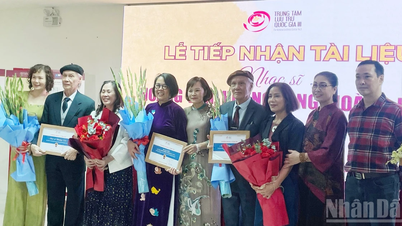
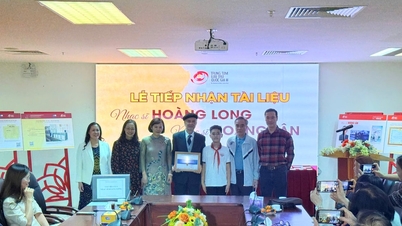
On December 10th, in Hanoi , the National Archives Center III held a ceremony to receive the second batch of valuable documents and artifacts related to composer Hoang Van and two other composers, Hoang Long and Hoang Lan.
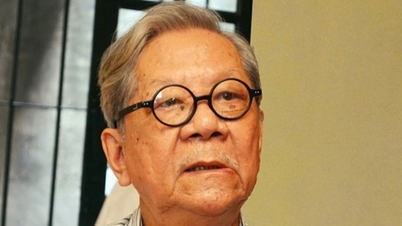
Composer Hoang Van (1930-2018) was one of the great and influential figures in modern Vietnamese music .
Following his death, his family embarked on a quiet and meaningful journey to gather, systematize, and preserve his vast artistic legacy.

Dr. Tran Viet Hoa - Director of the National Archives Center III - receives the donation from the daughter of composer Hoang Van - Dr. Y Linh.
The journey of gathering information from the drawer under the bed.
Speaking to a reporter from Dan Tri newspaper, Dr. Le Y Linh, a scholar of ethnomusicology and the eldest daughter of composer Hoang Van, said that it took her a long time after Hoang Van's death to muster the courage to reopen the drawers under his bed – where he kept his mementos from his final years.
Those were very large drawers, and Ms. Le Y Linh had to spend an entire day rearranging them. As she opened each drawer, a world of her father's mementos gradually unfolded.
Among the faded papers, she found three or four novels in French and English, most notably *Je suis compositeur* by Arthur Honneger – a book she had given him just a few months before his death, and which he had meticulously transcribed his favorite passages from.
In addition, there are three dictionaries: Chinese-Vietnamese, English-Vietnamese, and French-Vietnamese, along with Vuong Hong Sen's book "The Hobby of Collecting Antiques "—books closely associated with his reading habits and intellectual life.
The drawers still hold many mementos containing memories of a lifetime of artistic activity: newspaper articles about him, and the Music magazine commemorating the 60th anniversary of the Musicians' Association.
She was particularly moved when she found the music box he had bought for her during a trip to Saigon in the late 1970s; when she wound it up, the melody of "Lara's Lover" played, transporting her back to her childhood years.
He carefully preserved articles about the day she defended her thesis, along with a collection of enlarged photographs he had taken from a small portrait published in a magazine, and articles about the June 2005 concert, when conductor Le Phi Phi – her younger brother – conducted three of his instrumental works, including "Dien Bien Phu" .
Beneath the papers were other mementos: numerous pens and paper, a seal, an ink box, several ancient scrolls of paper for calligraphy; and a collection of about 30 children's songs that he had separated, along with two little-known poems.
According to Ms. Y Linh, composer Hoang Van did not keep a diary or tell any stories; all that remains are newspaper articles, musical manuscripts, and composition notebooks that she gradually found in the cupboards of his old house, which has stood for over a century.
"He wrote nothing other than music, poetry, and calligraphy. Even near the time of his death, when he stopped composing, he never intended to write a memoir," Linh said.
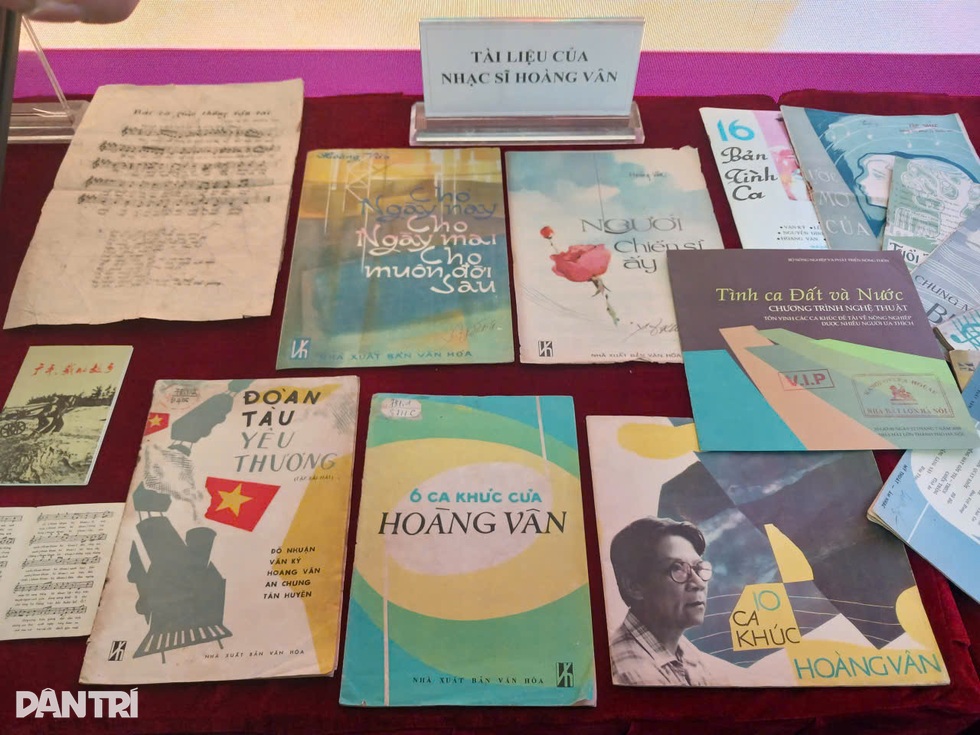
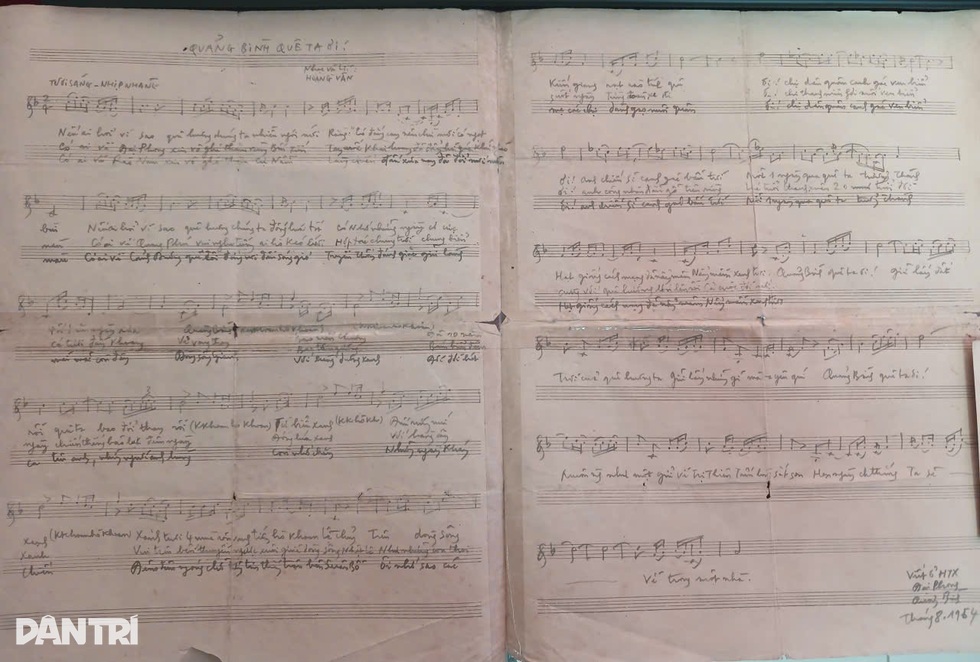
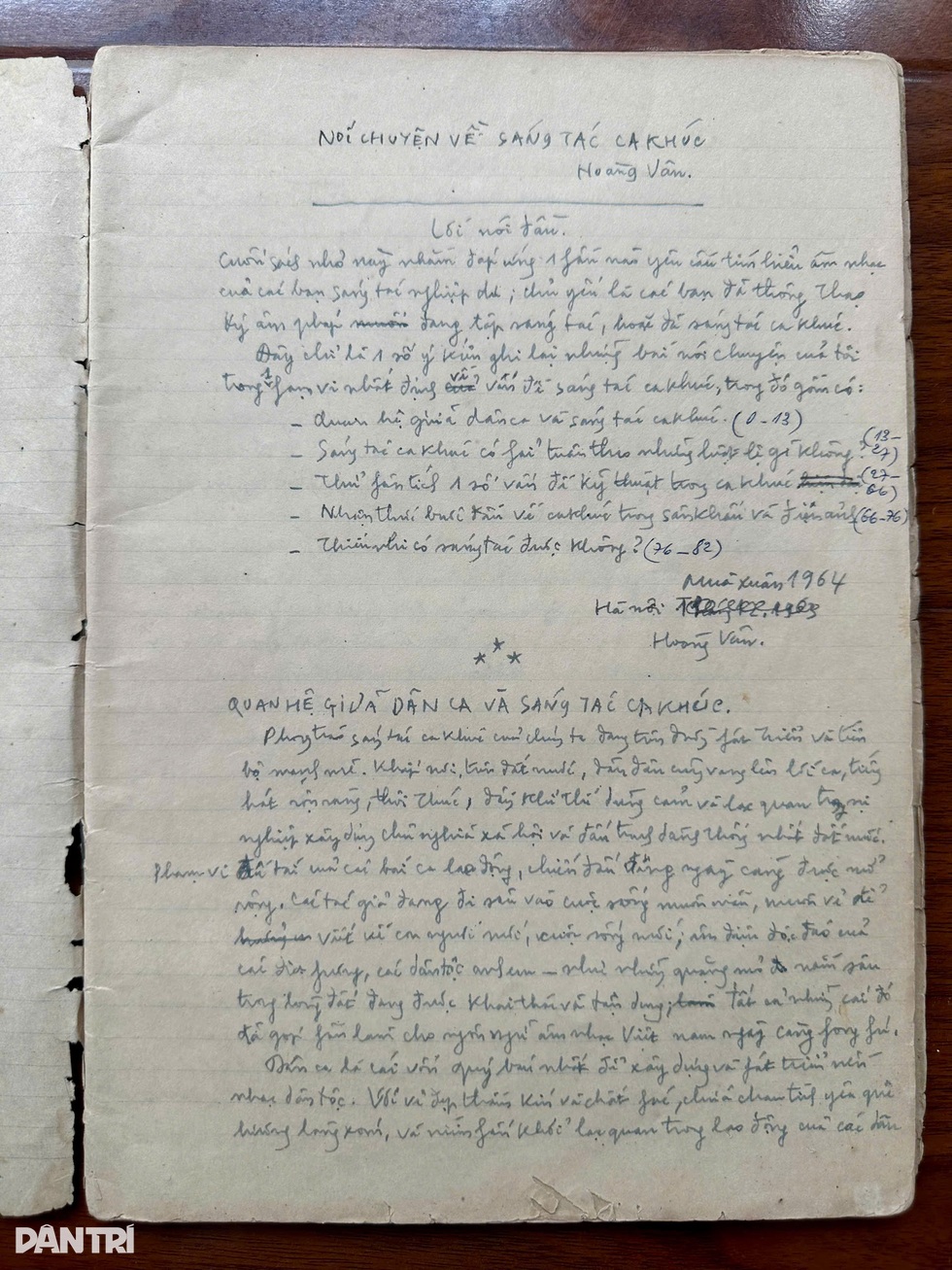
Valuable documents, materials, and manuscripts of exceptional value, contributing to the enrichment of the Hoang Van Collection - a UNESCO World Heritage documentary collection - were donated in the second phase by the family of musician Hoang Van to the National Archives Center III.
Collecting these surviving works therefore becomes a personal journey, but one that also carries a sense of responsibility.
She recalled her efforts starting in 1994, when she persuaded her father to transcribe 10 songs for use in concerts in Paris, then in 2000 organizing the search for all the recordings at the Voice of Vietnam radio station, and in 2015 scanning a box of musical scores containing over 150 songs - half of which had never been published.
After his death, the real collecting began. She met with his colleagues, friends, and students, followed every lead in the documentation, reread newspapers and books, compared information, and researched the specific time of his works.
Conductor Le Phi Phi was in charge of restoring the musical scores, listening to the recordings to proofread and make corrections.
“I am incredibly grateful to the friends, colleagues, and fans who have silently preserved every photograph, every recording, every piece of paper of his over the years. We had to reorganize all the handwritten notes, printed copies, and recordings, and then track down the missing musical scores. That's a huge amount of work, but if we didn't do it immediately, time would sweep everything away,” Linh said emotionally.
The deeper she delved into her father's and contemporary musicians' materials, the more she appreciated the value of a special period in Vietnamese music history. That's why she believes that compiling and preserving these materials "is not only the responsibility of a daughter, but also a responsibility to the music of our nation."
Speaking about composer Hoang Van in his everyday life, Dr. Le Y Linh described him as a kind, gentle father figure, not strict but profound.
Throughout her childhood, she remembers her father sitting at his desk working from early morning until late at night – a persistent work ethic that his children could easily sense without him having to mention it.
“My father wasn’t strict in an overbearing way. He gave his children quite a bit of freedom, but always taught them with gentle advice. The quote I remember most is: ‘When faced with two paths, choose the more difficult one.’ I’ve applied that saying throughout my life because I find it true and deeply impactful. He didn’t talk much about his emotions, but the way he lived and worked made us understand him so much,” Linh recounted.
In the memory of composer Hoang Van's eldest daughter, he was very indulgent towards his children, showing it in small things, such as her preference for writing with fountain pens and her frequent requests for new ones.
He used to joke, "Linh takes every pen she sees that looks nice from her dad." Those little memories have stayed with her to this day.
Composer Hoang Van's life was closely intertwined with his work as a composer. For nearly six decades, from 1951 to 2010, he tirelessly wrote music, leaving behind a vast legacy. Because he devoted almost all his time to music, he rarely shared personal matters with his children.
Conversations between him and Le Y Linh, especially after she grew up, almost always revolved around their profession. He talked about the works he was writing, domestic music projects, or suggested that his daughter explore more topics he was passionate about.
She added: "Those conversations were mostly about work – they showed little emotion, but were profound in the way that his generation did."
His passion for composing music, spanning nearly 60 years, made it the center of his life. And in that continuous flow, what he left behind is both an artistic legacy and a part of his spirit that his children cherish with deep respect. The most influential character trait in Linh, inherited from her father, was his moderation and patience.
He always reminded her, "Everything has its time, there's no need to rush." But he was incredibly disciplined himself. The saying he often taught his children, "Don't put off until tomorrow what you can do today," has become a life motto that Linh has upheld to this day.
The calmness, patience, and perseverance—the distinctive qualities of composer Hoang Van—are also what she considers her greatest "spiritual asset" that she has inherited.
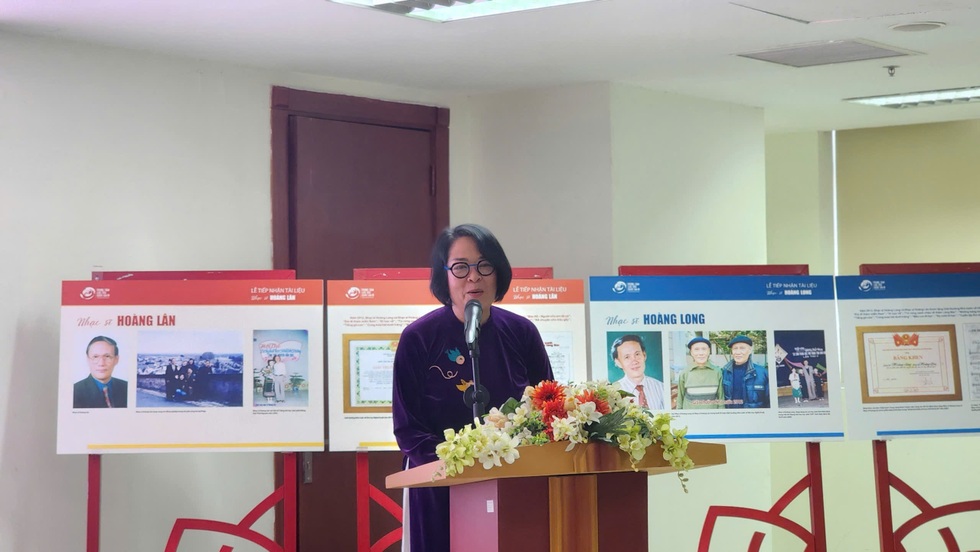
Dr. Le Y Linh, the eldest daughter of composer Hoang Van, shared her thoughts at the event.
Precious treasures for generations to come.
Dr. Le Y Linh said that this donation of documents is the second time the family has handed over original manuscripts, valuable printed copies, and many newly discovered documents about her father's literary career.
“I was truly taken aback when officials from the National Archives Center III came to my house to take away the files. Those were very sacred remnants of my father. But I believe that placing them in a prestigious and trustworthy place like the Center was the right choice.”
"With the hot and humid climate in Vietnam, documents that are 60-70 years old are very easily damaged. Once, I discovered that the manuscripts had been gnawed by cockroaches and rats. Therefore, when the documents were sent to the archives, my family felt extremely reassured," Ms. Linh confided.
Some of the materials were kept as family heirlooms, but all documents directly related to her creative work were handed over. For her, this is not just about preserving her family's heritage, but also a responsibility to the national music scene.
She said, “My father passed away in 2018, but the work of preserving the heritage must continue. We hope that when other musician families see that the documents can be sent to a safe place, well-preserved, and made available to the community for research, they will feel reassured to do the same.”
Ms. Tran Viet Hoa, Director of the National Archives Center III, said that this collection of documents had been carefully selected, classified, and digitized by the family of musician Hoang Van over a long period of time, with the hope that the Center could immediately use it for exhibitions, research, and education on the history of music.
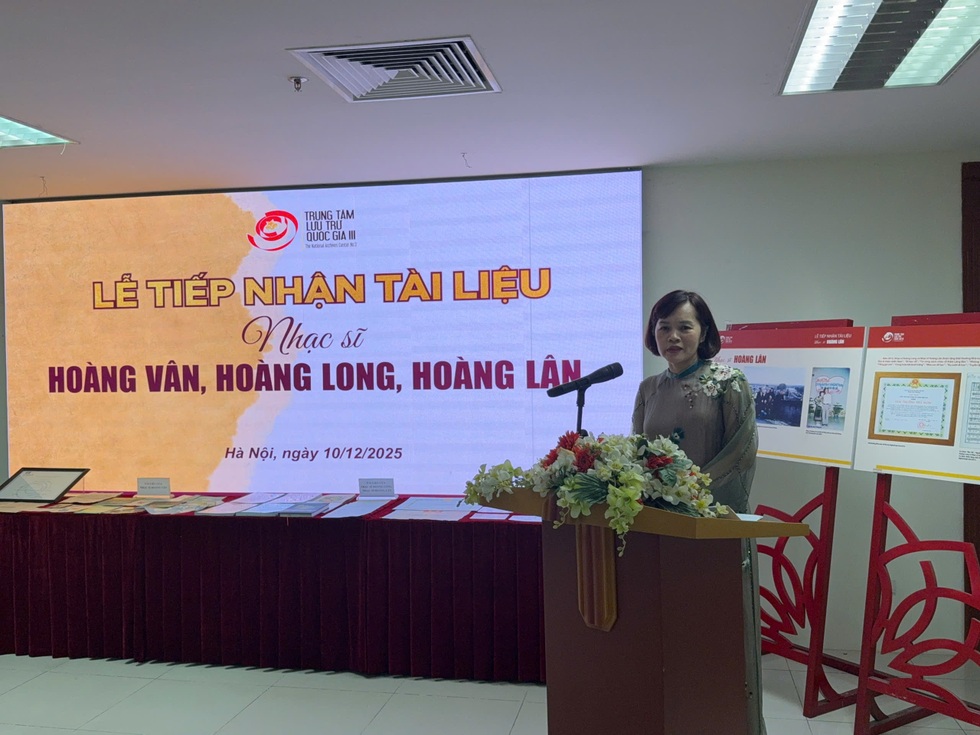
Ms. Tran Viet Hoa, Director of the National Archives Center III, shared her thoughts at the event.
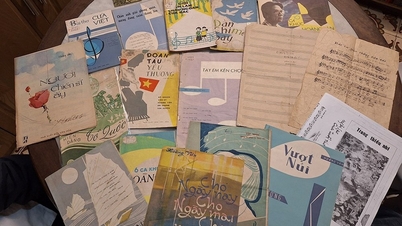
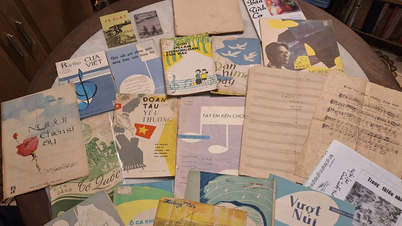
This second handover includes nearly 20 publications, including songbooks and sheet music by composer Hoang Van, as well as collections of his works published from 1959 to 1991, newly collected from 2022 to the present. These documents, manuscripts, and artifacts are of exceptional value, specifically:
Handwritten manuscript of "Talking about Songwriting" (Hoang Van, 1964) (Note: This document was not published and was not available for reference before publication). Pocket sheet music of "Quang Binh, My Homeland!" , published by the Vietnamese Embassy in China. Handwritten manuscript by composer Hoang Van for the work " Quang Binh, My Homeland!" (1964).
Along with other documents, especially some documents about past performances and concerts by Hoang Van.
Ms. Hoa emphasized: "The documents transferred in this batch are highly rare, many of them recovered after a long period of dispersal due to wartime circumstances and being preserved through various individuals and organizations both domestically and internationally."
The rediscovery, restoration, and systematization of these artifacts is a persistent effort by the family, with the support of researchers and the community of Hoàng Vân music lovers.
The collection, systematization, and transfer to the State Archives demonstrates the family's responsibility in preserving the musical heritage of composer Hoang Van, while also contributing to enhancing the completeness, continuity, and research value of the Hoang Van Collection, a UNESCO World Documentary Heritage."
Ms. Hoa hopes that, in the future, the family of composer Hoang Van will continue to cooperate closely with the National Archives Center III, the Vietnam Music Museum, and the press to widely disseminate valuable documents about composer Hoang Van.
Sharing this heritage not only helps the public, especially young people, gain a deeper understanding of an important period in Vietnamese music, but also contributes to preserving the memory of those who dedicated their lives to the national art scene.
Photo: Huong Ho - T. Le
Source: https://dantri.com.vn/giai-tri/hoi-uc-xuc-dong-sau-nhung-ky-vat-tu-lieu-quy-ve-nhac-si-hoang-van-20251211092819930.htm



![[Photo] Closing Ceremony of the 10th Session of the 15th National Assembly](/_next/image?url=https%3A%2F%2Fvphoto.vietnam.vn%2Fthumb%2F1200x675%2Fvietnam%2Fresource%2FIMAGE%2F2025%2F12%2F11%2F1765448959967_image-1437-jpg.webp&w=3840&q=75)





































![[OFFICIAL] MISA GROUP ANNOUNCES ITS PIONEERING BRAND POSITIONING IN BUILDING AGENTIC AI FOR BUSINESSES, HOUSEHOLDS, AND THE GOVERNMENT](https://vphoto.vietnam.vn/thumb/402x226/vietnam/resource/IMAGE/2025/12/11/1765444754256_agentic-ai_postfb-scaled.png)








































Comment (0)