

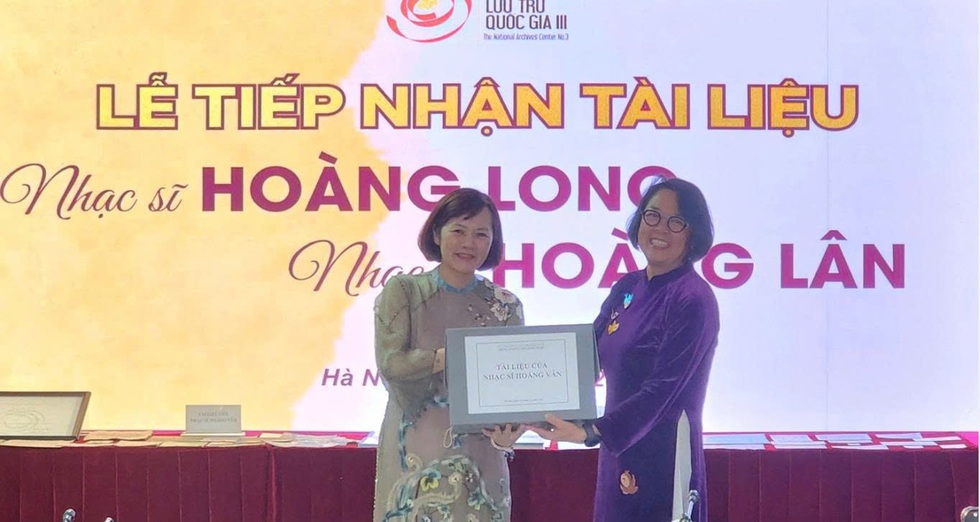
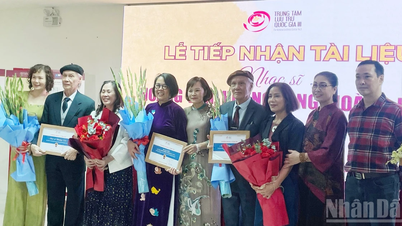
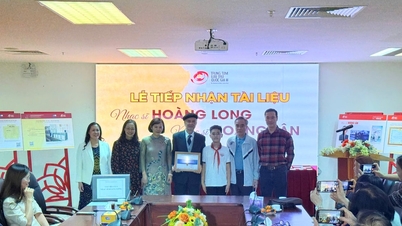
Dr. Tran Viet Hoa - Director of the National Archives Center III - receives the donation from the daughter of composer Hoang Van - Dr. Y Linh.
On December 10th, in Hanoi , the National Archives Center III held a ceremony to receive the second batch of valuable documents and artifacts related to composer Hoang Van and two other composers, Hoang Long and Hoang Lan.
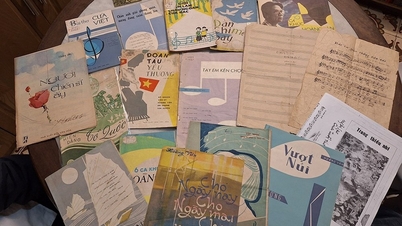
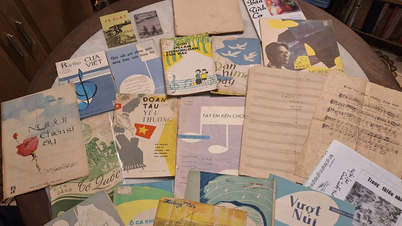
Among these, the bilingual Vietnamese-Chinese pocket-sized sheet music "Quang Binh, My Homeland" is particularly noteworthy. Printed using the musical notation popular in China in the 1960s and published by the Vietnamese Embassy in China, it evokes many emotions.
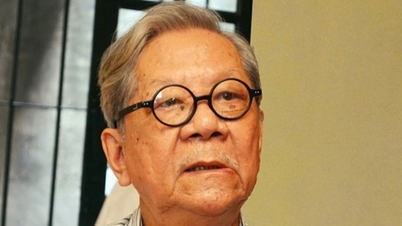
Composer Hoang Van (1930-2018) is considered one of the leading figures of Vietnamese revolutionary music .
Throughout his life as a composer, he left behind many works that left a deep mark on the spiritual life of the public, such as: "Ho Keo Phao" ( Dragging the Cannon), "Toi La Nguoi Tho Lo" ( I Am a Furnace Worker) , " Bai Ca Xay Dung" (Song of Construction) , "Ha Noi - Hue - Saigon" (Hanoi - Hue - Saigon) , "Hat Ve Cay Lua Hom Nay" (Singing About Today's Rice Plant )... Among them, the song "Quang Binh Que Ta Oi" (Oh, My Homeland Quang Binh) is like a special connection with Hoang Van.
"Quang Binh, My Homeland" - the favorite song of General Vo Nguyen Giap.
During his lifetime, not only Hoang Van, but also his children always considered Quang Binh their second home. His daughter Le Y Linh and son Le Phi Phi always dreamed of following in their father's footsteps and "writing part 2" of " Quang Binh, My Homeland."
Speaking to a reporter from Dan Tri newspaper, Dr. Le Y Linh, a scholar of ethnomusicology and the eldest daughter of composer Hoang Van, said that from childhood to adulthood, her father often recounted the circumstances surrounding the creation of this song.
Ms. Linh recounted that in 1964, composer Hoang Van was sent on a field trip to Quang Binh. At the beginning of the year, the area was very peaceful, with farmers diligently engaged in production and full of vitality. However, on August 5th, the Gulf of Tonkin incident occurred, and American planes began bombing North Vietnam, including Quang Binh – the most fiercely contested battlefront in Central Vietnam.
In the memories recounted by his father, that scene was etched into his mind as an unforgettable milestone. The people of Quang Binh, even amidst bombs and bullets, continued to fight and produce, remaining optimistic, resilient, and full of vitality. That unwavering spirit evoked a powerful emotion that he could not suppress.
"My father used to say that it was during those days on the battlefield, amidst the rain of bombs and the indomitable spirit of the people of Quang Binh, that songs and melodies flowed from him in a remarkably natural way."
He said he didn't intentionally write it; the song just spontaneously emerged from strong emotions for the people and the land. After completing the first draft, he immediately returned to Hanoi to arrange and record it with the Vietnam National Radio Orchestra. And the song spread instantly, as if it had been waiting to be sung for a long time,” Y Linh confided.
"Quang Binh, My Homeland" became a phenomenon in a short period of time. Singer Kim Oanh was the first to perform the recording and was also the voice most favored by composer Hoang Van when singing this song.
Two years later, the work was performed as a report before President Ho Chi Minh, General Secretary Le Duan, General Vo Nguyen Giap, and the Politburo.
The Quang Binh Provincial Party Committee also presented him with a Soviet-made transistor radio – a gift that he cherishes deeply whenever he recalls it.
Unlike many other regional songs, "Quang Binh, My Homeland" does not borrow from any original folk melodies. Composer Hoang Van uses folk material very proactively, transforming it in his own unique style.
"Quang Binh, My Homeland" is considered by experts to be a song that fully embodies the beauty of Central Vietnamese folk music: characteristic embellishments, a vigorous rhythm, and emotions that are sometimes smooth and gentle, and at other times heavy with contemplation.
When he sang a few lines for his family and colleagues, composer Pham Tuyen exclaimed, "That's great! Excellent! How did you learn so quickly?"
The song was subsequently played repeatedly on the "Music on Demand" program. At one point, there were even concerns that the song was too gentle for the atmosphere of war.
During a visit by President Ho Chi Minh to the Voice of Vietnam radio station, the station's leaders decided to perform this song for him. After listening, President Ho smiled – an acknowledgment sufficient to dispel any doubts.
Later, the song was recorded in most socialist countries, played in fundraising events of the Vietnamese community in France and the United States, and performed in many countries throughout the years 1965-1975.
Notably, General Vo Nguyen Giap, a native of Quang Binh province, always held a deep affection for the song.
During his treatment at Hospital 108, the nurses would play "Quang Binh, My Homeland" for him; and each time, his eyes would well up with tears.
Dr. Le Y Linh said emotionally, "My father always said that it's impossible to rank his 'spiritual children,' but Quang Binh, my homeland, always holds a special place in his career and heart."
It is the culmination of experience, love for the country, creativity, and the most genuine emotions.
Therefore, it has been able to live on to this day – in the hearts of the people of Quang Binh and in the hearts of countless generations who love Vietnamese music. On the day my father passed away, many people from Quang Binh came to pay their respects.”
Speaking about composer Hoang Van in his everyday life, Dr. Le Y Linh described him as a kind father figure, not strict but profound.
She remembers seeing her father diligently working at his desk from early morning until late at night throughout her childhood – a persistent work ethic that needed no explanation, but which his children all clearly understood.
“My father wasn’t overbearing. He gave his children freedom but always taught them gently. The saying I remember most is: When faced with two paths, choose the more difficult one . I’ve applied that throughout my life because I find it true and deeply impactful,” she recounted.
The musician rarely spoke about his emotions, but the way he lived was enough for his children to understand a great deal.
In Linh's memory, her father was very indulgent towards her, showing it in small things like her fascination with fountain pens and her frequent requests to "ask" for them from him. He once joked, "Linh takes every interesting pen she sees from her father."
Hoang Van's life was closely intertwined with his work as a composer. He devoted most of his time to music, so conversations with his children—especially as his daughter Linh grew older—primarily revolved around his profession.
Those conversations were devoid of emotion but profound in the way that his generation did.
The greatest influence her father had on Linh was the importance of moderation and patience.
He taught, "Everything has its time, there's no need to rush," but he was extremely disciplined himself. The saying, "Don't put off until tomorrow what you can do today," has become her motto to this day.
For her, composer Hoang Van's calmness, perseverance, and attitude towards life are his most precious "spiritual assets."
Precious treasures for generations to come.
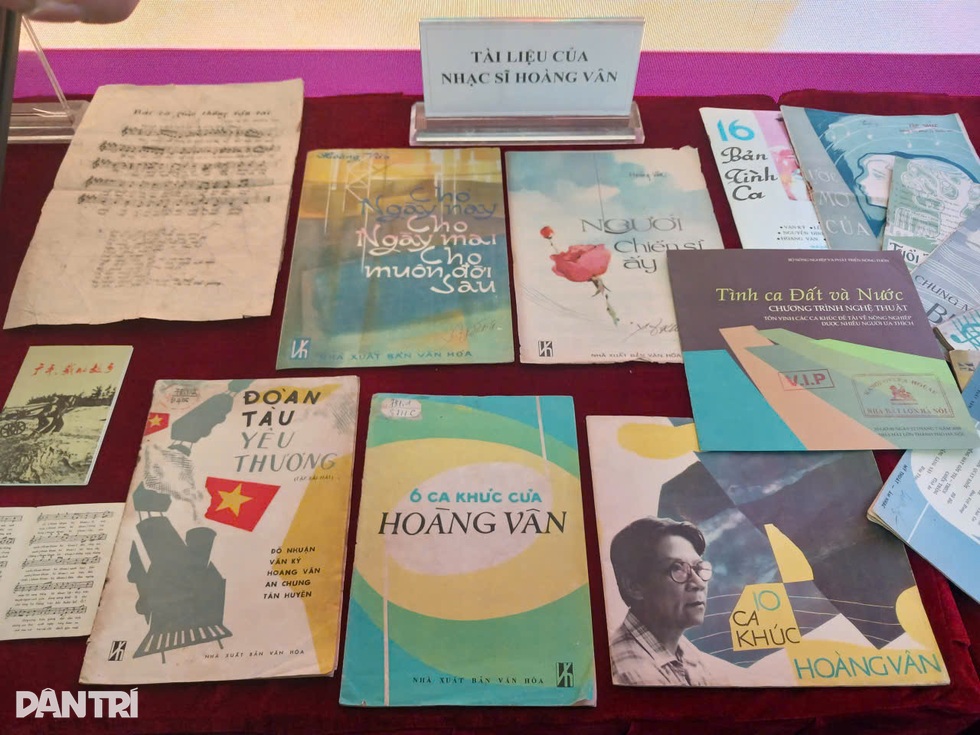
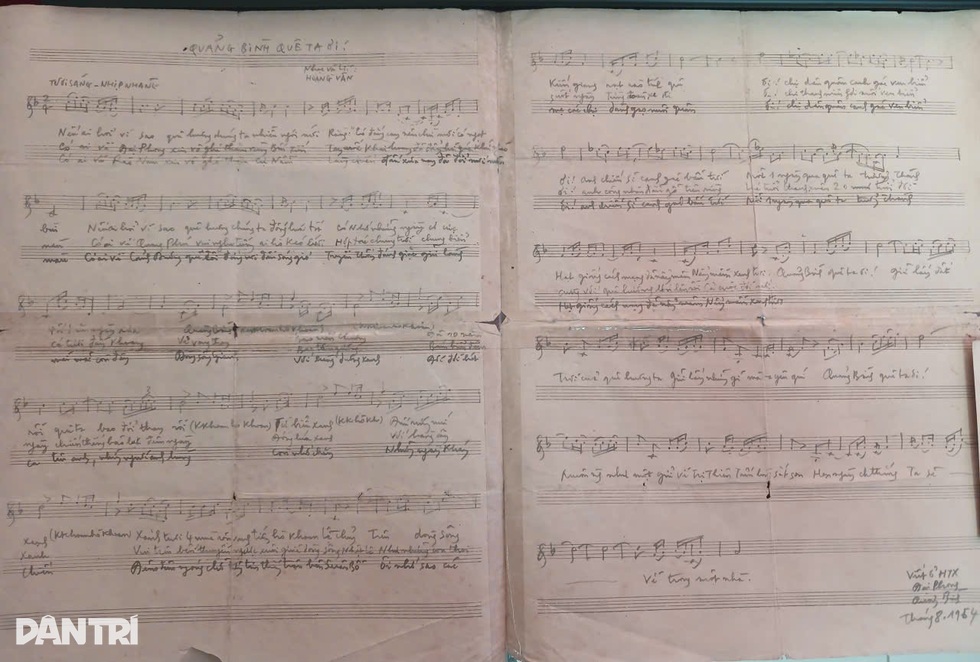
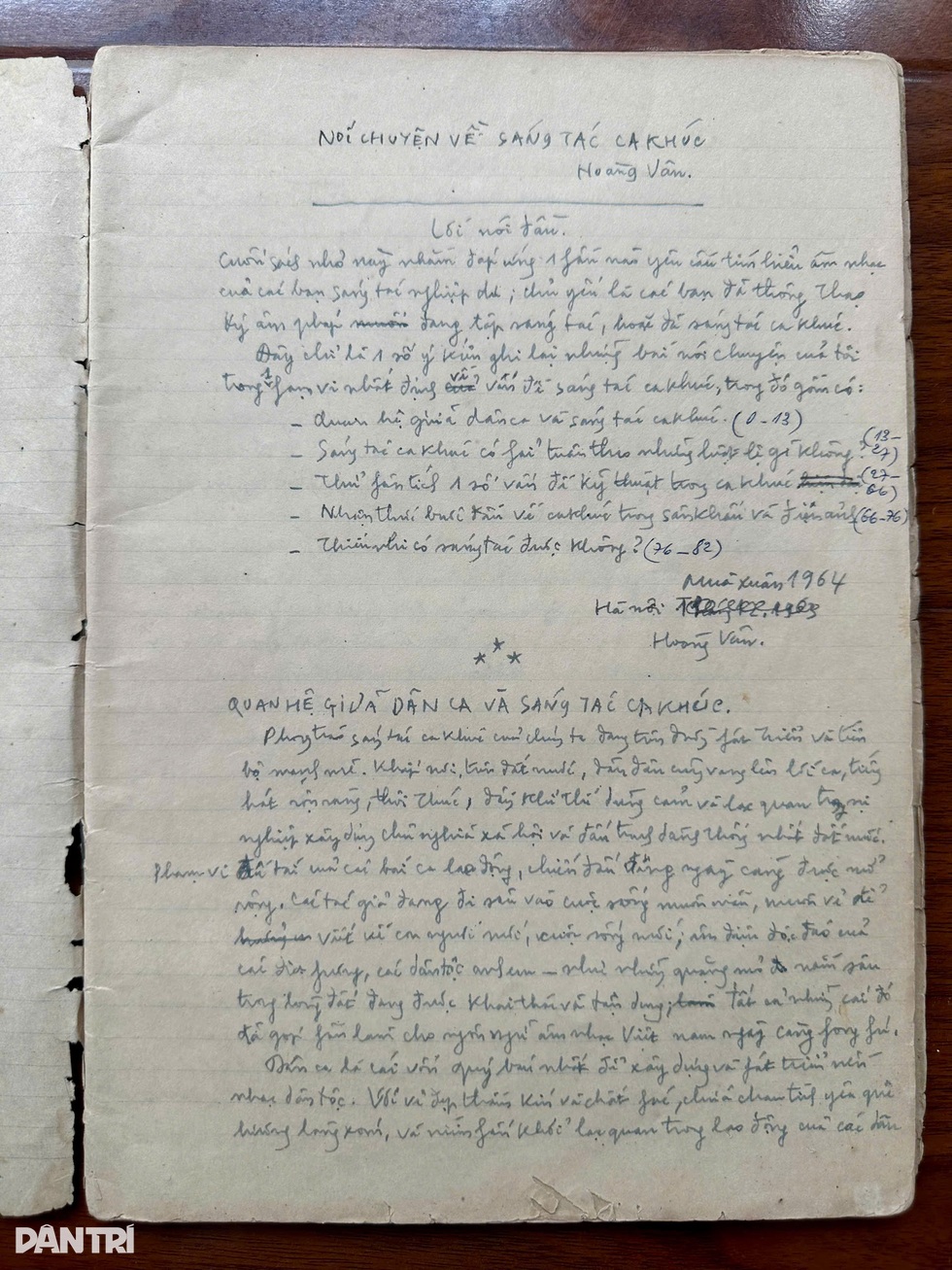
Valuable documents, materials, and manuscripts of exceptional value, contributing to the enrichment of the Hoang Van Collection - a UNESCO World Heritage documentary collection - were donated in the second phase by the family of musician Hoang Van to the National Archives Center III.
Dr. Le Y Linh stated that this donation marks the second time the family has handed over original manuscripts, valuable printed copies, and many newly discovered documents about her father's literary career.
“I was truly taken aback when officials from the National Archives Center III came to my house to take away the files. Those were very sacred remnants of my father. But I believe that placing them in a prestigious and trustworthy place like the Center was the right choice.”
"With the hot and humid climate in Vietnam, documents that are 60-70 years old are very easily damaged. Once, I discovered that the manuscripts had been gnawed by cockroaches and rats. Therefore, when the documents were sent to the archives, my family felt extremely reassured," Ms. Linh confided.
According to Linh, all documents directly related to her father's songwriting work have been handed over by the family. For her, this is not only about preserving the family's legacy, but also a responsibility to the national music scene.
She said, “My father passed away in 2018, but the work of preserving the heritage must continue. We hope that when other musician families see that the documents can be sent to a safe place, well-preserved, and made available to the community for research, they will feel reassured to do the same.”

Composer Hoang Van is considered one of the leading figures of Vietnamese revolutionary music (Photo: Provided by the family).
Ms. Tran Viet Hoa, Director of the National Archives Center III, said that this collection of documents had been carefully selected, classified, and digitized by the family of musician Hoang Van over a long period of time, with the hope that the center could immediately use it for exhibitions, research, and education on the history of music.
Ms. Hoa emphasized: "The documents transferred in this batch are highly rare, many of them recovered after a long period of dispersal due to wartime circumstances and being preserved through various individuals and organizations both domestically and internationally."
The rediscovery, restoration, and systematization of these artifacts is a persistent effort by the family, with the support of researchers and the community of Hoàng Vân music lovers.
The collection, systematization, and transfer to the State Archives demonstrates the family's responsibility in preserving the musical heritage of composer Hoang Van, while also contributing to enhancing the completeness, continuity, and research value of the Hoang Van Collection, a UNESCO World Documentary Heritage."
Ms. Hoa hopes that, in the future, the family of composer Hoang Van will continue to cooperate closely with the National Archives Center III, the Vietnam Music Museum, and the press to widely disseminate valuable documents about composer Hoang Van.
Sharing this heritage not only helps the public, especially young people, gain a deeper understanding of an important period in Vietnamese music, but also contributes to preserving the memory of those who dedicated their lives to the national art scene.
Composer Hoàng Vân - real name Lê Văn Ngọ (born in 1930 in Hanoi) - is one of the icons of 20th-century Vietnamese music.
From a teenager who joined the National Salvation Youth Team, then served as a liaison officer and cadet during the resistance war, Hoang Van was early instilled with a strong patriotic spirit, which formed the foundation for his writing style, rich in epic inspiration and imbued with humanistic qualities.
After peace was restored, he was sent to study at the Beijing Conservatory of Music (1954-1960), and then furthered his studies at the Sofia Conservatory of Music (1974-1975). Upon returning to Vietnam, he conducted the orchestra of the Voice of Vietnam Radio Music Ensemble, taught at the Hanoi Conservatory of Music, and worked for many years at the Vietnam Musicians Association, contributing to the training of many generations of talented musicians.
Photo: Huong Ho - T. Le
Source: https://dantri.com.vn/giai-tri/tiet-lo-ve-quang-binh-que-ta-oi-duoc-dai-tuong-vo-nguyen-giap-yeu-thich-20251211092819930.htm






































![[OFFICIAL] MISA GROUP ANNOUNCES ITS PIONEERING BRAND POSITIONING IN BUILDING AGENTIC AI FOR BUSINESSES, HOUSEHOLDS, AND THE GOVERNMENT](https://vphoto.vietnam.vn/thumb/402x226/vietnam/resource/IMAGE/2025/12/11/1765444754256_agentic-ai_postfb-scaled.png)










































Comment (0)