


A land as beautiful as a dream.
Mr. Bui Xuan Truong, Deputy Director of the Department of Culture, Sports and Tourism of Phu Tho province, shared that when visiting Van Son commune, tourists will witness firsthand the ancient Muong culture clearly evident in each stilt house with its sloping roof shaped like a turtle shell, in the black brocade dresses with intricate patterns, in the joyful laughter at the early morning market, or in the jars of rice wine by the firelight of the stilt house...
Van Son commune, formerly known as Lung Van, is a high-altitude, rather isolated area with difficult access. In a record by cultural scholar Phan Cam Thuong about the Lung Van region, there is a passage that reads: "This isolated land has resulted in its products, customs, and traditions being almost entirely indigenous, with little mixing, preserving a rare originality..."
The remote and isolated terrain also contributes to the ancient Muong character of this place. The only road leading to Van Son commune winds gently like a silk ribbon halfway up the mountain, surrounded by magical "cloud valleys" at an altitude of nearly 1,000m.
The natural landscape unfolds in its entirety, with stilt houses nestled on the mountainside, ancient tangerine orchards glistening golden in the sun, the sounds of forest birds echoing from the primeval forests, and mist lingering over the villages.
Today, Van Son commune was formed on the basis of merging the three old communes of Quyet Chien, Van Son and Ngo Luong. This is where the Muong people have lived for many generations, maintaining a peaceful lifestyle, along with a fresh climate. This land is called "the valley of longevity" by the Muong people because there are many old people who live to be a hundred years old and are still clear-minded and healthy.

Mrs. Bui Thi Un, from Xom hamlet, said: "Our ancestral homeland in the Muong Bi region, including what is now Van Son commune, was established after a great flood. It began with a couple who survived the flood by clinging to an ancient bi tree. They then cleared the mountains and forests, built a village, tamed wild animals, cultivated fields, and developed a highland rice-farming civilization. The name Muong Bi originated from that. That legend is still preserved as a sacred mark of the origins of the Muong people here."
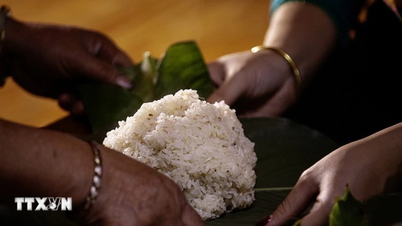
Van Son is at its most beautiful from after Tet (Lunar New Year) until the fourth lunar month each year. During this time, early mornings are covered in mist, clouds descend into the valleys and caress the terraced rice fields. Van Son rice is sticky and naturally fragrant. According to the elders, Van Son rice was once used as an offering to the Muong Lords - hence it is also called "Muong Lord's rice".
In the early morning mist, Lung Van market comes alive with baskets of bamboo shoots, wild vegetables, purple garlic, ripe yellow tangerines from Nam Son, and hand-woven brocade fabrics that have been woven for months. Lung Van market is held every Tuesday and Sunday. It is not just a place for buying and selling, but also a space to "connect" with the rhythm of life of the Muong people.
Ms. Hai Anh ( Hanoi ) shared: "Visiting Lung Van market, I was able to slow down and experience the gentle people and simple, rustic way of life. The market scene is like other rural markets, but full of life with many local products, helping me understand more deeply about Muong culture."
The tangerine orchards, ripening before Tet (Lunar New Year), have become a unique agricultural tourism highlight. Visitors can learn about this special fruit and stroll amidst the golden hillsides, enjoying the taste of the ancient tangerines of Muong Bi. The Nam Son tangerine, a source of pride, is a crop deeply rooted in the Muong people's heritage. Its thin skin, thick, juicy segments, and distinctive aroma have made it a "poverty alleviation" crop, providing high income for many households.

With its unique limestone geological features, this area has formed many cave systems, among which Nam Son Cave has long been considered the "rough gem" of Van Son commune, with its shimmering stalactites, clear turquoise lake 2-7m deep, and the sound of trickling water echoing in the tranquil space.
Specifically: Protecting intangible cultural heritage is the activity of implementing measures to ensure the vitality of intangible cultural heritage, including inventorying, identifying, documenting, researching, preserving, promoting, practicing, transmitting, and educating in or outside of schools and educational institutions, as well as restoring various aspects of the heritage.
The restoration of intangible cultural heritage is an activity based on the natural essence and value of the heritage, aiming to recreate and strengthen practices, preserve elements and expressions of heritage that are being altered or threatened with disappearance, and need to be protected so that intangible cultural heritage can survive and develop in the long term.
Nam Son Cave has been classified as a National Scenic Monument since 2008 and is an attractive destination for ecotourism, archaeological research, and those who enjoy exploration. Besides the cave, Van Son commune also boasts Thung Waterfall, Nui Kien Cave, and a cluster of 11 thousand-year-old ironwood trees in Bo Tram hamlet, a rare and rich ecosystem amidst the vast forest...
Traditional values pave the way for the future.
With its natural potential and unique local cultural values, many households in Van Son commune have pioneered the development of community-based tourism models. In Chien hamlet, Van Son commune, stilt houses have been renovated by the locals to be more spacious and modern while still preserving their traditional charm to serve tourists. Typical homestays in Chien hamlet include Lung Van homestay owned by Ms. Dinh Thi Truong's family, which can accommodate 15-20 guests at a time. Or Hai Than homestay owned by Ms. Ha Thi Tham and her husband, which received an investment of over 300 million VND and provides a stable income.

Ms. Ha Thi Tham said that what impresses tourists about Van Son is not only the beautiful scenery but also the experiences that homestays offer, allowing visitors to "live like locals," eat Muong rice, make sticky rice cakes, work in the fields, and go into the forest to pick bamboo shoots... Each visit to Van Son brings a new feeling. Homestay services that help tourists live in the rhythm of life of the Muong people are truly invaluable.
For the period 2025–2030, the Van Son Commune Party Committee has identified key development pillars such as infrastructure investment, development of specialty agriculture linked to tourism, and training in community tourism skills…
According to Mr. Nguyen Duy Tu, Secretary of the Party Committee of Van Son commune, the commune is developing a sustainable tourism development plan, positioning its unique products as ecological, Muong culture, and agricultural tourism; while also expanding the homestay model, organizing night markets, and strengthening tourism linkages within the triangle between Van Son - Mai Chau - Pu Luong regions.
Van Son deserves to be a prominent destination, a place that captivates tourists and fully embodies the spirit of the Muong people amidst the vast forests of the northern mountainous region and Phu Tho province. It is flourishing day by day, showcasing its rustic yet captivating local beauty, thanks to the wonderful blend of pristine nature, ancient Muong culture, and sustainable community-based tourism.
This article was commissioned by the Legal Department, Ministry of Culture, Sports and Tourism.
Source: https://baotintuc.vn/du-lich/khai-thac-gia-tri-van-hoa-muong-tro-thanh-diem-sang-du-lich-phu-tho-20251202155725889.htm



















![[Photo] Prime Minister Pham Minh Chinh holds a phone call with the CEO of Russia's Rosatom Corporation.](/_next/image?url=https%3A%2F%2Fvphoto.vietnam.vn%2Fthumb%2F1200x675%2Fvietnam%2Fresource%2FIMAGE%2F2025%2F12%2F11%2F1765464552365_dsc-5295-jpg.webp&w=3840&q=75)














































Comment (0)