

Tertiary hospitals have recorded many cases where patients who treated dengue fever at home or delayed seeking medical attention have suffered unfortunate consequences.
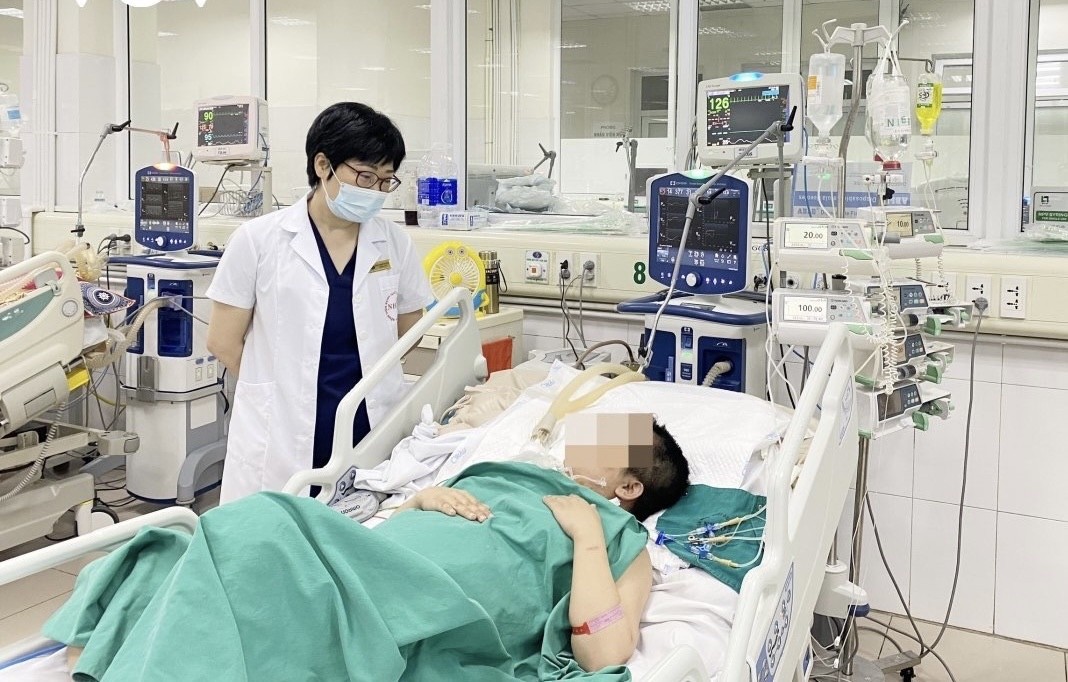 |
| Patients being treated for dengue fever at the National Hospital for Tropical Diseases. (Photo: Hoang Le) |
It's a mistake to think that once the fever is gone, the dengue fever is over.
Nationwide, more than 93,800 cases of dengue fever have been recorded, with 26 deaths. In Hanoi , the number of dengue cases continues to rise, with over 15,300 cases reported across the city.
According to Dr. Nguyen Trung Cap, Deputy Director of the Central Hospital for Tropical Diseases, dengue fever is divided into different stages (phases), specifically:
Phase 1: The patient experiences high fever, headache, and general discomfort lasting approximately 3 days. This phase causes significant discomfort due to high fever, headache, and vomiting, but rarely leads to serious complications; treatment involves fever reduction and oral rehydration solution (ORS).
Phase 2: From the end of day 3 to the end of day 7.
Patients have two possible outcomes: those with a good prognosis (94%) will gradually recover. The remaining 6% are at risk of developing severe conditions, with blood thickening in the blood vessels. In severe cases, this can lead to hypotension and shock.
“When dealing with dengue fever, different tests are needed depending on the stage of the disease. In the initial stage, a positive test result is crucial within the first three days, but if tested on the fourth day, it may be negative. Therefore, in some patients, even if they have clinical signs of dengue fever, a negative test result should still be considered dengue fever. A test on the following day may be positive. When receiving a test result, it is essential to understand which stage of the disease was tested to determine the value of the test,” said the Deputy Director of the National Hospital for Tropical Diseases.
At tertiary hospitals, many cases of dengue fever patients in critical condition have been recorded, including young people. Many cases have resulted in unfortunate consequences due to self-treatment at home or delaying hospital visits.
At the Center for Tropical Diseases, Bach Mai Hospital, six deaths due to dengue fever have been recorded, mostly due to late arrival at the hospital with symptoms of hypovolemic shock, coagulation disorders, and multiple organ failure.
At the National Hospital for Tropical Diseases, there have also been many unfortunate mistakes where, after the initial stage of the disease, patients and caregivers often mistakenly assume that the disease is cured when the fever subsides. Dr. Nguyen Trung Cap shared the case of a female student studying in Hanoi who developed a high fever in the early days of dengue fever.
During this period, the patient stayed at home, cared for and closely monitored by their roommate. By the fifth day, the patient's fever subsided. Thinking that the illness was almost cured, the roommate allowed the patient to rest alone at home while they went to school.
However, in a short time, the girl's condition unexpectedly worsened. By the time her roommate discovered her, she was in shock due to blood loss and plasma leakage. She was taken to the hospital but it was too late and she died shortly afterward.
There was a similar case involving an elderly man: during the first phase of high fever, his children stayed home to care for him. When the fever subsided during the second phase, the children went to work, leaving the old man alone at home. By the time they returned at the end of the day, his condition had worsened.
Signs and symptoms of dengue fever that can progress to a severe stage.
According to experts, the biggest concern with dengue fever patients is shock, which often occurs in phase 2 and is difficult to monitor. If patients receive prompt intervention from the first warning signs, before shock develops, they recover quickly. If it goes undetected and progresses to shock, the outcome is extremely poor, and the survival rate is low.
Dr. Nguyen Trung Cap also pointed out the warning signs of dengue fever becoming severe that people need to pay special attention to:
Patients are tired. Children and the elderly, in particular, may be lethargic, listless, and sluggish. Children who previously cried a lot are now listless.
- Some patients experience pain or discomfort in the liver area.
- Some patients experience pain throughout their abdomen.
- Some patients experience vomiting and nausea (vomiting 3 times in 8 hours is considered excessive vomiting).
- Bleeding gums, hemorrhages…
“These are warning signs that the disease is at risk of becoming severe. Tests show decreased platelets, blood concentration, elevated liver enzymes… When these warning signs are detected, you must go to a medical facility immediately for timely treatment. Because the time for treatment for the patient to recover is not much, only a few hours. If this stage is missed by 4-6 hours, the patient may experience hypotension, shock, uncontrolled bleeding, and the risk of multiple organ failure…”, said Dr. Nguyen Trung Cap, Specialist II.
| Those at high risk of developing severe symptoms when infected with dengue fever include: - The group under 4 years old, especially under 12 months old. - This group has underlying conditions that make them prone to bleeding, such as idiopathic thrombocytopenic purpura (ITP), or blood clotting disorders that make it difficult to control bleeding. Unfortunately, if bleeding occurs due to dengue fever or thrombocytopenia, controlling the bleeding becomes very complicated. - Obese individuals react very strongly to dengue fever, and the rate of severe cases is higher in this group. When severe cases occur, treatment is much more difficult. Pregnant women with dengue fever may give birth at any time. If platelet counts are low, the risk of bleeding during labor is very high. - In some other groups, people with blood type O may be heavier than people with other blood types...but these are only secondary factors. |
Source
![[Photo] Prime Minister Pham Minh Chinh holds a phone call with the CEO of Russia's Rosatom Corporation.](/_next/image?url=https%3A%2F%2Fvphoto.vietnam.vn%2Fthumb%2F1200x675%2Fvietnam%2Fresource%2FIMAGE%2F2025%2F12%2F11%2F1765464552365_dsc-5295-jpg.webp&w=3840&q=75)









































































Comment (0)