

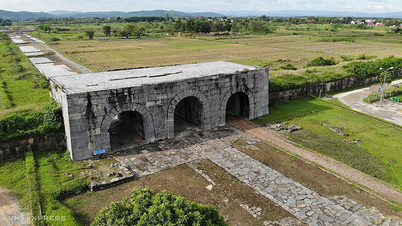
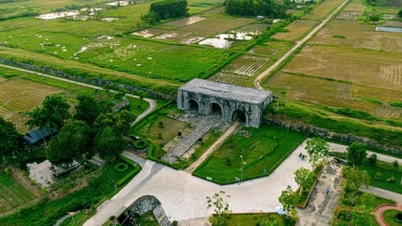
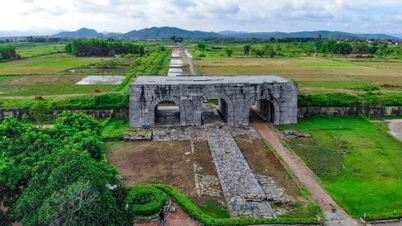
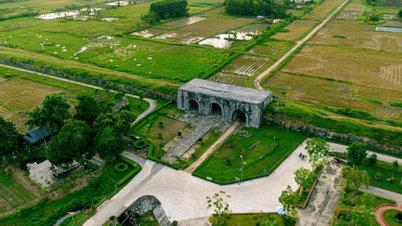
The Ho Dynasty Citadel (Tay Do) in Vinh Loc district, Thanh Hoa province, has just been recognized by UNESCO as a World Cultural Heritage site. Seven hundred years have passed, countless upheavals and changes have occurred, and now, standing at the foot of the ancient citadel, looking up at the sturdy stone walls with their massive, heavy slabs weighing tons, we ponder many things. We ponder about the stone citadel and the citadel of the people's hearts. The stone citadel, though precious, cannot compare to the citadel in the hearts of the people. As Nguyen Trai said, "One hundred thousand people means one hundred thousand hearts." Great national unity, gathering the people's hearts, is what makes it invincible; what good are high walls and deep moats! Ho Nguyen Truong, the Left Prime Minister of the Ho Dynasty, saw this and told the king: "I do not fear fighting, I only fear that the people's hearts will not follow." This is indeed accurate. Yet, more than 10 years later, when the Lam Son Uprising broke out, "farmers and serfs from all directions flocked together," creating a force capable of moving mountains and filling oceans.
So who built the Ho Dynasty Citadel? It was Ho Nguyen Truong, the man who uttered the famous words above.
He was the eldest son of Ho Quy Ly (1336-1407), his birth and death dates are unknown. His younger brother, Ho Han Thuong, became king, while he served as the Left Prime Minister. He was a scholar with many talents in science and technology. When the Ming invaders attacked, his father, brother, nephew, and he were all captured and taken to Yen Kinh (present-day Beijing). Ho Quy Ly and Ho Han Thuong were executed for the crime of "treason," while he and his nephew were spared because they "had talent." They were then forced into official positions to demonstrate their talents, serving the Ming court, and rose through the ranks to "Vice Minister" (similar to a Deputy Minister). Historical records state that he was skilled in manufacturing powerful cannons.
If only he had been so loyal that he would have died! But that's all in the past now, and we have a more tolerant view of him. Especially since, around 1438, he completed the book "Nam Ong Mong Luc" (Records of the Dreams of an Old Man from the South). The book originally consisted of 31 chapters, of which 28 remain today, reprinted in China.
These are notes, like memoirs, about some stories, history, and culture of Vietnam, a country he was, after all, originally from there: "Nam ông" (a Vietnamese term for a Southerner), but now, thinking about it, he is only a figure in his dreams.
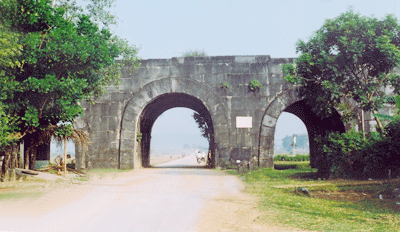
Ho Dynasty Citadel has been recognized as a World Cultural Heritage site.
Explaining the meaning of the word "dream," in the preface of the book, he said: "The book is named 'dream,' what does that mean? I replied: 'The characters in the book were once very numerous, but because times change and circumstances shift, almost no traces remain, so only I know the story and can recount it. Isn't that a dream? Do the great gentlemen understand?' As for the two words 'Nam Ong,' they are simply my courtesy name (preface - 1438).
Therefore, Nam Ong Mong Luc possesses valuable historical and literary value.
***
The story of Tran Nghe Tong (1322-1395) is a memoir of a wise ruler of the Tran dynasty, "a loyal and honest man, devoted to both the king and his father. His interactions with people were neither overly close nor overly distant; in matters of state, he neither excessively criticized nor excessively praised. When King Minh (Tran Minh Tong - his father) died, he mourned for three years, his eyes never drying from tears. After the mourning period, he did not buy clothes of silk or fancy colors; he did not care about the taste of food." After ascending the throne, he "turned chaos into order, followed the old customs, rewarded and punished fairly, and employed virtuous people..." Ho Nguyen Truong concludes the story with the exclamation: "In this land, are there such good people among the kings?" The records about Tran Nhan Tong, about Chu An "rigid and upright"... all have value and meaning. But perhaps the most meaningful story is "The Compassionate Doctor."
“My maternal grandfather was Pham Cong, whose given name was Ban. He came from a family of physicians and was appointed Imperial Physician by Tran Anh Tong. He often spent all his money stockpiling good medicine and rice. He would let orphans and the poor who were sick stay in his house, providing them with food and treatment, even if it involved blood and pus, without the slightest disgust. Suddenly, for several years, famine and epidemics spread, so he built houses for the poor and needy. Thanks to this, more than a thousand people who were hungry and sick were saved, and his name was highly respected at the time. One day, someone came to his door urgently, saying, “A woman in the house suddenly started bleeding profusely, her face pale.” Hearing this, he hurried away. Just as he left the door, he met a person sent by the king, who said, “There is a noble person in the palace suffering from malaria; the king has summoned you to see him.” He replied, “That illness is not urgent.” "Right now, someone's life hangs in the balance. Let me go save them first; I'll be back at the palace shortly." The messenger angrily replied, "As a servant, how can you do such a thing? You want to save that person's life but not your own?" The old man answered, "I am truly guilty, but I don't know what else to do! If I don't save them, they will die in a moment, and then what else can I expect?" "My life depends on Your Majesty; I hope to escape death, and I will accept all other punishments." Then he went to treat the man, and indeed, he recovered. Immediately afterward, he went to see the king. The king reprimanded him, and he took off his hat, apologized, and explained his true feelings. The king rejoiced and said, "You are truly a skilled physician, possessing both expertise and a compassionate heart to save the common people; you are truly worthy of my expectations." Later, two or three of his descendants became skilled physicians, holding high official positions of the fourth and fifth ranks. Everyone praised him for not letting his family's legacy be lost.
The medical ethics of Mr. Pham were later inherited and further glorified by Tue Tinh and Lan Ong, and in our time by Pham Ngoc Thach, Ton That Tung… All these examples make us reflect on medical ethics today and aspire to live up to the standards of our predecessors.
- Translated by Nguyen Duc Van and Tuan Nghi. Ly-Tran Poetry and Prose, Volume 3. Social Sciences Publishing House, 1978.
Mai Quoc Lien































































Comment (0)