

 |
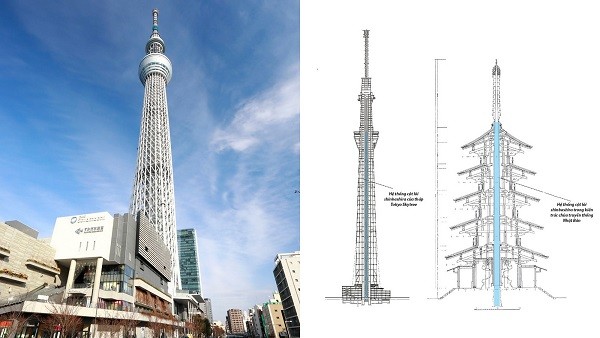
At 634 meters tall, the Tokyo Skytree (pictured left) employs a structure designed to reduce earthquake-induced vibrations through a core column vibration control system, sharing characteristics with the vertical shinbashira core columns of traditional Japanese temple architecture. (Source: japan.go.jp) |
Japan lies on the Pacific Ring of Fire, an area of intense seismic activity that stretches across Southeast Asia and the Pacific Basin, making it one of the most seismically active countries in the world .
The application of technology for warning and the use of shock-absorbing construction techniques are key to the Japanese success in minimizing earthquake damage.
Over the past decade, Japan has experienced approximately 20% of the world's earthquakes of magnitude 6 or higher. The worst disaster was the 2011 Tohoku earthquake, which triggered a tsunami that devastated the Fukushima nuclear power plant and killed around 15,000 people.
The Japanese government has invested significantly in disaster mitigation, including improving seismic techniques and applying advances in artificial intelligence (AI) to limit earthquake damage. Engineers and architects are constantly researching new designs to absorb shock from structures, helping buildings withstand strong earthquakes.
Japan doesn't measure earthquakes by magnitude (Richter scale), but rather by ground shaking. The Japanese Seismic Intensity Scale (JMA) uses Shindo units (shaking), from 1 to 7. In the Ishikawa earthquake, the shaking reached the maximum level of 7.
JMA comprises 180 seismometers and 627 seismometers, reporting earthquakes in real time to media outlets and the internet.
To withstand the impact of an earthquake, buildings must be able to absorb as much seismic energy as possible. This capability comes from "seismic isolation" techniques, specifically the foundations of buildings in Japan which incorporate a hydraulic damping system. Japanese engineers designed a complex damping system, similar in principle to a bicycle pump, in their structures to improve earthquake resistance.
"A high-rise building can be displaced by up to 1.5 meters due to tremors, but if there is a damping system from the second floor to the top floor, its movement can be minimized, preventing damage to the upper floors," commented Ziggy Lubkowski, a seismologist at the University of London (UK).
For recently constructed buildings, some companies are experimenting with more innovative methods and materials, such as lattice architecture to prevent building warping and help disperse absorbed energy during earthquakes. In Tokyo, the Maeda construction group is using steel and wood frames to build a 13-story office building.
"Wood is rarely used as an earthquake-resistant material inside steel-framed buildings. However, steel can withstand tensile forces, while wood can withstand compressive forces, so the two materials will complement each other," explained Yoshitaka Watanabe, chief engineer of Maeda Corporation.
Proof of the success of these techniques is that when the 9.0 magnitude earthquake struck in 2011, the shaking in Tokyo reached level 5. Giant skyscrapers shook, windows shattered, but no major buildings collapsed.
Source
![[Photo] General Secretary and President To Lam presides over a meeting on preparations for the review of one year of operation of the three-tiered government system.](https://vphoto.vietnam.vn/thumb/1200x675/vietnam/resource/IMAGE/2026/06/02/1780391821195_a1-bnd-4595-9717-jpg.webp)






























































































Comment (0)