

Recently, the Department of Culture, Sports and Tourism of Gia Lai province has continuously organized training courses on gong tuning techniques, brocade weaving, wood carving, etc., for students from many villages in the western part of the province.
These small classes have become special meeting places where artisans can share their passion with the younger generation, encouraging them to continue inheriting the traditional cultural features of their nation.
Special classes
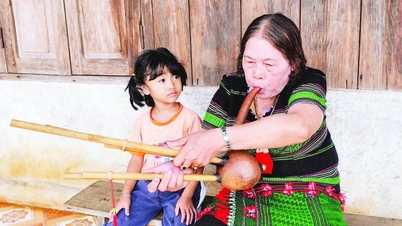
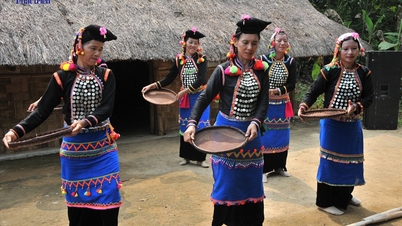
Within the framework of the National Target Program on socio -economic development of ethnic minority and mountainous areas in 2025, Gia Lai province organized classes on tuning Ba Na gongs and weaving brocade. Prior to this, the province had organized four other classes including tuning Ba Na gongs, tuning Gia Rai gongs, brocade weaving, and carving Ba Na wood sculptures, attracting 40 students from various localities in the province. A special feature of these classes is the participation of outstanding artisans, considered "living treasures" in the community, who directly pass on their skills and cultural essence to the younger generation.
In that unique classroom setting, the sounds and colors of Gia Lai 's traditional culture come alive. In one corner, an elderly artisan carefully taps the gong with a hammer, the sound lingering as if awakening the echoes of the mountains and forests. Not far away, through the skillful hands of a craftsman, threads are woven together to create vibrant patterns amidst the rhythmic clicking of the loom. The scent of freshly carved wood from the statues evokes ancient forms. This is not a classroom for literacy, but a place where artisans pass on the techniques of tuning gongs, weaving, and sculpting to the younger generation, ensuring that heritage values are not only preserved in the community's memory but also continue to develop in contemporary cultural life.
Devoting all his efforts to guiding the younger generation, Meritorious Artisan Dinh Doch (Al Ba commune) carefully strikes each hammer blow while teaching the technique of tuning gongs. He shares that if a gong sounds out of tune, it loses its soul. Therefore, preserving the sound of the gong is essential to maintaining the identity of his ethnic group. For him, each gong is not just a musical instrument, but also a repository of memories from the past. The sound of gongs resounding in festivals, weddings, and harvest celebrations has been intimately connected with every step of the community's journey.
Therefore, tuning the gongs is not simply about adjusting the sound, but about restoring the rhythm of life and rekindling national pride. Mr. Dôch always reminds his students to be patient and listen carefully to each sound, because only when the gong resonates correctly will it touch the hearts of the listeners. He believes that if the younger generation maintains their passion and sense of responsibility, the sound of the gongs will continue to echo in the mountains and forests, extending the cultural identity of the Ba Na people through many generations.
Similarly, Meritorious Artisan Nay Phai (from Phu Tuc commune), who has traveled throughout the villages to repair gongs with distorted sounds, enthusiastically shared: "I hope the younger generation learns well so that they can teach their children and grandchildren later." He added that the sound of the gongs is not just an audio element, but also the soul of the village, connected to festivals and the joys and sorrows of the community. Every time he successfully adjusts a set of gongs to produce the correct sound, he feels as if he has restored a forgotten part of the village's identity. Mr. Nay Phai believes that if the younger generation perseveres in learning and cherishes the heritage, the sound of the gongs will continue to resonate, reminding everyone of their origins and national pride every time it rings out.
Preserve to promote
Among the trainees, one young man who made a strong impression was Dinh Hot (from Tpon village, Cho Long commune), who was proficient in both playing gongs and weaving baskets. In addition, he actively participated in various training classes, from tuning gongs and carving statues to weaving brocade, a job traditionally considered women's work. For him, each skill learned is not just a profession, but also a part of his ethnic identity. He confided: “The Ba Na ethnic identity has many wonderful and beautiful things that are gradually disappearing. I want to learn to preserve them and pass them on to the children in the village. The responsibility of young people is to continue the legacy left by our ancestors.” Therefore, he is not afraid to try his hand at seemingly unfamiliar fields, because he believes that the more he understands and masters the techniques, the more fully he can pass them on to future generations.
Ms. Le Thi Thu Huong, Deputy Director of the Department of Culture, Sports and Tourism of Gia Lai province, affirmed that classes like these are very special, especially as the number of people honored as "living human treasures" is gradually decreasing. They will create opportunities for artisans to interact, learn, and further hone their experience and skills, thereby contributing to maintaining the transmission of knowledge to the younger generation in the locality. Ms. Huong also emphasized her hope that outstanding artisans will continue to inspire and proactively maintain the transmission of knowledge, supporting the younger generation in the journey of preserving and promoting traditional cultural identity.
Intangible cultural heritage is not just about skills and techniques. It is also about spiritual strength and the bonds that unite communities. The resounding gongs in festivals, the brocade draped over women's shoulders, the wooden statues placed in communal houses… all are symbols of identity and national unity. In the modern context, where life is changing rapidly, these heritage values need to be preserved even more. From small classes in Gia Lai, this model can be replicated and spread to many other localities, so that heritage not only lives on in memory but also exists in life today and tomorrow.
Source: https://baolamdong.vn/lan-toa-gia-tri-truyen-thong-cac-dan-toc-o-gia-lai-409699.html


![[Photo] Closing Ceremony of the 10th Session of the 15th National Assembly](/_next/image?url=https%3A%2F%2Fvphoto.vietnam.vn%2Fthumb%2F1200x675%2Fvietnam%2Fresource%2FIMAGE%2F2025%2F12%2F11%2F1765448959967_image-1437-jpg.webp&w=3840&q=75)


![[Photo] Prime Minister Pham Minh Chinh holds a phone call with the CEO of Russia's Rosatom Corporation.](/_next/image?url=https%3A%2F%2Fvphoto.vietnam.vn%2Fthumb%2F1200x675%2Fvietnam%2Fresource%2FIMAGE%2F2025%2F12%2F11%2F1765464552365_dsc-5295-jpg.webp&w=3840&q=75)


![[Infographic] Preventing students from making their own firecrackers: 7 things parents need to know](https://vphoto.vietnam.vn/thumb/402x226/vietnam/resource/IMAGE/2025/12/11/1765466656703_img_0320_20251211183542.jpeg)





























![[OFFICIAL] MISA GROUP ANNOUNCES ITS PIONEERING BRAND POSITIONING IN BUILDING AGENTIC AI FOR BUSINESSES, HOUSEHOLDS, AND THE GOVERNMENT](https://vphoto.vietnam.vn/thumb/402x226/vietnam/resource/IMAGE/2025/12/11/1765444754256_agentic-ai_postfb-scaled.png)






































Comment (0)