

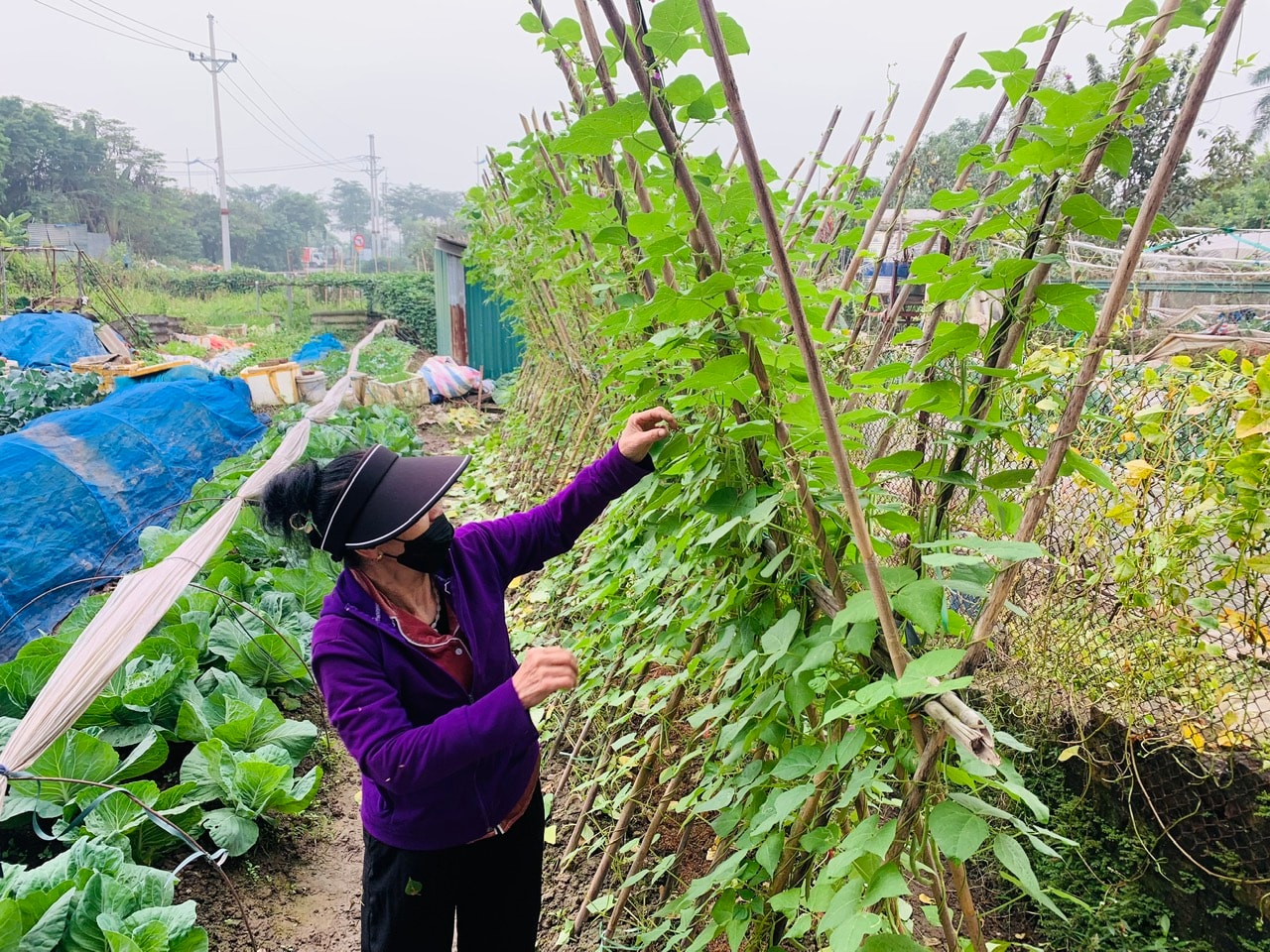
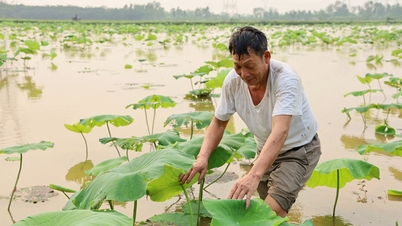
Recently, green vegetables have been scarce and prices have risen sharply. Taking advantage of this opportunity, Ms. Nguyen Thi Loan, from Thien Loc commune ( Hanoi ), is always busy in her nearly one-acre cabbage field, fertilizing and spraying pesticides.
"To make the vegetables grow faster, I compost bird droppings under the plants and add nitrogen fertilizer. As for pests and diseases, I spray pesticides every two weeks," Mrs. Loan said.
It's not just Mrs. Loan; many other farmers have similar farming methods. "Now that we're not healthy enough to compost and transport the fertilizer to the fields, many people buy chemical fertilizers for faster results," shared Mr. Nguyen Huu Thinh from Thien Loc commune.
In Phuc Thinh commune, when the bean plants flower, Ms. Nguyen Thi Huong immediately sprays them with a type of pesticide with foreign language labels that she and many others in the village buy at Van Tri market under the name "bean fruit." When the pods just begin to sprout, she sprays insecticide to "prevent insects from eating them." "The timing of fertilization and spraying is based on our lifelong farming experience; no one has ever instructed us," Ms. Huong explained.
According to statistics from the Hanoi Department of Crop Production and Plant Protection, many farmers apply fertilizer in excess of their needs, by 2-3 times, or even 5-7 times. However, the plant's absorption efficiency is very low, only 40-45% nitrogen, 25-30% phosphorus, and 55-60% potassium. The rest seeps into the soil and is washed into rivers and lakes by rainwater, causing long-term pollution.
Associate Professor Dr. Nguyen Quang Thach, a soil expert from the Vietnam Academy of Agricultural Sciences, argues that prolonged use of chemical fertilizers causes soil compaction, reduces fertility, and disrupts nutrient balance. While crops may appear lush and green, they are actually weak, prone to lodging, and less resistant to pests and diseases. From an economic perspective, the overuse of fertilizers is causing the agricultural sector to "waste money."
According to Nguyen Quy Duong, Deputy Director of the Department of Crop Production and Plant Protection ( Ministry of Agriculture and Environment ), Vietnam uses over 10 million tons of fertilizer annually, but loses 5-5.5 million tons, equivalent to 44 trillion VND. This is a huge amount of money "thrown into the ground" that crops cannot absorb, driving up farmers' production costs and reducing the competitiveness of Vietnamese agricultural products.
Assessing the harmful effects of using fertilizers and pesticides improperly, Dr. Nguyen Huu Anh, former lecturer at the Vietnam Academy of Agriculture, emphasized: "When nitrates in vegetables exceed the limit and enter the body, they are converted into nitrites, which easily combine to form nitrosamines - substances that can cause cancer. The danger is that nitrates have already permeated plant tissues and cannot be washed away or removed."
Despite the increasing demand for safe vegetables, the area of safe production according to VietGAP standards nationwide currently only reaches 0.5-0.6% of the total area. This modest figure shows that safe production has not yet become a habit. Many farmers have not received training, have not accessed safe farming techniques, and even still consider traditional practices passed down from generation to generation as the "sure thing". This makes Vietnamese agricultural products not only difficult to export but also threatens the health of domestic consumers.
To produce safe agricultural products, we must change production methods from the root. Therefore, authorities need to train farmers on fertilization and pesticide application according to crop needs; strictly control the fertilizer and pesticide market; and encourage the use of organic fertilizers and biological products.
Reducing fertilizer and pesticide use is not only about protecting the environment and consumers, but also about protecting the income and health of farmers – those who directly produce agricultural products for society.
Source: https://hanoimoi.vn/lang-phi-lon-tu-thoi-quen-canh-tac-cam-tinh-725780.html
![[Image] National Assembly discusses the implementation of the socio-economic development plan.](https://vphoto.vietnam.vn/thumb/1200x675/vietnam/resource/IMAGE/2026/04/20/1776696707422_ndo_br_img-20260420-185419-jpg.webp)

![[Photo] General Secretary and President To Lam meets with National Assembly delegates from ethnic minorities.](https://vphoto.vietnam.vn/thumb/1200x675/vietnam/resource/IMAGE/2026/04/20/1776696701056_a1-bnd-8331-3342-jpg.webp)









































































Comment (0)