

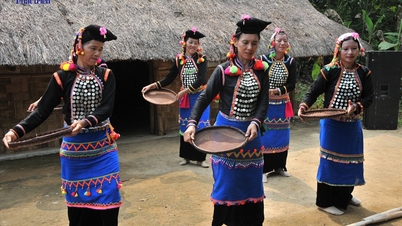
When talking about the Nhu Xuan region, it's impossible not to mention the outstanding intangible cultural heritage that the Tho ethnic people here have preserved and developed for generations. These include lullabies, traditional games and performances such as the "slow boat" dance, drum and gong singing, and frog-catching dances... all associated with the Dinh Thi festival, held annually in the middle of the third lunar month.

Scenes from the Dinh Thi festival. (Archival photo)
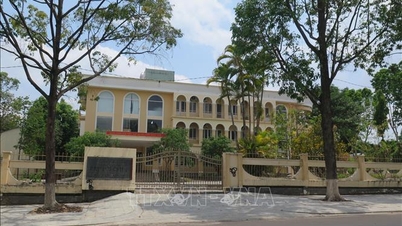
Dinh Thi, located in Trung Thanh village, Yen Le commune (now Trung Thanh neighborhood, Yen Cat town), was recognized as a provincial-level historical and cultural relic according to Decision No. 98/QD-VHTT dated December 14, 1995. In 2011, the Provincial People's Committee granted it the status of a provincial-level historical and cultural relic.
Located about 5 km from the district center, the temple is the most notable historical site of the Tho ethnic community, dedicated to the benevolent deity Le Phuc Thanh - a figure who played a key role in the Lam Son uprising against the invading Ming army in the 15th century.
The temple is nestled against the mountain, its front facing the rice fields (also known as Dong Set), exuding an air of majesty and grandeur. To the south is Mount Mun Tuong (locally known as Mount Chop Non). To the north is Mount Dong Co. Behind it are the Lanh rice fields and the villages below. The main hall of Dinh Thi Temple is built in the traditional architectural style, primarily using wood, and consists of three sections: a front hall and a rear sanctuary. In addition, there are other structures such as the Ho Chi Minh Memorial Hall...
Since 2007, Thanh Hoa province and Nhu Xuan district have been restoring the original version of the Dinh Thi festival. Since then, the festival has been organized to restore, preserve, and promote the unique cultural heritage of the Tho ethnic community in Thanh Hoa.

Dinh Thi Temple prepares for the 2024 festival.
Dinh Thi is primarily a place of worship for the village's tutelary deity, Le Phuc Thanh. According to historical documents, Le Phuc Thanh was of the Tho ethnic group, with the surname Cam, and his ancestors originated from the Nua mountain region (present-day Nong Cong - Trieu Son). Upon hearing of Le Loi's rebellion, he joined the Lam Son army from its early days (1416-1417), becoming a general who participated in many battles and achieved numerous victories. After the rebellion's success, the king granted him the royal surname (changing it to Le) and sent him to Set village (present-day Trung Thanh neighborhood) to clear land, establish a settlement, and organize the people to live and work.
At that time, the village of Sẹt was mainly inhabited by the indigenous people, with a landscape of hills and fields interspersed. The hills were suitable for many types of valuable timber trees, and the fields were ideal for rice cultivation. Recognizing this as a fertile and prosperous land, Lê Phúc Thành worked diligently with the villagers to build Sẹt village into a harmonious, peaceful , and prosperous community, transforming the dense forests and barren hills into a thriving village.
After his death, the villagers and his descendants built a temple in his honor and bestowed upon him the title of tutelary deity of the village.
According to historical records, Dinh Thi was likely built in the 16th century and was looked after and preserved by the local people. After many ups and downs, Dinh Thi was dismantled in 1949. Later, the local people and authorities used the remaining foundations to restore and renovate the temple, constructing it in the style of a mallet handle, consisting of a three-bay rear and front hall, three twelve-panel hinged doors, a three-bay front hall, and a wide veranda with supporting columns for the roof. The main building material was ironwood.

The Dinh Thi Festival is closely associated with the cultural life of the Tho ethnic group.
The Đình Thi temple houses two deities: "The Supreme and Most Sacred White-robed Deity of the Locality" and the local tutelary deity Lê Phúc Thành. The temple has an altar, a set of incense burners, and all the religious objects are gilded. Besides the altar dedicated to Lê Phúc Thành, there are four altars dedicated to his sons. Other artifacts related to Đình Thi include four silk-woven banners decorated with patterns in the artistic style of the late Lê and early Nguyễn dynasties. Additionally, there are two royal decrees issued during the reigns of Emperor Khải Định and Emperor Bảo Đại.
The Dinh Thi Festival is held annually as a grand ceremony, with the buffalo sacrifice being the most special part of the ritual. According to the elders, to prepare for this ceremony, the head of the Le clan would have people in the area select a young male buffalo, which would then be carefully tended by unmarried young men. The buffalo would be bathed and scrubbed clean daily. Women and children were forbidden from approaching the buffalo. Before the ceremony, the buffalo would be led to the communal house, where the head of the household would inform the village deity about the buffalo sacrifice. The master of ceremonies, holding three incense sticks and a cup of wine, would bow to the deity, asking permission to perform the buffalo sacrifice. Afterward, he would walk around the buffalo nine times and then sprinkle the wine and incense on its head, a ritual called the "awakening ceremony."
On the main day of the ceremony (at midnight on the 16th day of the 3rd lunar month), the sacrificial buffalo is tied by its legs and is not allowed to be slaughtered but only its blood is drained. The buffalo's blood is collected in bamboo tubes, while the meat is butchered and prepared as offerings to the village guardian deity. The offerings to the guardian deity include the buffalo's head, blood, intestines, liver, and tail, along with a feast consisting of sticky rice, chicken, glutinous rice balls, small rice cakes, and banh chung (traditional Vietnamese rice cakes)... In addition to the offerings from Set village, Pheo, Thi, Thuong, and Thuong Coc villages also have their own offerings to the deity.
After the offerings are made to the deity, the offerings and food are divided among the villagers for them to share and eat together. From the 10th to the 16th, the rituals are performed sequentially from one village to another. The ceremonies are conducted solemnly and respectfully, expressing faith in the village guardian deity and praying for favorable weather, bountiful harvests, and prosperity for the people.

Along with the rituals, the long-standing traditional cultural activities of the Thai, Tho, and Muong ethnic groups, such as sand dance, rice pounding, folk singing, bamboo pole dancing, throwing the ball, tug-of-war; folk singing, lullabies, love songs, stick pushing, throwing the ball, drum and gong dance, stilt walking... are all performed in a lively and attractive manner.
Today, besides the rituals and offerings, the games and performances are revived but simplified compared to the past. The festival duration is shortened to just two days, on the 15th and 16th of the third lunar month, and the procession only takes place from the communal house to the tomb of the village guardian deity and back. The festival also includes new activities such as cultural village camps, folk art performances, a beauty contest in traditional Tho ethnic costumes, and modern sports activities.
With the successful restoration of the Dinh Thi festival, Nhu Xuan district is demonstrating the right approach in skillfully combining economic development, political stability, and the building of a rich and distinctive culture.
The 2024 Dinh Thi Festival will be held on a district-wide scale from April 23rd to 24th, 2024 (corresponding to the 15th to 16th of the 3rd lunar month) to honor and commemorate the merits and demonstrate the principle of remembering one's roots towards General Le Phuc Thanh.
At the same time, the Party Committee and the government of Nhu Xuan district are proactively coordinating with competent authorities at all levels to build a scientific dossier on the Dinh Thi Festival as a national intangible cultural heritage, contributing to preserving the cultural identity of the Tho ethnic group and adding it to the cultural heritage of the Vietnamese ethnic communities in general and Thanh Hoa province in particular.
Minh Hieu
Source


![[Photo] Closing Ceremony of the 10th Session of the 15th National Assembly](/_next/image?url=https%3A%2F%2Fvphoto.vietnam.vn%2Fthumb%2F1200x675%2Fvietnam%2Fresource%2FIMAGE%2F2025%2F12%2F11%2F1765448959967_image-1437-jpg.webp&w=3840&q=75)













![[OFFICIAL] MISA GROUP ANNOUNCES ITS PIONEERING BRAND POSITIONING IN BUILDING AGENTIC AI FOR BUSINESSES, HOUSEHOLDS, AND THE GOVERNMENT](https://vphoto.vietnam.vn/thumb/402x226/vietnam/resource/IMAGE/2025/12/11/1765444754256_agentic-ai_postfb-scaled.png)




















































Comment (0)