


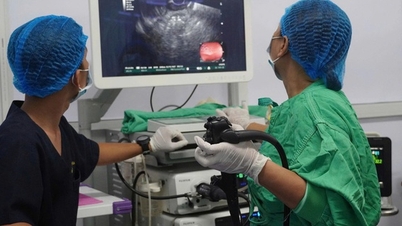
Doctors at E Hospital perform surgery on a patient - Photo: Hospital provided.
A 63-year-old male patient from Hanoi presented with severe abdominal pain in the epigastric region (leaning to the left), a high fever of 39 degrees Celsius, and progressively worsening jaundice (yellowing of the skin and eyes)...
As the symptoms worsened, the family took the patient to Hospital E for examination and treatment.
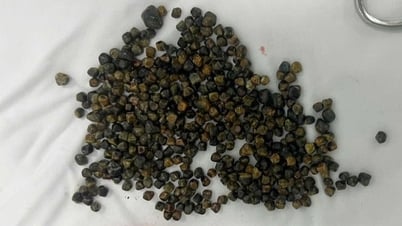
Through clinical examination combined with paraclinical tests and imaging diagnostics, doctors quickly determined that the patient had biliary tract infection - bile duct obstruction, acute pancreatitis due to gallstones in the common bile duct.
In particular, the patient has a congenital anomaly of complete situs inversus, with all organs in the abdomen and chest arranged in the opposite position compared to normal people, making diagnosis, surgery and manipulation by surgeons much more difficult and complicated.
According to Dr. Nguyen Khac Diep from the Department of Gastrointestinal Surgery at E Hospital, situs inversus is a rare congenital defect, inherited through a recessive gene on an autosomal chromosome, with an incidence rate of only about 1 in 5,000 to 1 in 20,000 people depending on the region.
In people with this condition, the internal organs in the chest and abdomen are arranged in a "mirror image" compared to their normal structure.
Situs inversus does not increase the risk of gallstones, but it creates many difficulties in diagnosis and treatment because the clinical signs and anatomical images are reversed.
Therefore, a thorough understanding of the pathological characteristics and the selection of appropriate treatment methods are key factors in ensuring a successful treatment outcome.
Dr. Huu Hoai Anh, Head of the Department of Gastrointestinal Surgery at E Hospital, and his surgical team initially provided intensive medical treatment to control the acute hepatitis and infection, before proceeding with open surgery to remove gallstones from the common bile duct.
Because the patient suffers from situs inversus (reversal of the internal organs), the entire stomach, duodenum, liver, bile ducts, and gallbladder are anatomically altered, causing significant difficulties during surgical dissection and localization of these structures.
Faced with this challenge, the surgical team conducted a meticulous and careful assessment of every anatomical detail, then performed a choledochal stone removal combined with a complete endoscopic examination of the biliary tract for thorough inspection. Thanks to careful preparation and precise procedures, the surgery proceeded smoothly and safely.
Gastrointestinal surgeons advise that gallstones are a fairly common condition and can cause many dangerous complications if not detected and treated promptly, especially in complex cases like this patient's.
Therefore, when experiencing symptoms such as lower abdominal pain, high fever, jaundice, yellowing of the eyes, etc., it is necessary to immediately go to a reputable medical facility with full specialized departments for examination and treatment to avoid life-threatening dangers.
Source: https://tuoitre.vn/mot-nguoi-co-trai-tim-ben-phai-phu-tang-dao-nguoc-20250909091508142.htm

![[Photo] Closing Ceremony of the 10th Session of the 15th National Assembly](/_next/image?url=https%3A%2F%2Fvphoto.vietnam.vn%2Fthumb%2F1200x675%2Fvietnam%2Fresource%2FIMAGE%2F2025%2F12%2F11%2F1765448959967_image-1437-jpg.webp&w=3840&q=75)

![[Photo] Prime Minister Pham Minh Chinh holds a phone call with the CEO of Russia's Rosatom Corporation.](/_next/image?url=https%3A%2F%2Fvphoto.vietnam.vn%2Fthumb%2F1200x675%2Fvietnam%2Fresource%2FIMAGE%2F2025%2F12%2F11%2F1765464552365_dsc-5295-jpg.webp&w=3840&q=75)



































![[OFFICIAL] MISA GROUP ANNOUNCES ITS PIONEERING BRAND POSITIONING IN BUILDING AGENTIC AI FOR BUSINESSES, HOUSEHOLDS, AND THE GOVERNMENT](https://vphoto.vietnam.vn/thumb/402x226/vietnam/resource/IMAGE/2025/12/11/1765444754256_agentic-ai_postfb-scaled.png)







































Comment (0)