

The United States and South Korea affirmed their unity in confronting all threats and pledged to further enhance cooperation to deter any provocative actions.
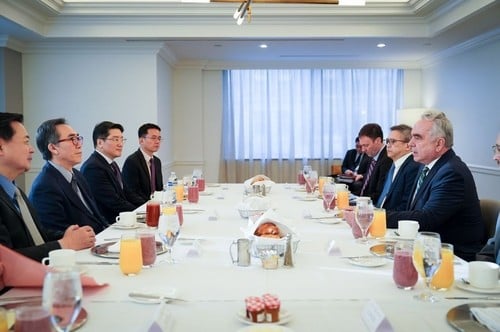 |
| South Korean Foreign Minister Cho Tae-yul (second from left) and U.S. Deputy Secretary of State Kurt Campbell (far right) at a working breakfast in Washington on February 29. (Source: Yonhap) |
On February 29, South Korean Foreign Minister Cho Tae-yul, who was visiting the United States, had a breakfast meeting with his US Vice Foreign Minister Kurt Campbell.
According to Yonhap , at the meeting, both sides expressed deep concern about North Korea's labeling of inter-Korean relations as those between two warring nations, as well as any potential unilateral attempts to alter the status quo in the West Sea.
Officials from both countries assessed that Seoul and Washington are united in confronting all threats, and agreed to further enhance coordination to deter any provocative actions.
In addition, the two sides also discussed military cooperation between Russia and North Korea, including Moscow's use of missiles manufactured by Pyongyang to attack Ukraine.
Foreign Minister Cho proposed that the two sides further develop bilateral US-South Korea cooperation and trilateral US-Japan-South Korea cooperation in 2024, and requested that Deputy Secretary Campbell play an active role.
Mr. Campbell previously served as the Indo- Pacific Coordinator on the White House National Security Council.
For his part, affirming that he highly values US-Korea and US-Japan-Korea cooperation, Mr. Campbell expressed his expectation that Seoul will play an even greater role on the international stage given the current status and capabilities of the Northeast Asian nation, and affirmed that the US is ready to actively support this process.
During the talks, Mr. Cho requested that the US side pay attention to ensuring that South Korean businesses receive incentives commensurate with the scale of their investments in the US while Washington implements the Inflation Reduction Act (IRA), the Chip Act, and the Science and Technology Act.
The two sides also discussed strengthening cooperation on economic security, information, and high technology, including artificial intelligence (AI).
Source















![[Photo] Prime Minister Pham Minh Chinh holds a phone call with the CEO of Russia's Rosatom Corporation.](/_next/image?url=https%3A%2F%2Fvphoto.vietnam.vn%2Fthumb%2F1200x675%2Fvietnam%2Fresource%2FIMAGE%2F2025%2F12%2F11%2F1765464552365_dsc-5295-jpg.webp&w=3840&q=75)














































Comment (0)