

The U.S. Department of Energy (DOE) aims to maintain America's leading position in high-performance computing. The DOE has issued a tender for the design of an advanced supercomputer called Discover, intended to replace Frontier, currently the world's fastest supercomputer, projected to reach 8.5 exaflops.
This supercomputer was built with AMD Epyc processors, comprises 74 HPE Cray EX computer cabinets, and contains nearly 8.7 million CPU cores combined with GPUs. Additionally, the machine boasts a Linpack performance benchmark of 1,206 exaflops. Exaflops are a unit of measurement for the total computing power of a computer system, equivalent to one quadrillion floating-point operations per second.
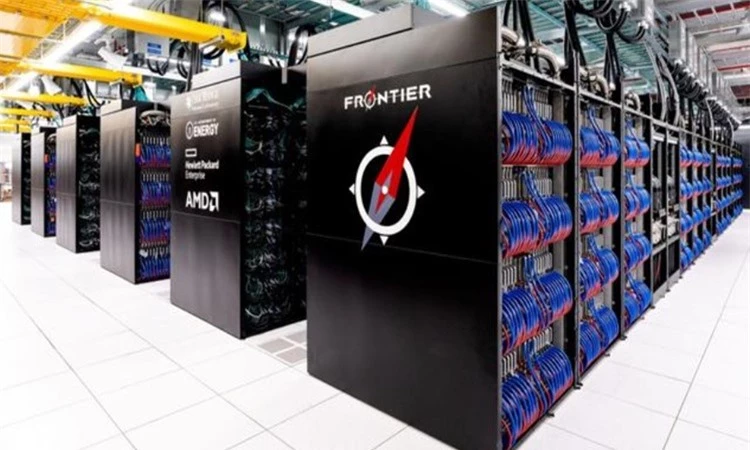
Although the DOE did not specify the exact performance targets for Discovery, the new supercomputer is expected to deliver 3-5 times the computing power of Frontier, potentially exceeding 8.5 exaflops (a unit of measurement for the combined computing power of computer systems). According to Matt Sieger, Discovery project manager at ORNL, Discovery will revolutionize scientific research in many different fields, driving breakthroughs in climate change prediction, drug discovery, high-energy physics, and green energy solutions thanks to its upgraded computing power.
Speaking about Discovery's potential, Georgia Tourassi, associate director of computer science at ORNL, emphasized that the scientific community can model real-world situations at a new level of detail. "The machine will help us study challenging problems that cannot be easily explored through experimentation, observation, or theory alone," Tourassi said.
Beyond its scientific applications, the new supercomputer is designed to excel in artificial intelligence and machine learning tasks, pushing the boundaries of materials science and industrial product design. Additionally, Discovery will play a key role in the DOE's Integrated Research Infrastructure initiative, a program that aims to integrate various research tools and scientific foundations.
The Department of Engineering (DOE) set a deadline of August 30, 2024, for contractors to submit proposals for the Discovery supercomputer. Delivery to the Oak Ridge Advanced Computing Facility (OLCF) is scheduled for 2027 or early 2028. Instead of specifying speed targets, the DOE outlined numerous requirements for the next-generation system, including improved energy efficiency, system-wide modeling and simulation, and enhanced capabilities related to AI and machine learning.
Energy saving remains a top priority for OLCF, a facility that has increased computing power 500-fold while electricity consumption has only quadrupled over the past decade. Once operational, it is expected that researchers worldwide will have access to Discovery.
According to Intellectual Property and Innovation
Source: https://doanhnghiepvn.vn/cong-nghe/my-se-san-xuat-sieu-may-tinh-manh-gap-5-lan-ky-luc-hien-nay/20240804081042099




























































































Comment (0)