

The regulatory function of culture in the movement and development of modern society: Identifying culture in Ho Chi Minh's thought
The regulatory function of culture in the movement and development of modern society: Lesson 1 - Identifying culture from its foundation to its regulatory capacity
From there, we recognize the cultural structure with its characteristics, which are the connection and interpenetration of the surface structure and the deep structure of culture.
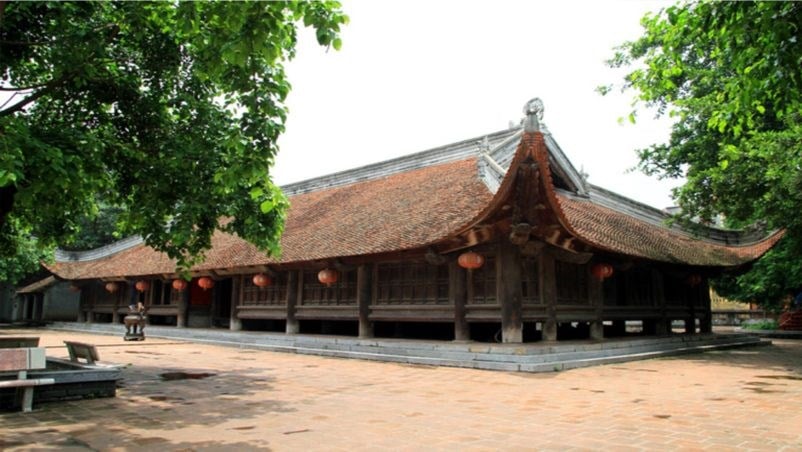
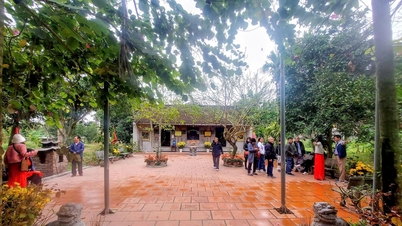
Village communal house - a cultural symbol in Vietnamese life
Surface variation and depth durability
Surface structure is all the specific cultural creations that take place every day, creating an infinity of cultural products of all its forms and genres. Deep structure is what settles in the flow of culture, leaving an impression on people's perception and reception.
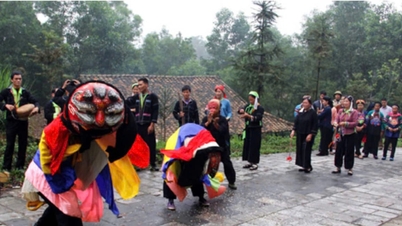
A simple comparison, culture is like a river that flows forever, but within its heart there is fertile alluvium. Or in everyday terms, the surface structure is what we see, hear, touch, read... (like a festival, a piece of music, a statue, a work of literature...).
The deep structure is what we perceive and feel. In linguistic and philosophical terms, the surface structure is what is expressed , the deep structure is what is expressed , meaning that what is expressed is what is externally apparent (the obvious) and what is expressed is in the spirit, consciousness (the secret) and is less variable.
Thus, the deep structure is hidden in the surface structure, and at the same time, a deep structure can be revealed in many different surface structures. If we look at the dialectical movement of culture, the surface structure is the dynamic element of culture (that is the specific, diverse, rich, and constantly changing cultural life of a community or a nation).
The deep structure is the hidden part in the surface structure, recognized through the reception of the human spirit and consciousness, which rarely changes and is the static element of culture. If viewed from a "mathematical" perspective, the surface structure is a variable , and the deep structure is a constant . What is expressed, the static element, the constant in the constant movement of culture, is the cultural value system .
Discovering, nurturing, building, affirming, and spreading values and value systems is an intrinsic function of the culture of a community or a nation, creating the characteristics and identity of that nation's culture. In turn, this value system plays a role in orienting and regulating changes on the surface of culture.
Since then, the changes on the surface of culture, despite their "multi-faceted" and "ever-changing" forms, are still directly or indirectly influenced by the value system that has become the characteristics, character, and soul of the community and nation.
On the other hand, from there, the surface elements, in the process of transformation, gradually penetrate and impact the deep structure, making the values and value system increasingly more complete and changing in development (although it may be slow).
Unlike political , economic, and technological changes (which are often sudden, spontaneous, and revolutionary), cultural change is gradual, inherited, and acculturated.
It is from the above characteristics in the internal structure and movement of culture that the regulatory role of culture becomes an intrinsic function of it. Regulating the movement, transformation and development of society through and by the system of cultural values.
That regulatory capacity comes from values, it is the driving force for development, at the same time it has the ability to orient, and sometimes, it is the braking force when the movement of life shows signs of imbalance with negative, anti-cultural, anti-development manifestations.
Identifying the cultural structure with two layers of meaning - surface and depth, and the dialectical relationship between the two layers is the objective scientific basis for us to determine the task of taking care of cultural development, both creating extremely diverse, rich and varied cultural products, and consolidating, promoting and creating values and value systems that have the role of orienting and regulating the movement of society and people.
Cultural values and norms: The foundation for social life orientation
In the two parts above, we have tried to explain the scientific basis of the social regulatory function of culture and determined that it is an inherent, internal function, not an external "assignment" to culture.
Reality in recent years shows that the regulatory function of culture plays an increasingly important role when society is showing alarming signs with the appearance of many anti-cultural, uncultured, and uncultured events and phenomena that if only stopping at general appeals or handling them purely administratively will be ineffective.
Perhaps, for a long time, we have not paid attention to the issue of social management with the regulatory power of culture - a part, a particularly important element that creates a comprehensive power to orient and regulate the movement and development of society.
However, the next question is: How to regulate and how to regulate? In the most general and comprehensive view, the regulatory function of culture is carried out by using and promoting cultural values and cultural norms, or in other words, in practical terms, the extent to which cultural values and norms are absorbed into human personality and in the human community will determine and control the effectiveness of the social regulatory function of culture.
Therefore, the extremely important issue is to nurture and build cultural values and norms in human personality, in the common quality of the community, making those cultural values and norms become the ego , become the "second instinct" in human dignity and personality (as said by C. Marx). Without doing that, it is impossible to regulate the relationship between humans and life and society.
As presented above, the little change, the static, the constant in the structure of culture in the human mind is the cultural value, creating the sustainable vitality of a culture.
Philosopher Tran Duc Thao made a profound observation: What determines the life of trees is their roots . People can pick flowers, pick fruits, cut branches... trees still live and continue to grow and flourish. Trees only die when we cut or dig up their roots . Culture is exactly the same. The root of culture is the system of values. The general, all-encompassing value system of culture is truth, goodness, and beauty . The absorption of that value system into human personality is a great power to perform the function of regulating society.
The prominent expression of “truth” is the real, the right. The value of the real, the right always has the power to adjust, regulate and attract people to the truth, to perceive and voluntarily follow the right, the truth.
Therefore, “truth” requires not only the ability to understand and explore, but also the attitude of behaving and directing actions honestly, voluntarily, and impartially. True value is the real value, completely opposite to the fake - false, artificial, deceitful. It is that “truth” in personality that is the basis, the strongest spiritual - intellectual, emotional resource for people to regulate all their thoughts, behaviors, and activities.
The most concentrated expression of “goodness” is goodness, kindness, altruism, compassion, and love for humanity. “Goodness” is the characteristic of human nature and human love. Goodness, kindness, charity, volunteer work, and good living go together in a personality, and that is the fundamentals of a moral person. Goodness, in that sense, is always opposed to Evil – the highest expression of counterculture. Taking “goodness” as the highest and deepest standard to regulate all human relationships is the most beautiful expression in social life.
The typical expression of “beauty” is beauty. Beauty, according to human perception, is present in all areas of life, and at the same time it is most concentratedly expressed in the field of literary and artistic creation. Beauty becomes the standard, becomes the noble ideal for people to strive for, in which the pinnacle is the noble, heroic.
In life, people are always subject to collisions and conflicts between beauty and ugliness, nobility and baseness... Beauty is always the most solid support for people to regulate all their thoughts and behaviors.
From the above general and all-encompassing value system, each nation and country, starting from its own history and tradition, seeks to synthesize and build its own national value system and cultural value system. Like the general value system of “truth, goodness, beauty”, these cultural value systems also become the fulcrum for the ethnic community to regulate its development.
A specific example: Vietnam has a unique belief in ancestor worship. That is also a typical cultural value of the Vietnamese people. Ancestors are extremely sacred, each person needs to wholeheartedly respect, be grateful and pray for protection and protection, therefore, the altar is a symbol of "sacred space" for Vietnamese families. Burning incense before the altar of ancestors, grandparents, parents with all sincerity and gratitude makes people better, purifies the soul, and lives more emotionally. That is profound self-regulation .
(To be continued)
Source: https://baovanhoa.vn/van-hoa/nen-mong-tu-dieu-tiet-cua-doi-song-van-hoa-viet-185328.html













![[Photo] Worshiping the Tuyet Son statue - a nearly 400-year-old treasure at Keo Pagoda](/_next/image?url=https%3A%2F%2Fvphoto.vietnam.vn%2Fthumb%2F1200x675%2Fvietnam%2Fresource%2FIMAGE%2F2025%2F12%2F02%2F1764679323086_ndo_br_tempimageomw0hi-4884-jpg.webp&w=3840&q=75)
![[Photo] Parade to celebrate the 50th anniversary of Laos' National Day](/_next/image?url=https%3A%2F%2Fvphoto.vietnam.vn%2Fthumb%2F1200x675%2Fvietnam%2Fresource%2FIMAGE%2F2025%2F12%2F02%2F1764691918289_ndo_br_0-jpg.webp&w=3840&q=75)

















































Comment (0)