

Smoke from burning forests in Canada is spreading across cities in North America, forcing residents to stay indoors.
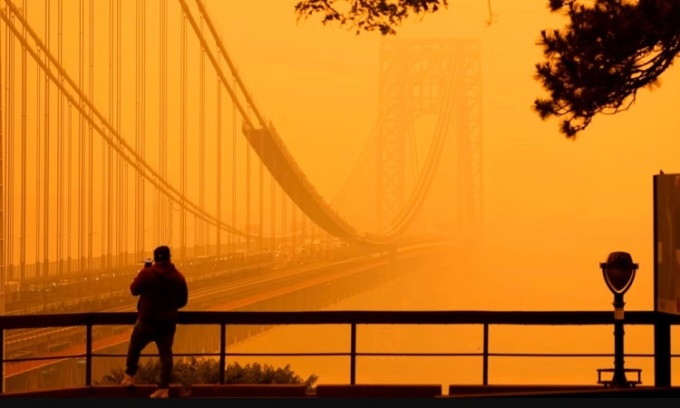
The George Washington Bridge in New York is shrouded in smog. Photo: AP
Thick smoke from wildfires in Canada has blanketed North America, disrupting everything from air travel to concerts. Authorities issued health warnings to millions of people in the eastern United States and Canada on June 7th as a haze formed by hundreds of wildfires moved south, engulfing densely populated areas from Ottawa to Washington, D.C. In New York City, air quality on June 7th was the worst among major cities worldwide , surpassing even New Delhi, India, according to the IQAir air quality index.
While air pollution from wildfires has become a recurring problem on the West Coast of the United States in recent years, it is far less common on the East Coast. Many residents panicked when the sky suddenly turned a hazy orange and had to wear masks. Schools in New York and Washington canceled outdoor activities, while US aviation authorities delayed flights to Philadelphia, Newark, New Jersey, and LaGuardia Airport due to poor visibility. The toxic air quality in New York also prevented some Broadway artists from performing.
Smog blanketed many famous landmarks such as the Statue of Liberty and Yankee Stadium. New York City Mayor Eric Adams urged residents to stay indoors and keep windows closed in the coming days. Even if the situation improves in the coming days, Adams stressed that the scene could repeat itself in the future due to climate change.
Canada is grappling with wildfire season, with fires breaking out in nearly 10 provinces over the past month. Canada's environment regulator has rated air quality in the capital, Ottawa, at the highest health risk level. Many areas in Quebec and Ontario are also under air quality warnings. As of June 7th, more than 400 fires were burning across Canada, and approximately 4 million hectares of land have been burned since the beginning of the year.
Scientists have observed an increase in wildfires in the Northern Hemisphere over the past decade, with average temperatures rising faster than near the equator due to global warming. May 2023 became the second hottest May on record, according to the European Union's Copernicus program.
An Khang (According to Financial Times )
Source link

































































































Comment (0)