

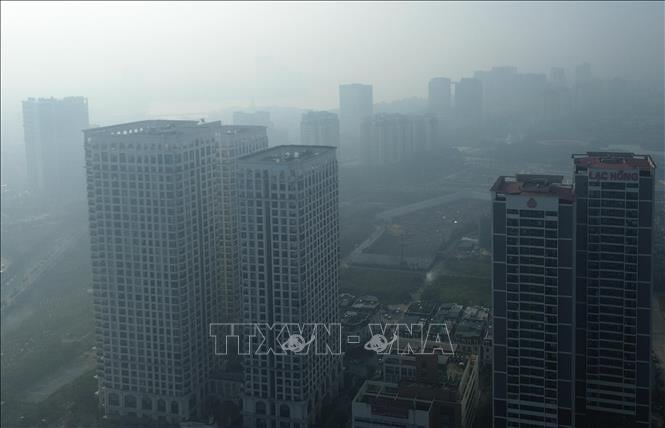
In early December 2025, international rankings consistently indicated that Hanoi, the capital of Vietnam, was among the most polluted cities in the world , with PM2.5 levels reaching "very harmful" and "dangerous" levels for public health.
On the morning of December 10th, AirVisual recorded Hanoi as the third most polluted city globally, with an average Air Quality Index (AQI) of 236. The day before, IQAir (Switzerland), a global air quality monitoring agency, also ranked Hanoi among the top 10 most polluted cities in the world.
This is not an unusual phenomenon, but rather a recurring situation over many years. According to NBC News, in early 2025, the AQI in Hanoi frequently exceeded 300, forcing many schools to close and people to rely on N95 masks to protect their health.
In March 2025, PM2.5 levels were recorded as being 24 times higher than the World Health Organization (WHO) recommendation. According to many environmental experts, this is due not only to unfavorable meteorological conditions but also to the increasing emission pressure from a rapidly developing city.
Rapid growth – environmental infrastructure has not kept pace.
Hanoi has become one of the country's strongest growth poles as Vietnam emerges as a new manufacturing hub in Asia. The high rate of population growth due to migration, high traffic density, and continuous construction expansion have placed significant pressure on air quality.
According to domestic statistics, transportation accounts for approximately 50% of total air pollution emissions in Hanoi, while industry accounts for 30% and construction activities account for 10-15%. The suburban areas are witnessing a series of housing projects, industrial zones, and large-scale urban developments, contributing to an increase in the concentration of fine particulate matter in the air.
NBC News commented that Hanoi is experiencing a development cycle similar to many Asian cities: rapid expansion, high energy consumption, but environmental infrastructure that has not kept pace. Numerous large-scale building projects are continuously being implemented, indicating that the trend of urban expansion will continue.
The terrain and weather conditions—especially during temperature inversions—cause fine dust to be trapped close to the ground, exacerbating pollution.
Urban air pollution is classified by the WHO as one of the greatest environmental risks to human health. Prolonged exposure to PM2.5 is directly linked to cardiovascular disease, lung cancer, asthma, and many other respiratory illnesses.
Notably, the impact of pollution is not evenly distributed. Poor workers living near industrial areas or major transportation routes are the most severely affected group, yet they have the least access to quality healthcare services.
The report “The Global Health Cost of PM2.5 Pollution,” published by the World Bank (WB) in 2023, indicates that air pollution causes damage equivalent to 3-5% of Gross Domestic Product (GDP) annually in many developing countries. If pollution persists, healthcare costs and reduced labor productivity will further pressure urban economic growth.
International models – suggested solutions for Hanoi
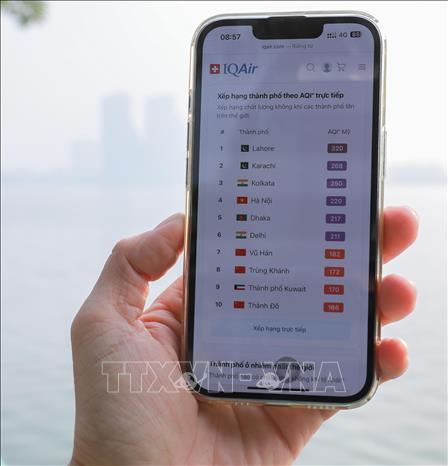
Many cities around the world have successfully implemented solutions to reduce air pollution, based on three pillars: controlling traffic emissions, managing construction and industry, and increasing air quality monitoring capacity.
London has implemented Ultra Low Emission Zones (ULEZs), requiring vehicles that do not meet emission standards to pay a fee when entering the city center. This policy has helped reduce NO₂ concentrations by 44% in just four years, since 2019. In addition, city officials are also promoting the transition to electric and clean vehicles, aiming to meet London's emissions reduction targets.
The French capital, Paris, has opted for solutions involving increasing green spaces and bicycle infrastructure. The city has continuously expanded bicycle lanes, banned older diesel vehicles, and converted many streets into pedestrian zones. These infrastructure improvements have significantly reduced emissions from traffic – the biggest source of urban pollution.
Meanwhile, the city of Amsterdam (Netherlands) prioritizes non-motorized transport. The city has reduced the need for private cars by creating the largest bicycle network in Europe.
In New York City, electrifying the bus fleet is a key development strategy. In 2023, the New York City Metropolitan Transportation Authority announced a plan to reduce CO₂ emissions by 500,000 tons annually upon completion of the transition to electric buses.
Similarly, the capital city of Oslo (Norway) has built many pedestrian-only neighborhoods, which has significantly improved air quality.
Notably, in Africa – home to a large proportion of developing economies and a continent with some of the most polluted cities globally – Kenya's capital, Nairobi, has adopted technology to increase data availability for improved environmental policy. The Mwendwa low-cost monitoring station initiative, installed along one of the city's busiest streets since 2021, allows for real-time data collection. This is a suitable solution for developing cities with limited resources but a need for timely data intervention.
This project model, though small, has made a difference in the community. “By sharing a link with the AirVisual app, the Mwendwa model easily provides data to students across Kenya, allowing them to research pollution themselves. The data is also used to inform parents of young children about the impact of poor air quality, helping people proactively respond to increased air pollution,” said Tedy Mwendwa, founder and operator of the monitoring station.
Based on international experience, some experts suggest solutions to mitigate air pollution that Hanoi could consider, including: Establishing low-emission zones and restricting old motorcycles and trucks in the inner city; Accelerating the electrification of public transportation, especially buses and taxis; Strengthening control of fine dust at construction sites, applying technologies for covering and treating construction materials; Expanding the air quality monitoring network, ensuring international data standards; Developing green spaces to increase the capacity for environmental absorption and regulation.
Air pollution in Hanoi serves as a clear warning that economic development must go hand in hand with sustainable development. As Hanoi aims to become a smart, green, and livable city, adopting international models along with solutions tailored to local realities is key to overcoming the "fine dust crisis" and building a more sustainable urban future.
Source: https://baotintuc.vn/xa-hoi/o-nhiem-khong-khi-tai-ha-noi-bai-hoc-tu-cac-do-thi-the-gioi-20251210165746964.htm
























![[Video] The craft of making Dong Ho folk paintings has been inscribed by UNESCO on the List of Crafts in Need of Urgent Safeguarding.](https://vphoto.vietnam.vn/thumb/402x226/vietnam/resource/IMAGE/2025/12/10/1765350246533_tranh-dong-ho-734-jpg.webp)























































Comment (0)