

On the morning of December 10, the National Assembly passed a Resolution to continue improving the effectiveness and efficiency of implementing policies and laws on environmental protection, requiring Hanoi and Ho Chi Minh City to immediately implement urgent measures to control and improve air pollution - an issue that has been assessed as having complicated developments over the past many years.
According to the Resolution, the Government and localities must focus on implementing a group of tasks and breakthrough solutions to overcome existing limitations and shortcomings, especially in controlling air quality in the two largest cities in the country. The focus is on overcoming and improving pollution in the 2025-2026 period, while developing a roadmap to reduce emissions and improve monitoring capacity in the following years.
The resolution sets a quantitative target for Hanoi and neighboring provinces for the first time. By 2030, the average annual PM2.5 concentration in Hanoi must decrease by approximately 20% compared to the 2024 average at all monitoring points of the national monitoring network.
In the provinces and cities surrounding Hanoi, including Thai Nguyen, Phu Tho, Bac Ninh , Hung Yen, Hai Phong, and Ninh Binh, the minimum reduction is 10%. For Ho Chi Minh City and other urban areas, air quality must be maintained at a stable level, preventing an increase in pollution levels.
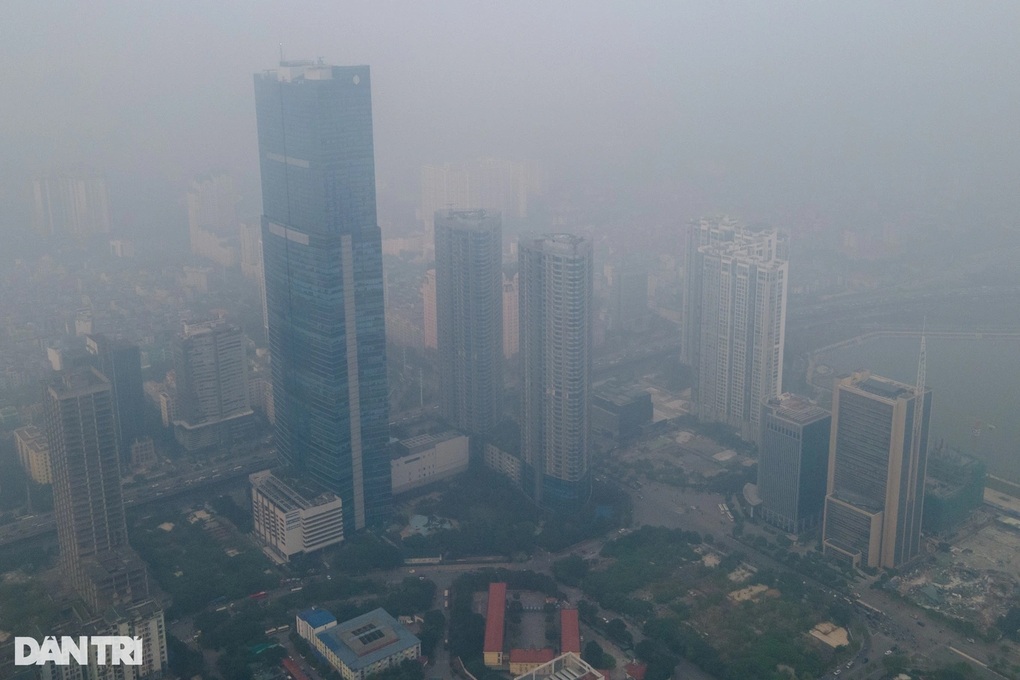
The National Assembly requires that by 2030, the average annual PM2.5 dust concentration in Hanoi must decrease by about 20% compared to the average level in 2024 (Photo: Thanh Dong).
To achieve this goal, the National Assembly requires strict control of vehicle emissions, restrictions on polluting vehicles in major cities based on environmental zoning, and the removal of substandard vehicles from circulation.
This is one of the key tasks in the period up to 2030, linked to the green transformation roadmap in transportation, infrastructure investment, and appropriate support policies to create social consensus.
Along with traffic, many other sources of pollution are also required to be strictly controlled. The resolution emphasizes the management of waste generated in construction and traffic; limiting the burning of agricultural by-products, especially in suburban areas; and increasing the collection and treatment of domestic wastewater to reduce widespread pollution in inner-city areas.
Regarding environmental quality monitoring and management, the National Assembly requested the urgent completion and operation of the national environmental information and database system, integrating environmental quality maps, making them public and applying them in large cities such as Hanoi and Ho Chi Minh City. This system will connect with national data and provide real-time information to serve management, monitoring and early warning.
In addition, the Resolution also requires strengthening control of activities generating dust and emissions from industry and craft villages; improving the effectiveness of appraisal and assessment of production technology to prevent the import of old, outdated technology that has the risk of causing pollution; and at the same time, strengthening the system of monitoring and forecasting the impact of climate change to prevent pollution risks early and from afar.
Localities must proactively allocate resources, closely coordinate with ministries and branches in implementing tasks; and be responsible to the National Assembly for the results of improving air quality. The resolution also requires the formation of a clear monitoring and evaluation mechanism, ensuring transparency, publicity and assigning responsibility to leaders.
With specific and strict requirements, the National Assembly expects that the implementation of the Resolution will create clear changes, gradually improving air quality in Hanoi, Ho Chi Minh City and neighboring areas, contributing to protecting people's health and promoting sustainable development in the period up to 2030.
Source: https://dantri.com.vn/thoi-su/quoc-hoi-yeu-cau-ha-noi-giam-20-bui-min-tu-2030-kiem-soat-chat-khi-thai-20251210105827530.htm

![[Photo] Explore the US Navy's USS Robert Smalls warship](/_next/image?url=https%3A%2F%2Fvphoto.vietnam.vn%2Fthumb%2F1200x675%2Fvietnam%2Fresource%2FIMAGE%2F2025%2F12%2F10%2F1765341533272_11212121-8303-jpg.webp&w=3840&q=75)


























![[Video] The craft of making Dong Ho folk paintings has been inscribed by UNESCO on the List of Crafts in Need of Urgent Safeguarding.](https://vphoto.vietnam.vn/thumb/402x226/vietnam/resource/IMAGE/2025/12/10/1765350246533_tranh-dong-ho-734-jpg.webp)






























































Comment (0)