

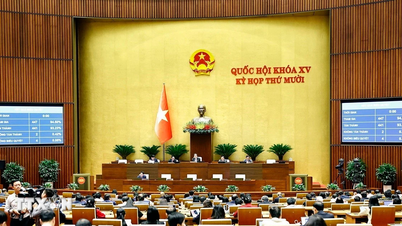
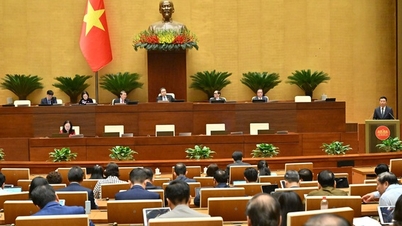
On the morning of December 10, with the majority of delegates voting in favor, the National Assembly passed the following laws: Law on Cyber Security; Law on Protection of State Secrets (amended); Law on amending and supplementing a number of articles of 10 laws related to security and order; Law on amending and supplementing a number of articles of the Law on National Defense Industry, Security and Industrial Mobilization; Law on Drug Prevention and Control (amended).
Protecting national sovereignty in cyberspace
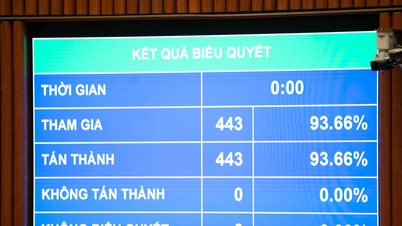
With 434/443 delegates participating in the vote, accounting for 91.75%, the National Assembly passed the draft Law on Cyber Security.
The law comprises 8 chapters and 45 articles, effective from July 1, 2026; creating a solid legal framework, enhancing the capacity to protect national sovereignty in cyberspace and promoting sustainable digital economic development.
The draft Law is built on the basis of merging the 2018 Law on Cyber Security and the 2015 Law on Network Information Security. This merger aims to ensure the consistency and uniformity of the legal system, overcome difficulties and shortcomings in practical implementation, and at the same time implement the spirit of Resolution No. 18-NQ/TW on streamlining the apparatus and operating effectively and efficiently.
The overarching principle is "one task should be assigned to only one lead agency, which is primarily responsible," ensuring clear division of responsibilities and authority among ministries and agencies, and avoiding overlapping functions and duties.
The law has several notable new points. The law clearly stipulates that the Ministry of Public Security is responsible to the Government for presiding over and coordinating the implementation of state management of cybersecurity. The Ministry of National Defense is responsible for managing the military information system; the Government Cipher Committee manages the cryptographic and cryptographic information system. This provision aims to resolve overlapping issues and ensure unified command and coordination in the context of global cybersecurity threats.
Expanding the scope and objects of protection, the Law supplements specific provisions on protecting vulnerable groups in cyberspace. In addition to children, the Law extends protection to the elderly and people with cognitive difficulties. For children, Article 16 details the responsibilities of agencies, organizations, businesses and families in preventing harmful information, establishing technical support tools and strictly handling acts of child abuse in cyberspace.
The Law also internalizes international commitments and enhances cyber security cooperation. Specifically, the Law has reviewed and internalized the provisions of the United Nations Convention against Cybercrime (Hanoi Convention) to which Vietnam is a member, creating a legal corridor for information sharing, coordination in investigation and prevention of cross-border cybercrime.
To ensure the necessary resources for implementation, the Law stipulates a minimum budget allocation for cybersecurity protection. Specifically, agencies and organizations using state budget funds must allocate at least 15% of the total budget for implementing programs, projects, and investment projects on digital transformation and information technology application to cybersecurity. This is an increase compared to previous proposals (from 10% to 15%) to better reflect practical requirements and the vital nature of cybersecurity in the digital age.

Regarding data security assurance, the Law specifically stipulates Article 26 on "Data Security Assurance", including policy formulation, application of technical measures, use of cryptography and cross-border data control. The concept of "Data Security" is also clearly defined in Article 2, emphasizing quality assurance and data protection for socio-economic development.
Information systems are classified into five levels based on the degree of harm to national security and public order if an incident occurs. This regulation helps to identify the focus of protection and apply corresponding management measures.
Promoting decentralization and delegation of power in protecting state secrets
With 434/436 delegates participating in the vote, accounting for 91.75%, the National Assembly passed the draft Law on Protection of State Secrets (amended). The law consists of 5 chapters and 28 articles; effective from March 1, 2026.
Based on the opinions of National Assembly deputies and practical requirements, the Law has many important new points in terms of scope, technology and administrative reform. Accordingly, the Law has supplemented and clearly explained terms such as "State secret electronic documents" (documents containing state secrets in digital data form) and "Independent LAN" (internal network not connected to the Internet/telecommunications) to cover the management of digital data.
A notable new point is that the Law adds a provision prohibiting the use of artificial intelligence (AI) or new technology to violate state secrets. The Law also stipulates the responsibilities of agencies and organizations in deploying and using AI systems or new technology in state secret protection activities.
The law has revised the provisions on the scope of state secrets in areas such as legislation, supervision, finance, budget, agriculture, environment... in a limited and narrow direction. This is to meet the requirements of socio-economic development, ensure the right to access information and international integration. The scope of state secrets is built in a general, general direction for identification.

The Law also promotes decentralization, delegation of power and reduction of administrative procedures, by abolishing the regulation on authorization to determine state secrets to simplify procedures; the head and deputy head of an agency or organization are directly responsible for determining state secrets; strongly decentralizing the authority to allow copying, photographing and destroying state secret documents, giving the right to decide on document destruction to the head of the agency or organization (in cases where it is not necessary to keep them) and specifically regulating the destruction council.
The law supplements and clarifies the prohibited acts related to the illegal collection, exchange, provision, and transfer of state secrets to third parties without a confidentiality agreement.
Also on the morning of December 10, with 425/433 delegates participating in the vote, accounting for 89.85%, the National Assembly passed the draft Law amending and supplementing a number of articles of 10 laws related to security and order, including 11 articles. In particular, amending and supplementing the Law on Guards with additional provisions on the regime and measures of guarding to ensure compliance with Regulation 368 of the Politburo on the list of positions, groups of positions, and leadership positions of the political system.
With the majority of delegates voting in favor, the National Assembly passed the draft Law amending and supplementing a number of articles of the Law on Defense Industry, Security and Industrial Mobilization. The draft Law is concisely designed with 2 articles. This Law takes effect from January 1, 2026. In particular, the regulations on planning and finance will take effect later, from March 1, 2026.
The passing of this draft law aims to standardize the Party's policy on building a security industry in the era of national development, contributing to perfecting the legal corridor, creating an environment for the development of a security industry serving the entire political system and aiming for export. The content of the law ensures compliance with the Constitution and is consistent with international treaties to which Vietnam is a member.
With 440 out of 444 delegates voting, representing 93.02%, the National Assembly passed the draft Law on Drug Prevention and Control (amended). The law consists of 8 chapters and 56 articles; including 11 new articles, 40 amended articles, 10 repealed articles, and 5 articles that remain unchanged from the current law.
This comprehensive amendment of the Law aims to institutionalize the viewpoints of our Party and State on perfecting and streamlining the organizational apparatus and political system; continuing to perfect the legal basis in preventing and combating drug crimes; resolving difficulties and problems arising from the practical state management of drug addiction treatment and post-drug addiction treatment management.
One of the new provisions of the Law is the regulation of electronic monitoring measures. Accordingly, the drafting agency has added impact assessments on the implementation of electronic monitoring, such as: the target groups, projected number of people to be affected, resources for implementation, and impacts of applying the measure (including impacts on human rights).
The Law has supplemented regulations in the direction of determining the subjects of application, applicable authority, responsibilities of persons under electronic surveillance and assigned the Government to specify in detail the equipment, means, conditions, time limits, order and procedures for handling violations in the application of electronic surveillance measures./.
Source: https://www.vietnamplus.vn/quoc-hoi-thong-qua-luat-an-ninh-mang-va-cac-luat-ve-an-ninh-quoc-phong-post1082172.vnp
![[Photo] Explore the US Navy's USS Robert Smalls warship](/_next/image?url=https%3A%2F%2Fvphoto.vietnam.vn%2Fthumb%2F1200x675%2Fvietnam%2Fresource%2FIMAGE%2F2025%2F12%2F10%2F1765341533272_11212121-8303-jpg.webp&w=3840&q=75)


![[Photo] The captivating scenery of the fragrant maple forest in Quang Tri](/_next/image?url=https%3A%2F%2Fvphoto.vietnam.vn%2Fthumb%2F1200x675%2Fvietnam%2Fresource%2FIMAGE%2F2025%2F12%2F10%2F1765353233198_lan09046-jpg.webp&w=3840&q=75)




























![[Video] The craft of making Dong Ho folk paintings has been inscribed by UNESCO on the List of Crafts in Need of Urgent Safeguarding.](https://vphoto.vietnam.vn/thumb/402x226/vietnam/resource/IMAGE/2025/12/10/1765350246533_tranh-dong-ho-734-jpg.webp)



































































Comment (0)