

(kontumtv.vn) – Right from the beginning of 2025, several banks have launched preferential credit packages to support customers and stimulate credit demand during the peak shopping season of the Lunar New Year. With a targeted GDP growth rate of over 8%, banks are expected to have ample room to boost lending this year.
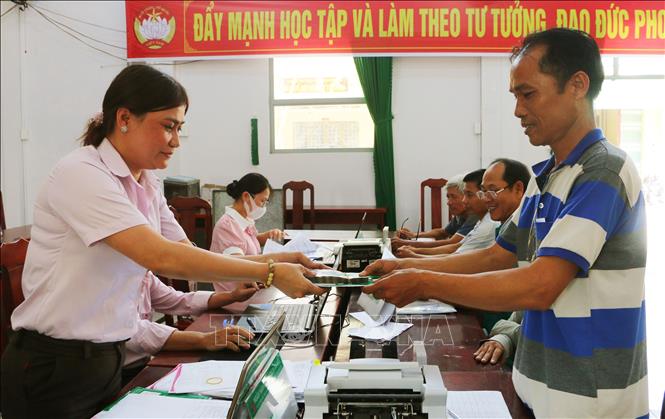
Preferential loan interest rates starting from only 3.5%/year
The Vietnam Bank for Agriculture and Rural Development ( Agribank ) has just announced a preferential credit package of up to VND 110,000 billion to support individual customers. This is considered a strategic move by the bank to stimulate consumer demand and promote production and business, especially during the peak shopping season of the Lunar New Year (Year of the Snake).
According to Agribank, in this credit package, the bank has allocated 30,000 billion VND specifically for loans serving daily life needs, with short-term loan interest rates starting from only 4.5%/year, up to 1% lower than the usual interest rate, and 6%/year for medium and long-term loans, applied in the initial phase.
To support production and business activities and stimulate domestic consumption, Agribank has also allocated 70,000 billion VND in preferential loans under this credit package to support customers in investing and expanding their production activities.
In addition, Agribank has designed a 50,000 billion VND short-term loan package to meet the rapid working capital needs of individuals and small businesses with favorable interest rates; and a 20,000 billion VND package for medium and long-term loans with interest rates starting from 6% per year, aiming to support individual customers in implementing large investment plans or expanding their long-term business operations.
Notably, green and environmentally friendly projects will be eligible for loans with interest rates starting from just 3.5% per year. This is part of Agribank's 10,000 billion VND green credit package, dành for individual customers who boldly invest in green sectors, which typically require high initial costs.
Vietcombank (Vietnam Foreign Trade Commercial Bank) has also just announced the launch of a preferential loan program with interest rates starting from only 4.6% per year for individual customers borrowing capital for short-term production and business. Notably, the scale of this credit package is up to VND 250,000 billion, and the bank will apply it from January 1, 2025.
Not only the two banks mentioned above, but many other commercial banks are also planning to disburse capital from the beginning of the year with preferential credit packages for each priority customer group. In 2025, the State Bank of Vietnam forecasts credit growth for the entire system to be around 16%, an increase of about 1% compared to the 2024 results.
According to Deputy Governor of the State Bank of Vietnam, Dao Minh Tu, the credit growth target for this year is based on an assessment of last year's results and the economic growth target set by the National Assembly and which the Government is striving to achieve above 8%. However, this will still depend on actual conditions and the economy's capacity to absorb capital.
Previously, at the end of December 2024, the State Bank of Vietnam sent a document to banks publicly and transparently announcing the principles for assigning credit growth targets for 2025. This gives commercial banks a great deal of autonomy in implementing their business activities during the year.
The State Bank of Vietnam also stated that it will closely monitor actual developments to proactively, flexibly, promptly, and effectively manage credit growth of banks. This will help ensure sufficient credit supply to serve the economy and guarantee the safety of the system, while prioritizing economic growth, macroeconomic stability, and inflation control.
Where does the driving force behind credit growth come from?
At a recent investor conference, Mr. Pham Nhu Anh, General Director of Military Commercial Joint Stock Bank (MB), stated that in 2025, the bank will allocate at least 50% of its credit limit to the retail segment and small and medium-sized enterprises (SMEs); the remainder will be allocated to large enterprises. Among these, the bank will continue to focus on increasing lending to businesses in priority sectors.
According to Mr. Pham Nhu Anh, the bank's strategy of focusing on the retail segment is planned for the 2022-2026 development period. However, in the past two years, retail credit growth has been quite slow due to the frozen real estate market, stagnant demand for housing, and the difficult economic situation, which has led people to limit investment. Therefore, in the coming period, MB will prioritize focusing on developing the retail segment to ensure the achievement of its stated strategy.
MB's leadership also stated that, entering 2025, the economy is projected to improve, with the government expecting growth of 8-10%. If GDP growth is high, banks will have more room to lend. MB's credit growth is expected to reach 25-26% this year.
From an expert's perspective, Michael Kokalari, Director of Macroeconomic Analysis and Market Research at VinaCapital, believes that in 2025, banks will continue to benefit from the shift towards GDP growth driven by internal factors. This is because banks finance almost all sectors of the domestic economy; and also lend heavily to real estate and consumer spending – sectors expected to boost the economy in 2025.
According to VinaCapital, the government will take specific measures to boost the real estate market. Consequently, growth in home loan lending could double from 10% in 2024 to nearly 20% this year. The recovery of the real estate market will also boost consumer confidence, thereby driving up high-margin consumer lending segments such as auto loans and installment purchases.
“The government intends to support GDP growth in 2025 by boosting public investment, which is expected to expand lending opportunities for banks. The combined effect of increased public investment, real estate, and consumer spending will contribute to boosting credit growth and improving the asset quality of banks,” Michael Kokalari stated.
VinaCapital forecasts that system-wide credit growth will remain at around 15% in 2025. Of that, growth in lending to the high-margin individual customer segment is expected to accelerate from approximately 12% in 2024 to 15% this year. VinaCapital also expects banks to increase lending to infrastructure projects and real estate businesses, especially as this market continues to recover.
According to the latest survey on business trends of credit institutions published by the Forecasting and Statistics Department (State Bank of Vietnam), credit demand in 2025 is expected to increase across all sectors, borrowers, currencies, and maturities. The industrial and construction sector has the highest percentage of credit institutions forecasting increased loan demand; followed by demand for loans for living expenses and consumption, commercial and service loans, and loans for agricultural, forestry, and fisheries development.
Credit institutions anticipate that wholesale and retail trade; import and export; and loans for living expenses and consumption will be the three sectors driving the highest credit growth this year.
According to banks, economic growth trends, interest rates, changes in investment demand for production and business, and improved service quality are factors positively influencing the increase in credit demand from corporate customers in the first six months of the year and throughout 2025.
In addition, improvements in loan products, conditions, and procedures by credit institutions are also predicted to significantly impact the increase in demand for loans from individual customers in 2025…
Source: https://kontumtv.vn/tin-tuc/kinh-te/ngan-hang-thuc-giai-ngan-von-tin-dung-ngay-tu-dau-nam
![[Photo] Closing Ceremony of the 10th Session of the 15th National Assembly](/_next/image?url=https%3A%2F%2Fvphoto.vietnam.vn%2Fthumb%2F1200x675%2Fvietnam%2Fresource%2FIMAGE%2F2025%2F12%2F11%2F1765448959967_image-1437-jpg.webp&w=3840&q=75)
![[Photo] Prime Minister Pham Minh Chinh holds a phone call with the CEO of Russia's Rosatom Corporation.](/_next/image?url=https%3A%2F%2Fvphoto.vietnam.vn%2Fthumb%2F1200x675%2Fvietnam%2Fresource%2FIMAGE%2F2025%2F12%2F11%2F1765464552365_dsc-5295-jpg.webp&w=3840&q=75)






![[Infographic] Cross-exchange rates for determining taxable value from December 11-17](https://vphoto.vietnam.vn/thumb/402x226/vietnam/resource/IMAGE/2025/12/11/1765413245543_infographic-ty-gia-tinh-cheo-de-xac-dinh-tri-gia-tinh-thue-tu-11-1712-20251211021920.jpeg)




































![[OFFICIAL] MISA GROUP ANNOUNCES ITS PIONEERING BRAND POSITIONING IN BUILDING AGENTIC AI FOR BUSINESSES, HOUSEHOLDS, AND THE GOVERNMENT](https://vphoto.vietnam.vn/thumb/402x226/vietnam/resource/IMAGE/2025/12/11/1765444754256_agentic-ai_postfb-scaled.png)













































Comment (0)