

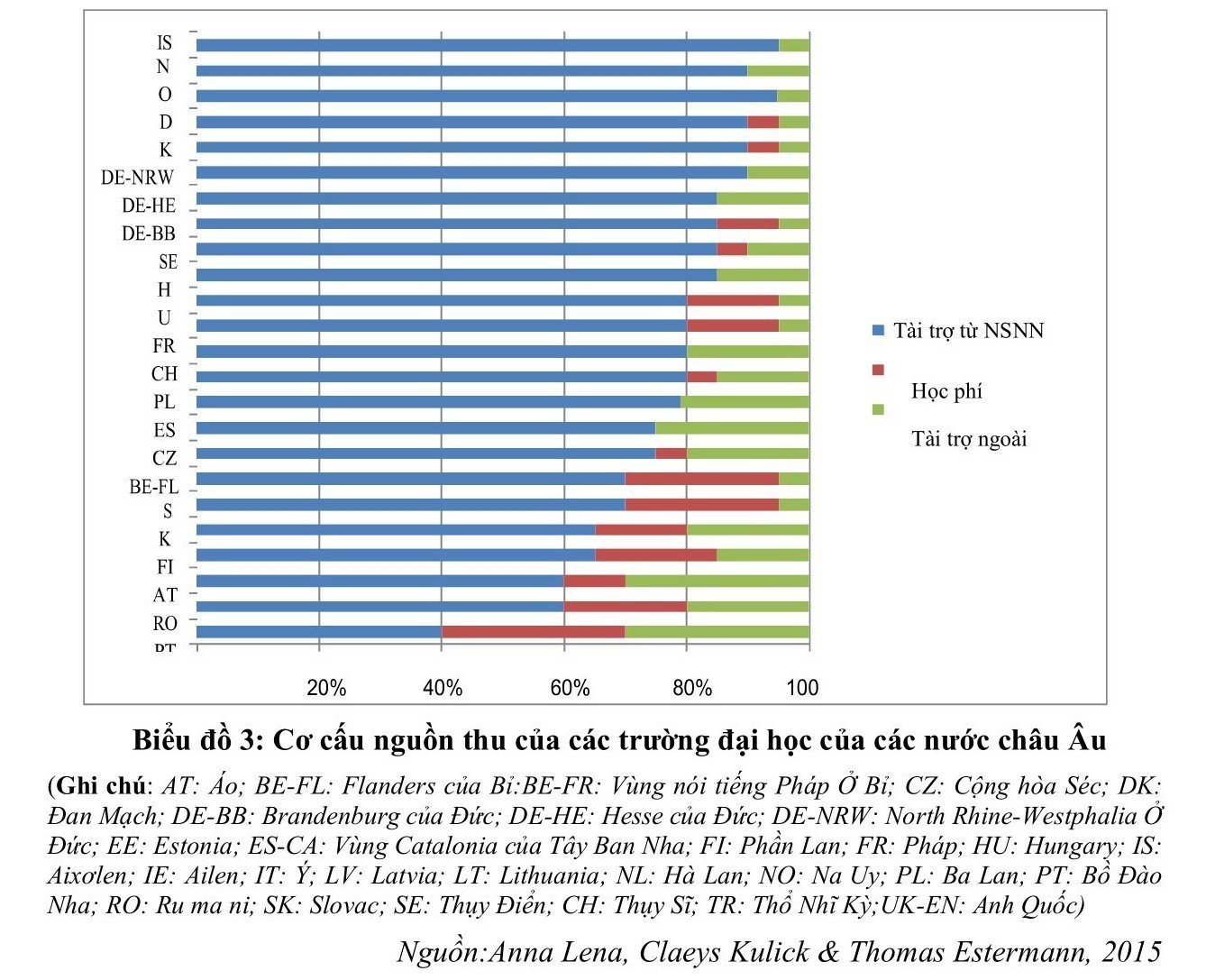
In Europe , the government accounts for up to 90% of the funding.
At a conference on university autonomy held in Ho Chi Minh City in April, Dr. Nguyen Thi Mai Hoa, Vice Chair of the National Assembly's Committee on Culture and Education , maintained that the global trend in financial investment for higher education is shifting towards reducing dependence on the state budget and allowing universities to proactively seek new revenue sources, diversify resources attracted from society (businesses, students), and adjust spending and financial management effectively. Nevertheless, funding from the state budget remains extremely important in the development of education in general and higher education in particular.
The proportion of government spending on higher education currently stands at only about 0.27% of GDP, significantly lower than in other countries in the region and the world.
However, according to research by Thanh Nien Newspaper, the trend of reducing dependence on the state budget stems from the context of European higher education, which receives very large public investments. A research group from the University of Commerce also stated that, although with many different approaches, studies on higher education all agree that financial investment from the state budget plays an extremely important role in promoting the development and improving the quality of universities.
In most European universities (with the exception of a few countries like the UK and Ireland), government funding accounts for 70-80% of their revenue. In some countries, such as Iceland, Denmark, and Norway, government funding even exceeds 90% of university revenue. In some countries like the UK, Ireland, Romania, and Portugal, due to lower government funding, universities tend to share costs with students or seek other supplementary funding sources.
Tuition fees at top Chinese universities are lower than in Vietnam.
Also at a seminar on university autonomy organized by the Ministry of Education and Training, Associate Professor Vu Hai Quan, Director of the Vietnam National University Ho Chi Minh City, raised the question: "Is the policy of cutting recurrent expenditures for autonomous universities in line with international practice?" Looking at neighboring China, their two leading universities, Tsinghua University and Peking University, had tuition fees for undergraduate programs in the 2018 academic year of around 18 million VND, lower than the tuition fees of autonomous universities in Vietnam. However, the average monthly salary of professors at these two universities is estimated at around 82 million VND, much higher than their counterparts in Vietnam. This figure shows that public investment in higher education in China is very large.
According to Associate Professor Vu Hai Quan, the process of implementing university autonomy in Vietnam poses three major challenges related to university finance. Without a comprehensive system of solutions, these challenges will limit access to higher education for a significant number of disadvantaged students, lead universities to focus on easily accessible programs, and disrupt the balance of human resources in the national development strategy. These challenges include: the lack of guaranteed funding from the state budget; the absence of appropriate student loan policies; and the failure to diversify revenue sources.
X. REVIEW THE ROADMAP FOR INCREASING THE PROPORTION OF EXPENDITURE ON HIGHER EDUCATION.
Ms. Hoa also acknowledged that public investment in higher education in Vietnam is still limited, only reaching 4.33 - 4.74% of the total budget expenditure for education and training. Comparing the proportion of state budget expenditure on higher education in Vietnam/GDP during the 2018-2020 period shows that the proportion of state budget expenditure on higher education is currently only about 0.27% of GDP, much lower than other countries in the region and the world.
The criteria for allocating state budget funds to higher education institutions are currently based only on budget capacity and input factors (scale, number of students; number of staff; history of state budget allocation in previous years, etc.), without linking them to quality criteria and output results or policies on bidding and ordering for the provision of public services. The allocation of budget through different governing bodies leads to a lack of uniformity in criteria and does not truly ensure fairness in benefits.
The tuition fees to be collected from students should be determined based on the average total training costs minus the amount of state support to ensure the quality of education. The state should expand the scope, target, and value of support and loans for students. In addition, consideration should be given to developing a roadmap to increase the proportion of state budget spending on higher education as a percentage of GDP to catch up with other countries in the region; and to focus investment on a number of strong higher education institutions, especially in priority sectors, to form a number of world-class, pioneering higher education institutions with a leading role and responsibility in the system, creating momentum for the development of science and technology and socio-economic development.
Source link
![[Photo] Prime Minister Pham Minh Chinh attends the Conference summarizing and implementing tasks of the judicial sector.](/_next/image?url=https%3A%2F%2Fvphoto.vietnam.vn%2Fthumb%2F1200x675%2Fvietnam%2Fresource%2FIMAGE%2F2025%2F12%2F13%2F1765616082148_dsc-5565-jpg.webp&w=3840&q=75)





















































































Comment (0)