

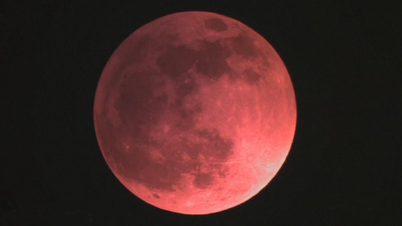
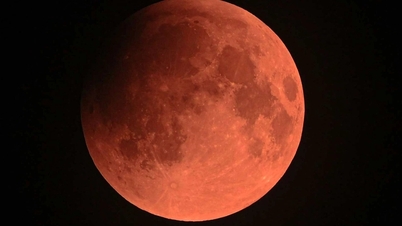
(Dan Tri Newspaper) - When the Moon is completely covered by the Earth's shadow, it darkens, but doesn't turn completely black. Instead, it takes on a deep red color and is called a "Red Moon," or "Blood Moon."
Fascinating astronomical phenomenon
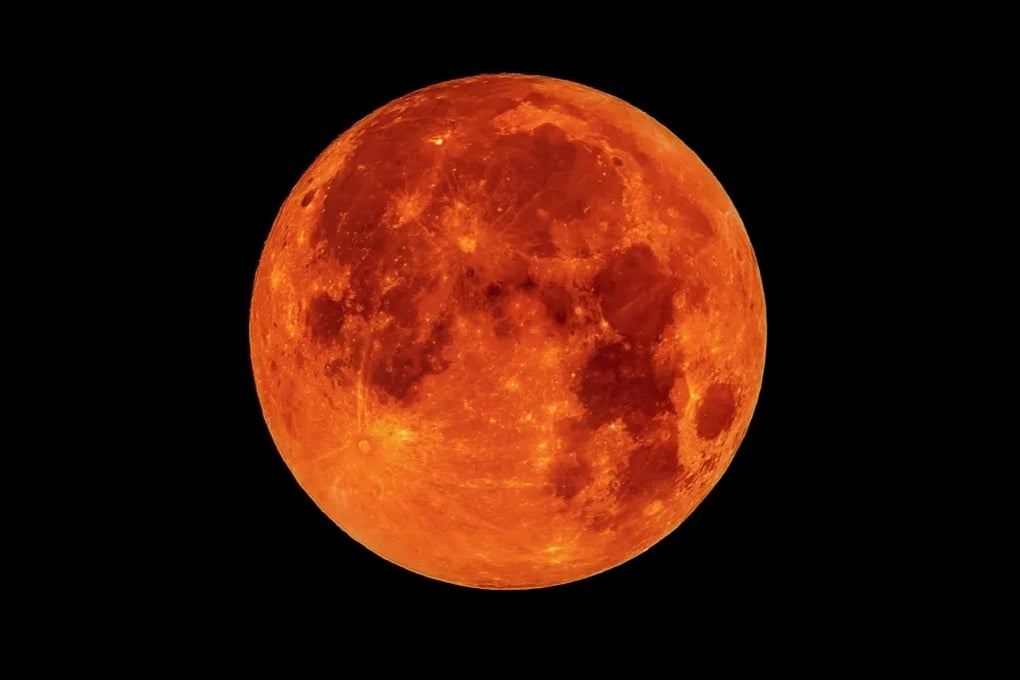
The blood moon is a fascinating astronomical phenomenon that many people look forward to (Photo: Getty).
On March 13-14, astronomy enthusiasts will have the opportunity to admire the total lunar eclipse, also known as the "blood moon".
This event becomes even more special when it recalls the lunar eclipse that Christopher Columbus (the explorer who opened the American expedition) took advantage of more than 5 centuries ago to manipulate the indigenous people.
According to historical accounts, in 1504, Columbus and his crew were stranded off the coast of Jamaica. When the Arawak natives refused to continue supplying food, Columbus used his astronomical knowledge.
He consulted an astronomical table and realized that there was a total lunar eclipse coming on March 1, 1504. Columbus warned the Arawaks that his god would "wipe out the moon" as punishment if they did not continue to provide food.
When the lunar eclipse occurred and the moon turned a fiery red, the Arawaks panicked and rushed to bring food to Columbus.
The reason the upcoming total lunar eclipse on March 13th is reminiscent of this historical event is because it occurs along the same path of the Moon through the Earth's shadow, that is, against the same backdrop of stars.
This lunar eclipse is no coincidence, but the result of the Saros cycle, an astronomical cycle that occurs every 223 lunar months (18 years, 11 days, and 8 hours). According to NASA, the March eclipse is part of Saros cycle 123, which began in 1628 and will continue into 2061.
Can Vietnam observe the lunar eclipse in March?
On March 13 and 14, a total lunar eclipse will occur, lasting about 5 hours, and the "blood moon" will appear for about 65 minutes. We can safely observe this phenomenon with the naked eye.
However, not every area in the world has the opportunity to admire this amazing natural phenomenon.
While the Pacific , North and South America will be able to see the eclipse clearly, some parts of Europe will only be able to catch a glimpse of it when the moon sets, which is near dawn. Some countries in East Asia will also get a glimpse of it when the moon rises.
However, according to Time&Date , Vietnam is not in the area where the lunar eclipse can be observed in March. This is because the lunar eclipse can only be observed from areas where the Moon is above the horizon.
If it is daytime in an area, the Moon will be below the horizon, making it impossible to observe the lunar eclipse.
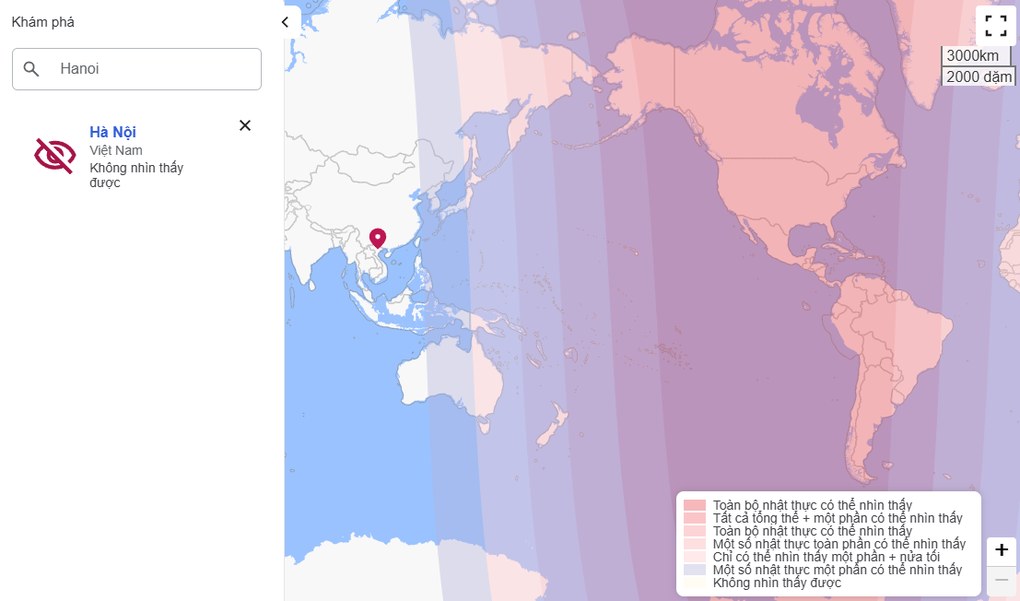
Vietnam is not in the area where the lunar eclipse in March can be observed (Photo: Date and Time).
Furthermore, the Moon does not orbit the Earth in a perfectly parallel orbit to the Earth's orbit around the Sun. This tilt of approximately 5 degrees means that lunar eclipses do not occur monthly, and when they do, only certain areas can see them in whole or in part.
While people in North America, Central America, and South America could witness the entire phenomenon from beginning to end, some European and African countries only saw a part of it, and most of the Middle East and Asia could not see it at all.
According to Time&Date, astronomy enthusiasts in Vietnam will have to wait until September 7th to observe the first total lunar eclipse of the year. This is also the longest total lunar eclipse since 2022, with its phases lasting 1 hour and 22 minutes.
Why is the Moon blood red?
When the Moon is completely covered by the Earth's shadow, it darkens, but doesn't turn completely black. Instead, it takes on a deep red color and is called a "Red Moon," or "Blood Moon."
Scientists explain this phenomenon by saying that sunlight contains all the colors we can see.
In this case, the gas particles that make up Earth's atmosphere are more likely to scatter blue-wavelength light, while red-wavelength light remains able to pass through.
This is called Rayleigh scattering, and it is why the sky is usually blue, but sunrises and sunsets are often red.
During a lunar eclipse, red light can pass through Earth's atmosphere and be refracted - or bent - toward the Moon, while blue light is filtered out. This makes the Moon appear reddish to Earth's observers.
Source: https://dantri.com.vn/khoa-hoc/ngay-133-xay-ra-trang-mau-viet-nam-co-xem-duoc-20250311102320774.htm



![[Photo] Prime Minister Pham Minh Chinh holds a phone call with the CEO of Russia's Rosatom Corporation.](/_next/image?url=https%3A%2F%2Fvphoto.vietnam.vn%2Fthumb%2F1200x675%2Fvietnam%2Fresource%2FIMAGE%2F2025%2F12%2F11%2F1765464552365_dsc-5295-jpg.webp&w=3840&q=75)
![[Photo] Closing Ceremony of the 10th Session of the 15th National Assembly](/_next/image?url=https%3A%2F%2Fvphoto.vietnam.vn%2Fthumb%2F1200x675%2Fvietnam%2Fresource%2FIMAGE%2F2025%2F12%2F11%2F1765448959967_image-1437-jpg.webp&w=3840&q=75)











































![[OFFICIAL] MISA GROUP ANNOUNCES ITS PIONEERING BRAND POSITIONING IN BUILDING AGENTIC AI FOR BUSINESSES, HOUSEHOLDS, AND THE GOVERNMENT](https://vphoto.vietnam.vn/thumb/402x226/vietnam/resource/IMAGE/2025/12/11/1765444754256_agentic-ai_postfb-scaled.png)













































Comment (0)