

After graduating with a degree in aquaculture from Nha Trang Fisheries University (now Nha Trang University) in 1998, Master Cao Van Nguyen joined the Institute of Oceanography and began his journey of exploring the diverse world of marine life.
Initially, he focused his research on marine vertebrates, particularly sea snakes and sea turtles. Since 2001, in collaboration with international organizations such as Denmark, the United States, and Australia, he has been involved in research on sea snakes, a field still shrouded in mystery.
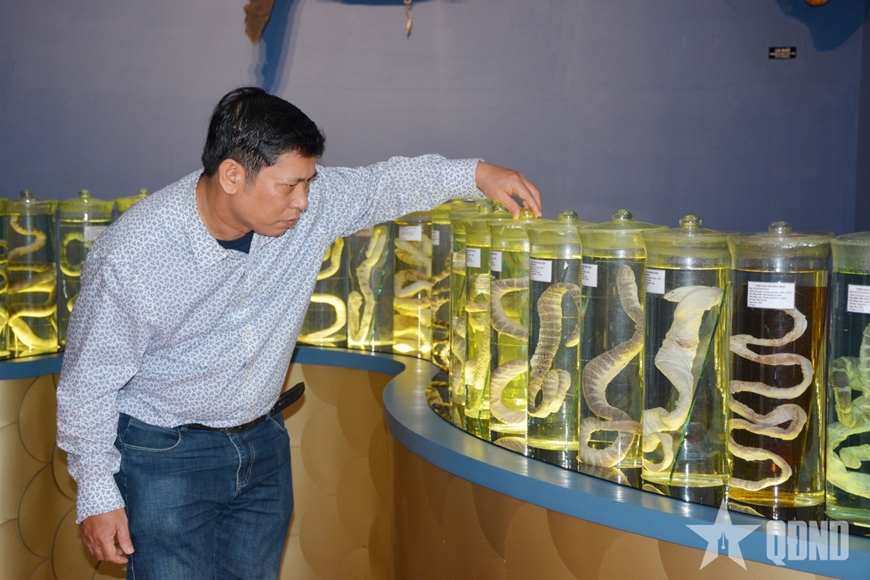
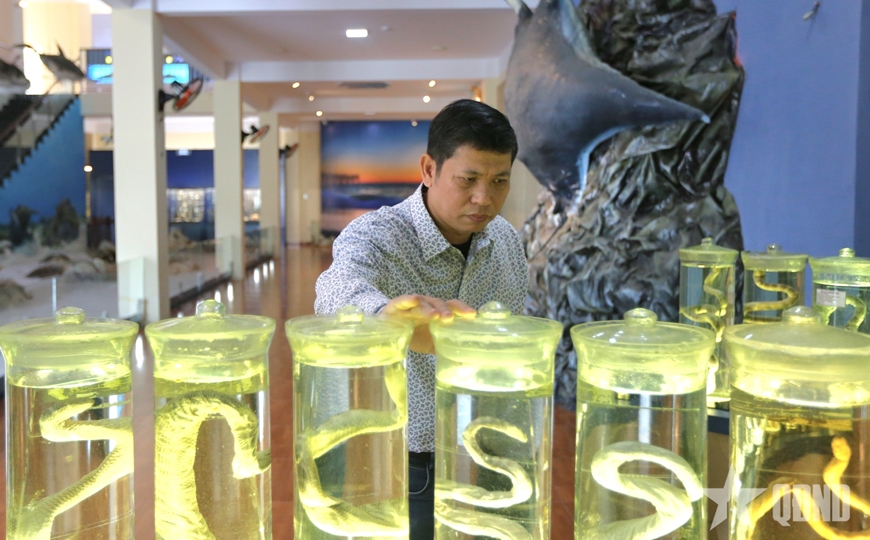 Master Cao Van Nguyen examines specimens of sea snakes.
Currently, the Oceanographic Museum is preserving 26 specimens of rare sea snake species; these are priceless specimens dating back to the French colonial era. He and his colleagues have diligently researched and preserved them, making a significant contribution to the preservation of this rare genetic resource.
Master Cao Van Nguyen shared: “Our goal is to create a repository of standardized specimens, serving scientists , students, and those interested in learning about sea snakes. Through researching, identifying, and taxonomically classifying sea snake species, we hope to contribute to raising public awareness about the importance of conserving marine biodiversity.”
 Master Cao Van Nguyen introduces sea snakes to foreign tourists.
According to Master Cao Van Nguyen, Vietnam is one of the countries with the highest diversity of sea snake species in the world , with 26 species recorded (the world has 62 species). Among them are extremely rare species such as the yellow-lipped krait, the only sea snake that lays eggs, and the beaked-nosed snake, the only venomous snake whose serum can be used to treat other species.
To preserve the sea snake specimens, he and his colleagues employed several advanced scientific methods, including formalin injection. He said, "This is a technique that requires meticulousness and caution. We must strictly adhere to occupational safety regulations to ensure our own safety and the safety of the environment."
Beyond conservation efforts, Master Cao Van Nguyen actively participates in research on the biological characteristics and role of sea snakes in the ecosystem, as well as the impact of climate change on their distribution and reproduction.
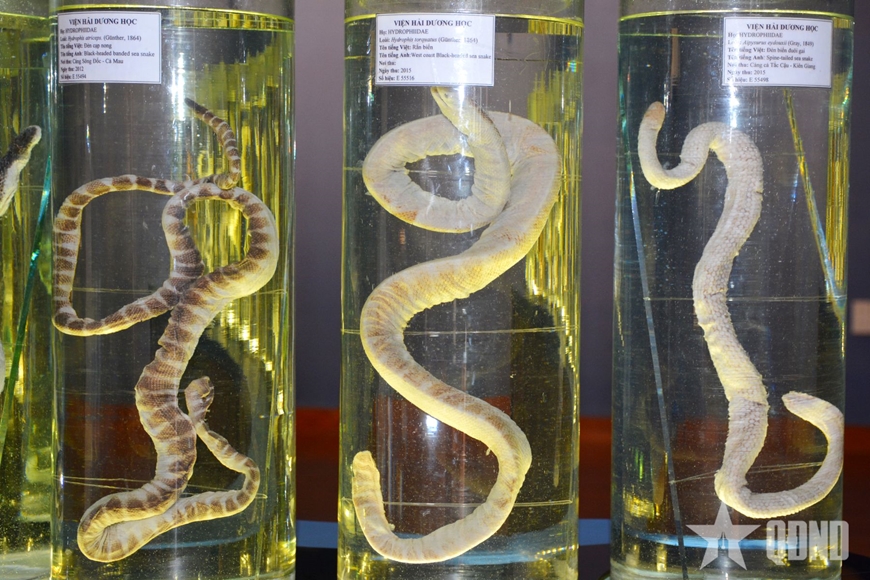
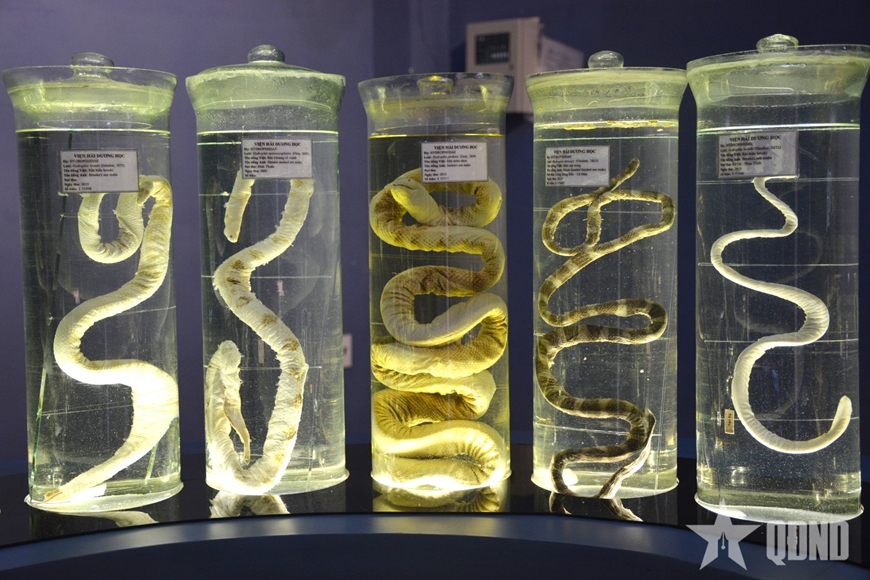
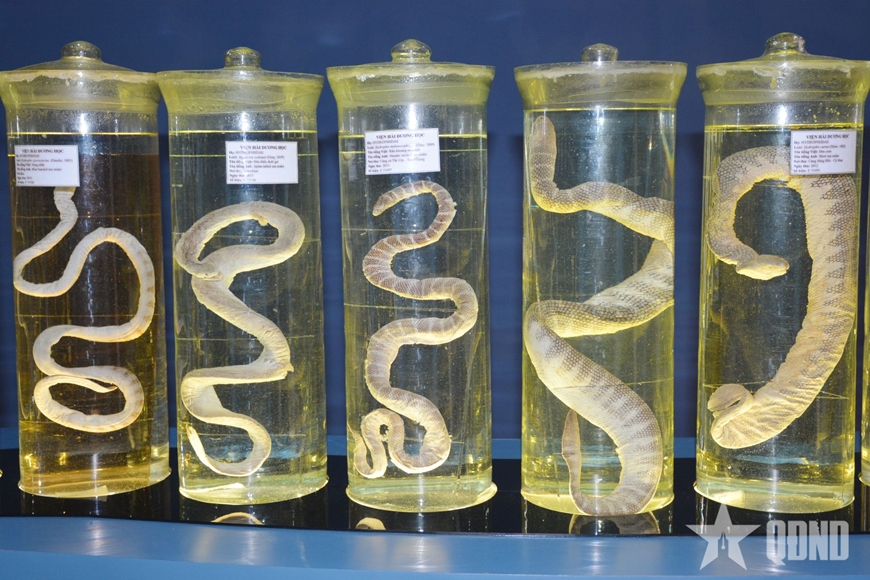 Specimens of sea snakes are preserved at the Oceanographic Museum.
Master Cao Van Nguyen is the lead author of the article published in the prestigious international journal "Conservation Biology" in 2014 titled "Sea Snake Harvest in the Gulf of Thailand," which calls on the global community to work together to protect sea snake resources, facing the risk of depletion.
He is also the lead author of the book "Vietnamese Sea Snakes" and co-author of three articles published in prestigious international journals in English in 2019, 2023, and 2024. The articles discuss the evolution of snakes in adapting to life in the sea, such as the transformation and tenfold increase in the vascular system in the head of sea snakes compared to land cobras. This allows sea snakes to directly extract oxygen from the water through this vascular network, accounting for up to 32% of the oxygen needed for their survival.
For his dedication and contributions to the research and preservation of sea snakes, Master Cao Van Nguyen is affectionately known by his colleagues as "the guardian of the soul" of sea snakes.

![[Photo] Closing Ceremony of the 10th Session of the 15th National Assembly](/_next/image?url=https%3A%2F%2Fvphoto.vietnam.vn%2Fthumb%2F1200x675%2Fvietnam%2Fresource%2FIMAGE%2F2025%2F12%2F11%2F1765448959967_image-1437-jpg.webp&w=3840&q=75)
![[Photo] Prime Minister Pham Minh Chinh holds a phone call with the CEO of Russia's Rosatom Corporation.](/_next/image?url=https%3A%2F%2Fvphoto.vietnam.vn%2Fthumb%2F1200x675%2Fvietnam%2Fresource%2FIMAGE%2F2025%2F12%2F11%2F1765464552365_dsc-5295-jpg.webp&w=3840&q=75)

































![[OFFICIAL] MISA GROUP ANNOUNCES ITS PIONEERING BRAND POSITIONING IN BUILDING AGENTIC AI FOR BUSINESSES, HOUSEHOLDS, AND THE GOVERNMENT](https://vphoto.vietnam.vn/thumb/402x226/vietnam/resource/IMAGE/2025/12/11/1765444754256_agentic-ai_postfb-scaled.png)






























Comment (0)