

 |
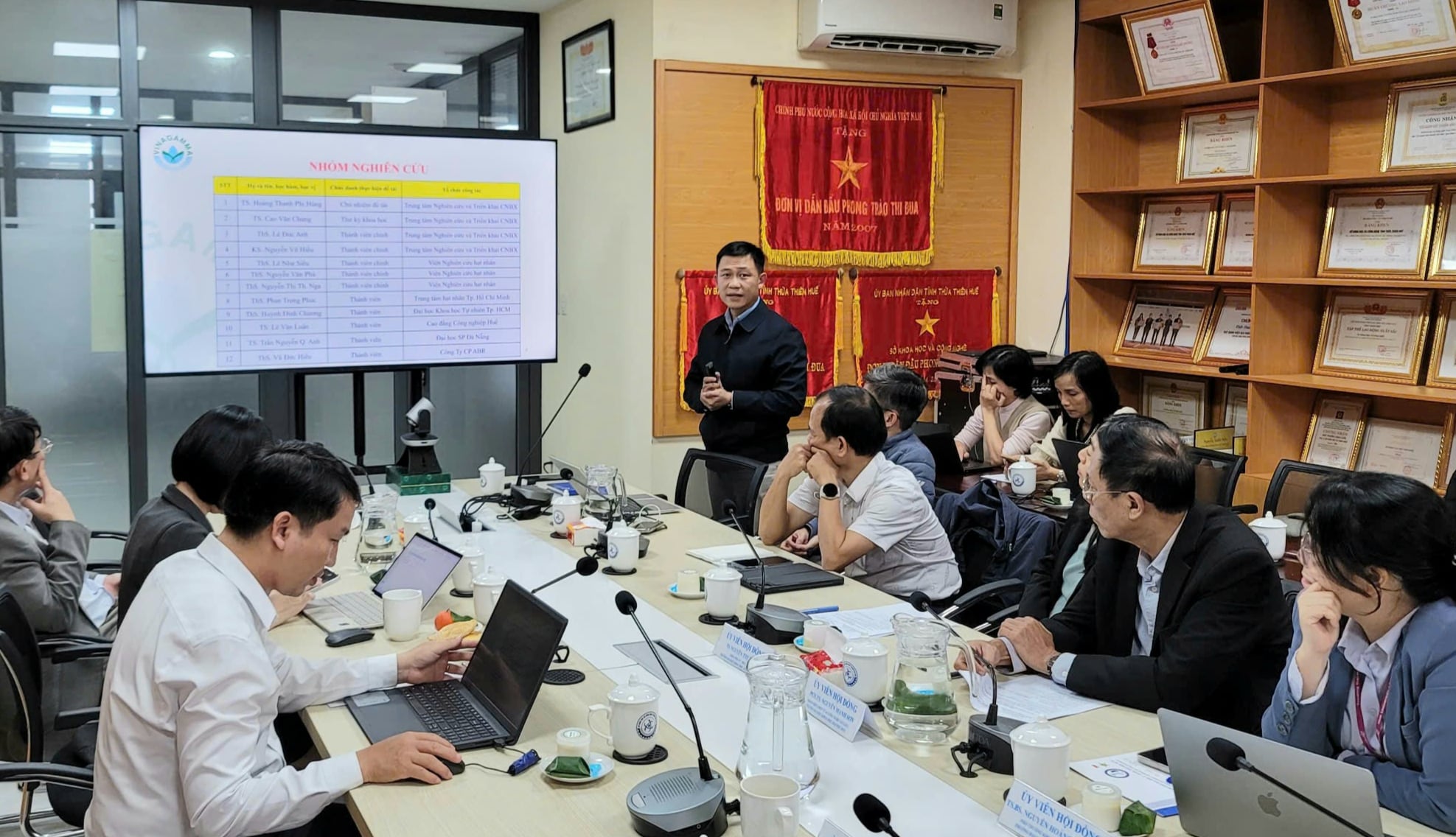
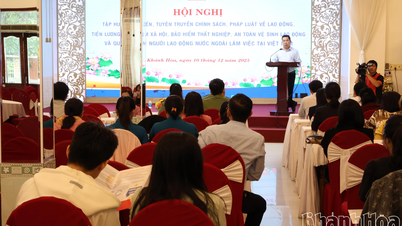
| The representative of the project implementation group reported and explained the project to the Council. |
Hue has diverse terrain, tropical monsoon climate, heavy rainfall, complex geology..., so these are factors affecting the distribution of natural environmental radiation background (PXMT). Along with that, Hue also has areas with high radiation background: The mountainous area west of Hue City (Phong Dien, Nam Dong... with mineral resources), industrial zones and hospitals (sources of artificial radiation such as Cs-137, Co-60, I-131, Tc-99m...).
In fact, Hue City has not yet built a GIS-integrated, continuous, synchronous PXMT monitoring program that can visualize and analyze risks. Data is fragmented, not updated regularly, and does not fully reflect risks. In addition, in Hue City, there is still no research on the application of biological indicator plants to assess the ability to accumulate radiation.
Faced with that situation, the project implementation team, the Center for Research and Development of Radiation Technology, conducted the main research contents: Systematizing and analyzing the results of PXMT monitoring; proposing a PXMT monitoring program and radiation safety management in Hue City; experimenting with indicator plants (tobacco, vetiver). In particular, focusing on collecting and synthesizing PXMT data from previous research sources; assessing the current status of existing data in Hue City (digital maps, missing indicators, blank areas...); comparing with national standards and international practices (according to QCVN and IAEA guidelines).
The research team set up a network of regular monitoring points, including air, soil, water, plants..., fixed station locations, semi-periodic measurement points in industrial parks, mineral mines, medical facilities...; built a database, oriented integration into the GIS-Hue system for management and early warning; built a program for basic radiation safety management... Planted biological indicator plants in 3-5 different radioactive background areas and evaluated radioactive accumulation in stems, roots, and leaves using HPGe and ICP-MS spectroscopy techniques...
It is expected that within 24 months, from December 2025 to December 2027, the implementing unit will complete the progress of the contents set out in the project explanatory report. The project results will produce the following main products: Assessment of the current status of the PXMT background in Hue City; selection of plants as biological indicators for monitoring radiation...
Source: https://huengaynay.vn/kinh-te/khoa-hoc-cong-nghe/nghien-cuu-xay-dung-he-thong-quan-ly-va-giam-sat-phong-phong-xa-moi-truong-160770.html





















![[Photo] Explore the US Navy's USS Robert Smalls warship](/_next/image?url=https%3A%2F%2Fvphoto.vietnam.vn%2Fthumb%2F1200x675%2Fvietnam%2Fresource%2FIMAGE%2F2025%2F12%2F10%2F1765341533272_11212121-8303-jpg.webp&w=3840&q=75)























































Comment (0)