

The character is not on the cast list.
Reading and watching "Southern Military District" (book, play) and the film "Quan Ky Nam ," one encounters a "character" not listed in the cast but almost the main character: the collective housing in Hanoi and the apartment buildings in Ho Chi Minh City in the 1980s. Through nostalgic film footage and a slow pace, "Quan Ky Nam" slowly captures familiar yet strange images of old apartment buildings: windows faded by time, landings, corridors, balconies... cluttered with belongings, potted plants, and even a chicken coop; a rooftop during a power outage; narrow walls covered with photos of loved ones; a broken brick used as a door stopper...
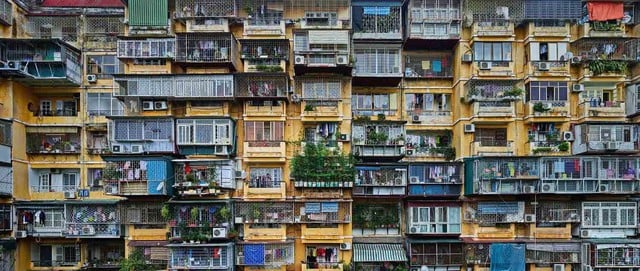
Old Hanoi apartment buildings captured by an American photographer.
PHOTO: PETER STEINHAUER
Despite its seemingly old, boring, and chaotic atmosphere, there's a unique order of human connection and emotion, subtly revealed by the character Khang (Lien Binh Phat): "It's not easy to find a place with so much joy like this!", when his elderly neighbor tactfully asks: "How have you been since you came here? Are you planning to stay or are you planning to move on?" It is precisely in this old-fashioned space that the young translator has found new feelings in his "muse," Ky Nam, which will become a lifelong companion.
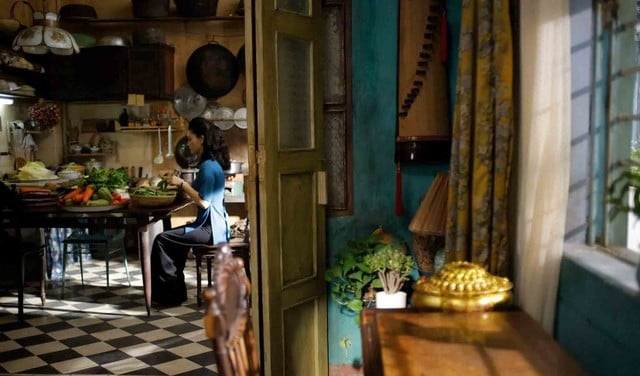
The setting is an old apartment building in the film Quan Ky Nam.
PHOTO: PROVIDED BY THE FILM CREW
In contrast to Quán Kỳ Nam – where shared spaces became private memories for the two individuals – Quân khu Nam Đồng , from book to play, is a portrait of the collective memories of mischievous boys from military families in Hanoi's largest military housing complex, also during the post-war years. If the apartment complex in Quán Kỳ Nam is a silent witness to the fragile yet enduring bond between two close friends separated by distance, the "character" of the Nam Đồng apartment complex acts as an "ally" to the mischievous children, preserving the "Nam Đồng military complex" brand. Two distinct spaces: one slow and melancholic, the other boisterous and playful, yet both leave viewers speechless at the inner wounds that war left on the post-war generation.
"The stairs leading up to the small attic, where our memories are kept..."
"Quán Kỳ Nam," with its carefully chosen, poetic shots depicting people and houses in an old residential area and a love story left unfulfilled, evokes the lyrics of a song composed by musician Dương Thụ to Tchaikovsky's music exactly 20 years ago: "Still the same window frame, the same stairs leading to the small, quiet attic, where our memories are kept..." (The Day We Parted - Album Chat with Mozart - Mỹ Linh). "A Saigon apartment building built in the 1970s, everything is old and worn, and so are the people, everything belongs to the previous century…, but somehow the people in the film feel so familiar to me, as if I've known them for a long time...", cinematographer Nguyễn Hữu Tuấn shared his feelings after watching "Quán Kỳ Nam ."
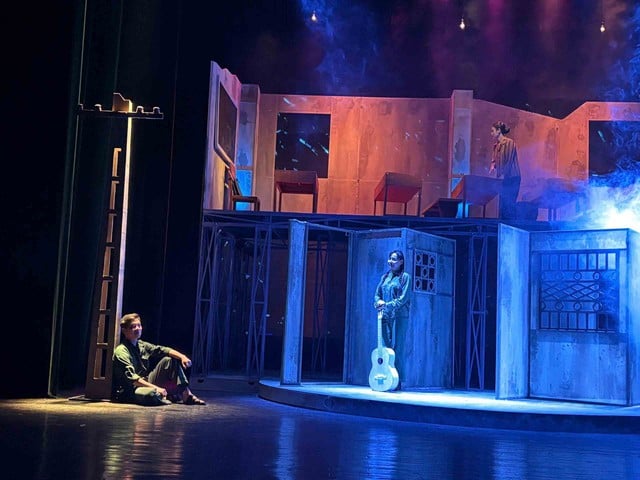
The stage design for the largest military housing complex in Hanoi for the play "Southern Military Region"
PHOTO: TL
"Familiarity" is also the source of inspiration for director Leon Quang Le, leading him to meticulously craft each frame for the setting of the film Quan Ky Nam . His memories were "frozen" from the time he left Vietnam at the age of 13, along with images of the old residential area where he grew up in the 1980s. Therefore, the "memory box" in Quan Ky Nam , for the director himself, is also a way for him to ask for "a ticket back to childhood"!
"The doorways and staircases leading up to those quiet little attics" are also a special source of inspiration for American photographer Peter Steinhauer, who has dedicated 30 years of his career to photographing Vietnam, especially the old apartment buildings in Hanoi. "Having lived in Hanoi for many years, I have seen and been inside these apartments hundreds of times, and photographing them has become an important part of my work. It is a unique part of Hanoi's soul...", he said.
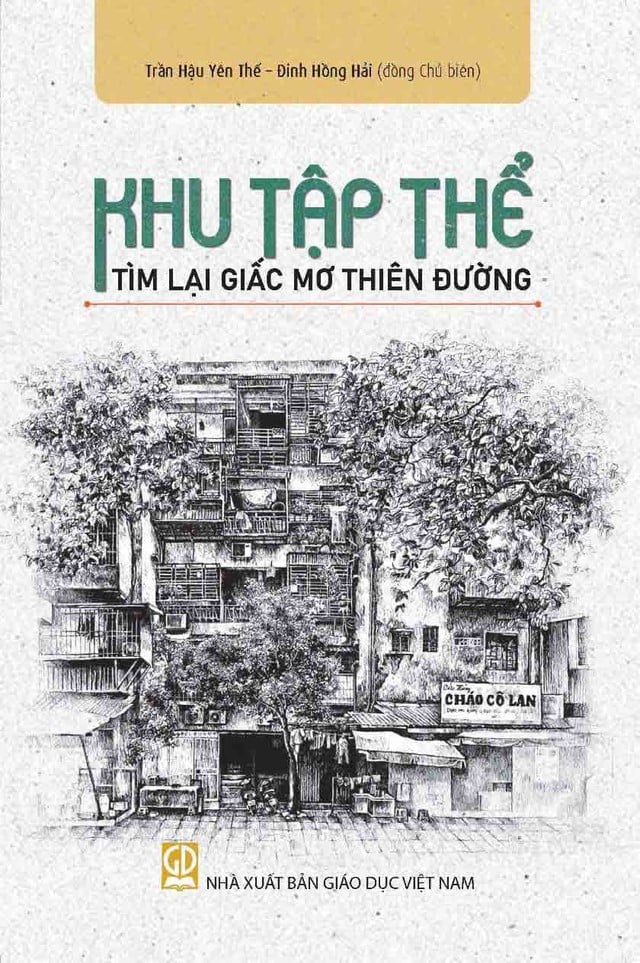
Book cover of "The Apartment Complex - Rediscovering the Dream of Paradise" (Vietnam Education Publishing House, 2025)
PHOTO: PROVIDED BY THE PUBLISHER
In the recently published research book , "Reclaiming the Dream of Paradise in Collective Housing," co-edited by Tran Hau Yen The and Dinh Hong Hai, collective housing once again becomes the "main character," this time exclusively playing a key role. The book is a vivid portrait of Hanoi during the war and the subsidy period, seen through the collective memories of many artists and writers who were once connected to this unique living space. "Collective housing has witnessed countless sorrows and joys, bitterness and happiness, of the people who lived there. In the current context, although there have been many discussions and solutions proposed by the government to replace old collective housing, the strong existence of these complexes is a vivid testament to a humane city – where people are the decisive factor in the vitality and survival of the city," Associate Professor Dinh Hong Hai said, explaining the motivation behind his and his colleagues' efforts in creating the book.
Source: https://thanhnien.vn/nha-tap-the-cu-ky-uc-tro-ve-185251203222516327.htm

![[Photo] Prime Minister Pham Minh Chinh receives the Chinese Ambassador to Vietnam](https://vphoto.vietnam.vn/thumb/1200x675/vietnam/resource/IMAGE/2026/04/05/1775397481797_ndo_br_dsc-5512-jpg.webp)




























































![[INFOGRAPHICS] Exploiting children's personal images for profit can result in fines of up to 50 million VND.](https://vphoto.vietnam.vn/thumb/402x226/vietnam/resource/IMAGE/2026/04/06/1775442200854_1775442148.webp)






















Comment (0)