

According to the fire safety law recently passed by the National Assembly , houses located in narrow alleys in centrally-governed cities will be required to be equipped with fire extinguishers and fire alarm communication devices.
These regulations are expected to prevent the fires in households, factories, mini-apartments, etc., that have caused particularly serious damage in recent times.
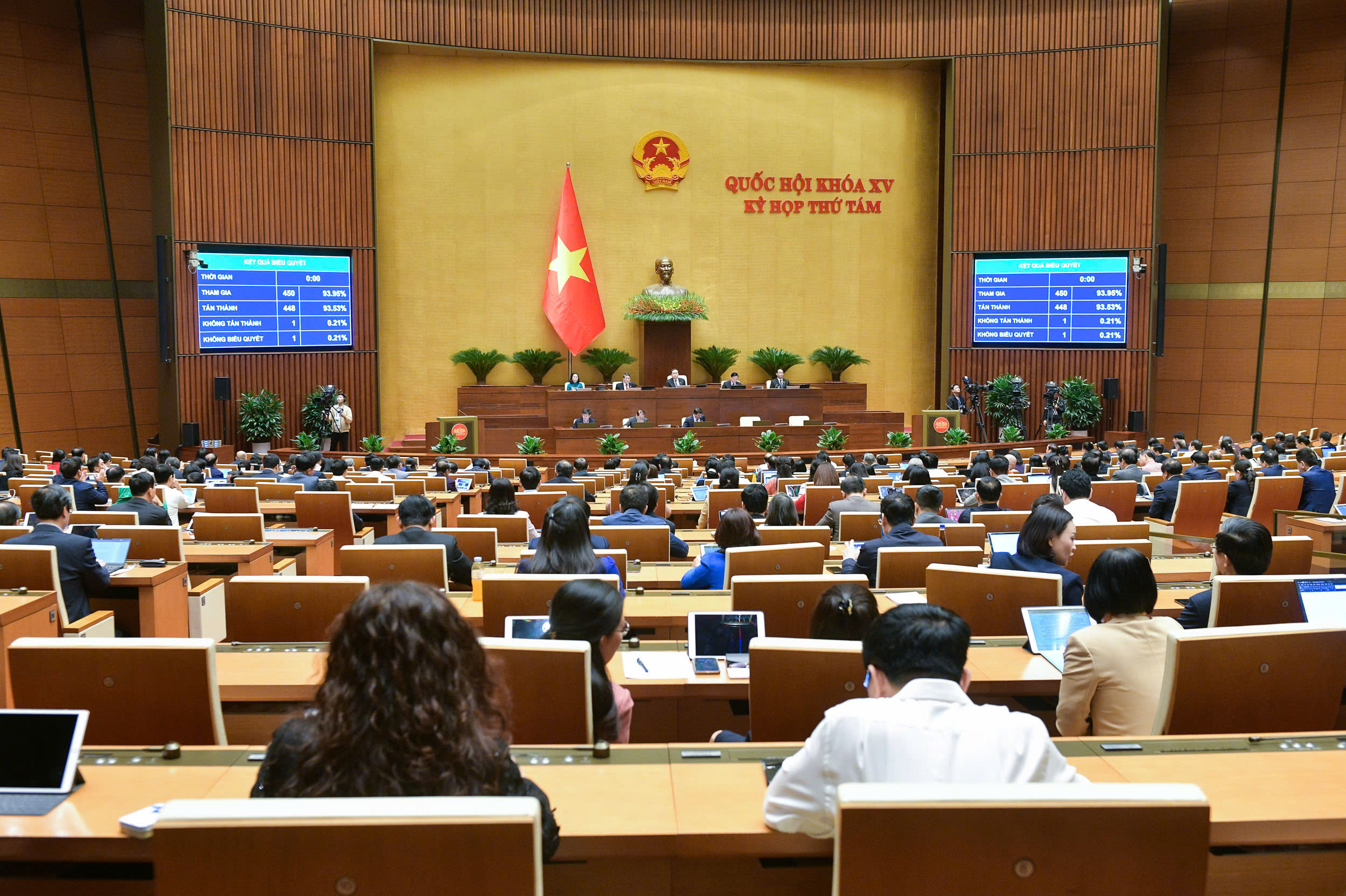
The National Assembly passed the Law on Fire Prevention and Rescue.
PHOTO: GIA HAN
Houses located in narrow alleys are required to be equipped with fire extinguishers.
The Law on Fire Prevention and Rescue dedicates Article 20 to regulating fire safety conditions for residential buildings. Specifically, residential buildings in centrally-governed cities located in areas lacking adequate transportation infrastructure or water sources for firefighting, or failing to meet technical standards for fire prevention and control, must be equipped with fire extinguishers and fire alarm communication devices connected to a fire prevention and rescue database system, transmitting fire alarms according to a schedule prescribed by the Government .
For residential buildings in other areas, the law encourages the installation of fire alarm communication devices, connected to a database system for fire prevention, rescue, and fire alarm transmission.
The Standing Committee of the National Assembly stated that houses subject to mandatory fire extinguisher and fire alarm communication equipment as stipulated above are those located in densely populated urban areas, cramped spaces, narrow alleys, and areas lacking adequate transportation infrastructure or water sources for firefighting as required by law and technical standards in fire prevention and control.
These types of housing are mainly found in centrally-governed cities, due to their historical planning and construction.
To ensure the timely deployment of firefighting forces and equipment, the fastest possible notification and reporting of fires to the fire police force is crucial, especially in determining the approach to residential buildings in the affected areas, the water supply plan for firefighting, and taking advantage of the initial "golden 5 minutes" before the fire escalates.
Therefore, mandatory regulations requiring the installation of fire extinguishers and fire alarm communication devices are necessary to protect the lives and property of people in these areas.

Chairman of the National Defense and Security Committee Le Tan Toi presented the report explaining, receiving feedback, and revising the draft law.
PHOTO: GIA HAN
Sleeping quarters are not permitted in flammable or explosive business premises.
The Law on Fire Prevention and Rescue also dedicates a separate article to regulating fire safety conditions for residential buildings combined with production and business activities.
Notably, residential buildings that combine living with the production and sale of flammable and explosive goods are not permitted to have sleeping quarters within the production or business area.
During the law-making process, some opinions suggested considering the feasibility of this regulation, and that it should only be encouraged or implemented with a suitable roadmap.
However, according to the Standing Committee of the National Assembly, the area for the production and trading of flammable and explosive goods is where goods with a high risk of fire and explosion are stored; when a fire or explosion occurs, there is a risk of large-scale fires breaking out, causing serious damage.
The regulation prohibiting sleeping quarters within production and business areas is necessary to ensure the safety of human lives in environments with a high risk of fire and explosion.
The Standing Committee of the National Assembly noted that if the regulation is merely "encouraging," it will be discretionary, lacking clear responsibility, leading to lax implementation, and potentially causing safety hazards and threatening the lives and health of people sleeping in places where flammable and explosive goods are produced or traded.
To ensure accuracy, the law clearly defines flammable and explosive goods as goods containing substances or items with a risk of fire or explosion in gaseous, liquid, or solid form, which, when managed, transported, or used, have the potential to cause fires or explosions, endangering human life and health, causing property damage, and affecting the environment, security, and public order.
At the same time, the law mandates the Government to regulate the detailed list of goods that are hazardous in terms of fire and explosion.
Residents do not have to pay for firefighting.
There have been suggestions to stipulate that agencies, organizations, and families must bear a portion of the costs of firefighting in the event of a fire. The National Assembly Standing Committee stated that firefighting is a component of the task of protecting security and order, and is funded by the State. When fires or explosions occur, agencies, organizations, and families have already suffered certain losses in terms of people and property. Adding a regulation requiring them to bear a portion of the firefighting costs would increase the burden on people who have already suffered losses. Therefore, to align with regulations on security and order and to demonstrate the humane nature of the law, the National Assembly Standing Committee recommends against adding the aforementioned proposal.Thanhnien.vn
Source: https://thanhnien.vn/nha-trong-hem-sau-o-ha-noi-tphcm-se-bat-buoc-mua-binh-chua-chay-185241129090000642.htm











































































Comment (0)