

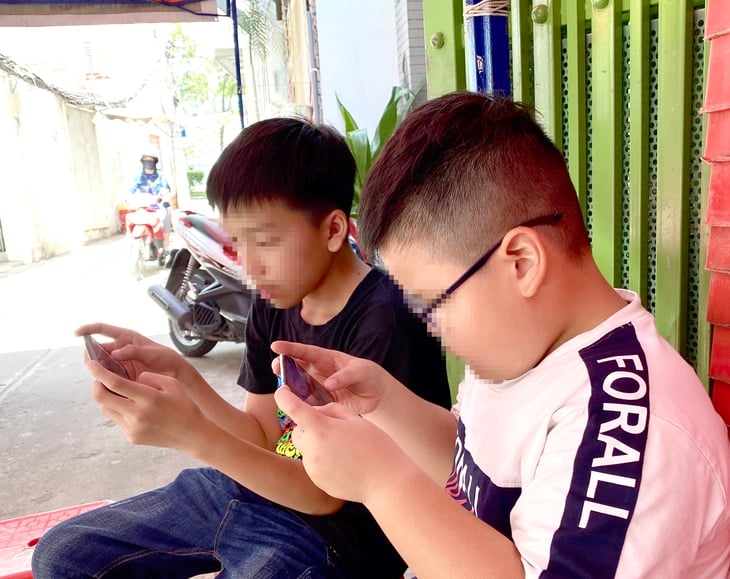
The majority of students in Vietnam under the age of 16 have used social media applications, from Facebook and TikTok to YouTube, to some extent. - Photo: TU TRUNG
In Vietnam, the question of whether or not to ban social media use for those under 16 is still receiving mixed opinions. However, most readers agree that there is a need for policies to protect and strictly manage the use of social media by children and teenagers.
* Dao Thanh An (student of Cho Gao High School, formerly Tien Giang province ):

Dao Thanh An (a student from Cho Gao High School, formerly Tien Giang province)
In my opinion, users under 16 should be banned from social media. Firstly, these individuals lack the awareness to distinguish between unhealthy and harmful content, and therefore cannot protect themselves from it.
Secondly, because they don't know the difference between fraudulent and legitimate websites, they may lose personal information, which I think will harm their future.
Moreover, if they don't use social media, it will create opportunities for children to develop physical activities, participate in sports , and form good habits...
The solution to this is for parents to be strict about their children's use of phones and social media, always educating and guiding them on how to use social media properly and how to avoid online vices and scams. In addition, I believe the government should also create healthy online platforms for children so they can learn new things.
* Huynh Ngoc Anh Thu (Vietnamese student at the University of Toronto, Canada):

Huynh Ngoc Anh Thu (Vietnamese student at the University of Toronto, Canada)
In today's modern life, social media is a place where we can learn many things and stay updated on the latest information and trends. Therefore, I believe that banning children under 16 from using social media is an extreme and impractical measure.
This not only limits their ability to communicate and connect, but also makes it difficult for them to keep up with their peers, leading to disadvantages in the development of social skills.
Instead of a complete ban, families and teachers should guide children on how to use social media responsibly, helping them develop good habits and a sense of responsibility in managing their time and content so that they can access social media effectively and healthily.
However, social media platforms still prohibit children under 13 from opening accounts because they lack full awareness at this age.
* Ms. Nguyen Thuy Vuong Khanh (Deputy Director of the Center for Communication, Admissions and Services, Ho Chi Minh City College of Economics):

Ms. Nguyen Thuy Vuong Khanh (Deputy Director of the Center for Communication, Admissions and Services, Ho Chi Minh City College of Economics)
It seems that one of the biggest concerns for young people today is social media platforms. For example, it has become normal for a young person to watch "top top" for over 180 minutes, meaning spending more than three hours browsing the internet, making it easy for them to fall into the habit of excessive use.
However, it cannot be denied that these very foundations are a powerful driving force for the development of Generation Z and Generation Alpha. Today's young people are dynamic, creative, perceptive, and constantly learning and exploring themselves.
These platforms help them access information, change their mindset, and profoundly impact their lifestyles. It's a double-edged sword, so instead of banning their use, we need to learn how to use them intelligently and appropriately.
To address the problem of dependence on social media, a multi-faceted approach is needed. Personally, I would like to propose the following solutions: Relevant authorities and social media platform management units need to coordinate to moderate content to ensure it is appropriate for different user age groups, and to limit screen time for specific age groups.
Internet service providers should also offer separate packages that allow parents to control their children's internet usage.
Furthermore, the role of parents is extremely important. Be a friend to your child, because when you are a friend, you will understand what your child is doing, thinking, and needing. Then, you will be able to "guide" your child, instead of just scolding, forbidding, or blaming them.
Even though your child may sometimes disagree with you, sharing your perspective will help them understand the downsides of social media and avoid the negative effects it can have.
* Ms. Nguyen Thai Chau (Deputy Head of Student Affairs Department, University of Finance - Marketing):

MSc. Nguyen Thai Chau (Deputy Head of Student Affairs Department, University of Finance - Marketing)
In my opinion, social media should not be banned for those under 16. Instead, educational institutions, schools, and especially families and parents need to guide students towards positive content and teach them to limit their online activity. This education can be done through orientation sessions, seminars, and discussions with experts in this field, educators, psychologists, and others.
High schools should also invest in other more attractive school activities to "compete" with social media for student engagement.
For example, investing in library services, keeping up with digital transformation, enabling students to effectively utilize social media platforms for learning and entertainment, and connecting with the world, academics, research, and pursuing their interests and passions...
* Education expert Bui Khanh Nguyen:
Different levels should be shown.

Education expert Bui Khanh Nguyen
Prohibiting students from using phones or social media can manifest itself at different levels: through legislation, as part of education sector regulations, or as a policy of individual schools. There is no one-size-fits-all solution; banning or not banning is simply a choice to achieve management goals.
Governments might ban social media because its negative effects outweigh its positive ones, or schools might ban phones to encourage student interaction.
How Vietnam should apply this should depend not only on referencing common practices (practical basis), but also on research findings (scientific basis) and other legal regulations (legal basis).
Many engineering problems

The majority of students in Vietnam under the age of 16 have used social media applications, from Facebook and TikTok to YouTube, to some extent. - Photo: TU TRUNG
Dr. Jeff Nijsse, a senior lecturer in software engineering at RMIT, commented that banning certain social media platforms could also cause teenagers to switch to other messaging and gaming platforms like WhatsApp, Discord, and Roblox, or use VPNs to mask their geographical location.
VPNs can mask your IP address but can also bypass geo-segmentation algorithms, isolating you from local groups of friends and providing irrelevant content from foreign regions. Free VPN apps can even pose more risks, such as malware.
Another issue raised by Dr. Nijsse is the use of disposable SIM cards. Vietnamese law requires all social media accounts to be verified via mobile phone numbers. However, disposable SIM cards are still rampant in the market, offering a potential solution for users who want to circumvent the verification process. When it's impossible to require users to provide identification documents, platforms will need to resort to estimating age based on facial recognition, but this technology is still under development.
Meanwhile, Ms. Vu Bich Phuong, a psychology lecturer at RMIT, said that instead of completely banning social media, a more effective solution would be to require technology companies to comply with creating a safer online environment for children and teenagers.
For example, they need to make the reporting function easier to identify and use, while also providing child-safe settings with proactive content moderation. "This is especially important because children's use of AI tools will also explode in the next few years," Ms. Phuong emphasized.
Source: https://tuoitre.vn/nhieu-nuoc-da-cam-viet-nam-nen-quan-chat-tre-em-dung-mang-xa-hoi-20251212232009834.htm

![[Image] Vietnam's colorful journey of innovation](/_next/image?url=https%3A%2F%2Fvphoto.vietnam.vn%2Fthumb%2F1200x675%2Fvietnam%2Fresource%2FIMAGE%2F2025%2F12%2F14%2F1765703036409_image-1.jpeg&w=3840&q=75)





























































![[Image] Vietnam's colorful journey of innovation](https://vphoto.vietnam.vn/thumb/402x226/vietnam/resource/IMAGE/2025/12/14/1765703036409_image-1.jpeg)


























Comment (0)