

Reviving the "billion-dollar" roads.
In early September, the "billion-dollar" streets in the heart of Ho Chi Minh City, such as Dong Khoi, Nguyen Hue, Le Loi, and Pasteur, are always bustling with tourists. In the morning, golden sunlight shines through the ancient trees, and groups of Western tourists leisurely stroll, stopping to take photos in front of luxurious fashion boutiques or the classic facade of the City Theater. Many groups of Korean and Japanese tourists take advantage of shopping at malls like Union Square and Takashimaya, then stop at small roadside cafes to enjoy a glass of "authentic Vietnamese" iced milk coffee.
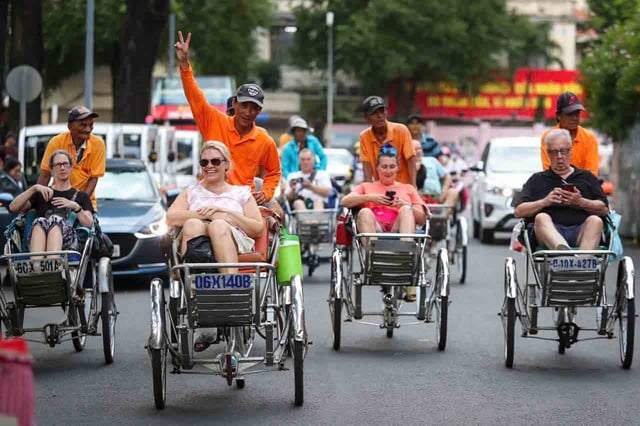
A cyclo tour around Ho Chi Minh City is an experience you can't miss.
PHOTO: NHAT THINH
A Korean couple had just landed at Tan Son Nhat Airport after a flight from Seoul. They chose a small boutique hotel on Pasteur Street, where the view from the window was of lush greenery and bustling motorbikes. Their first breakfast was a steaming bowl of pho, which surprised them with its rich flavor, quite different from Vietnamese restaurants in Korea. The young couple visited the City Post Office , Notre Dame Cathedral, and then leisurely walked to the book street...
At the Central Post Office in Ho Chi Minh City, Thuy, a Vietnam Post employee, shared that even before the peak year-end season, the number of visitors is still very high. "The busiest time is usually from around 10 am to 4-5 pm. On weekends, the stream of people coming to take pictures and send postcards is almost constant. We always have to prepare extra staff to support them," she said.
On Nguyen Hue pedestrian street, groups of international tourists lined up to take photos next to the statue of President Ho Chi Minh. The surrounding cafes and convenience stores also began to fill with customers, many of whom were foreigners choosing to sit on the patios to enjoy iced milk coffee while watching the passersby.
"I was very surprised to see how busy and lively it was here this morning. The air is fresh, there are many outdoor activities, and everyone is friendly. It feels very different from the cities I've been to in Southeast Asia," a Japanese tourist shared while taking photos.
At the War Remnants Museum (Xuan Hoa Ward) on the morning of September 12th, a long line of international tourists stretched in front of the ticket counter. Lightweight backpacks, wide-brimmed hats, and cameras slung around their necks created a familiar yet vibrant scene. English, French, Japanese, and Korean mingled in the murmuring conversations; some checked maps on their phones, while others stood silently admiring the tanks and helicopters on display in the courtyard.
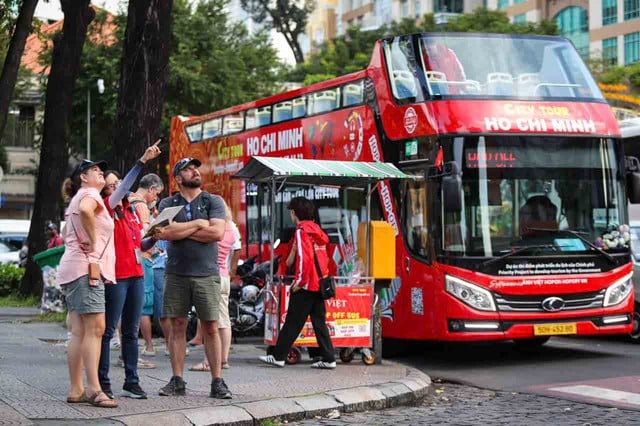
Double-decker buses are bustling with activity, and international tourists enjoy exploring the architectural landmarks in the city center.
PHOTO: NHAT THINH
Museum staff continuously guided visitors, distributed tickets, and controlled the flow of people, while behind the glass doors, streams of visitors streamed into the exhibition areas. This atmosphere of eager anticipation made many visitors feel as if they were about to embark on a journey back in time, to witness firsthand what they had only seen in books and newspapers.
David, a tourist from Canada, emerged from the ground-floor exhibition with a pensive expression, sharing: "Just seeing the exhibits on the ground floor gave me a chilling feeling because of the horrors of war. It was also fascinating to see firsthand the tools and weapons used during wartime; and to get a sense of what terrible times prisoners of war must have endured."
It's clear that the "billion-dollar" streets in Ho Chi Minh City have experienced a strong resurgence, no longer displaying "for rent" signs like they did a few years ago.
International visitors "come because of love"
Ho Chi Minh City is gradually becoming an unmissable destination on the Southeast Asian tourism map. According to the Department of Tourism, in the first eight months of 2025, the city welcomed over 5.16 million international visitors, an increase of nearly 50% compared to the same period last year. Domestic visitors reached over 25.1 million, bringing total tourism revenue to an estimated 161,887 billion VND. This is not only a strong sign of recovery but also affirms the increasingly prominent position of the tourism industry in the city's economic structure. So what keeps foreign tourists coming to Ho Chi Minh City?
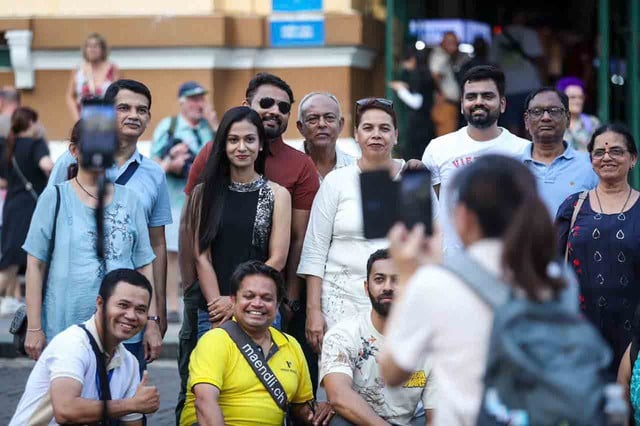
Many Indian tour groups are visiting Ho Chi Minh City during this time.
PHOTO: NHAT THINH
First and foremost is the allure of its architectural landmarks and historical heritage. The Central Post Office, Notre Dame Cathedral, the Reunification Hall, and the City Theatre always surprise visitors with how a modern city can still retain its distinctive classical charm. It is this interplay between past and present that creates its unique identity.
The cuisine is also a major plus. From steaming bowls of pho and crispy banh mi to iced milk coffee on the sidewalk, visitors can easily find unique flavors only found in this city. Many people say that the experience of sitting and eating on the sidewalk, chatting with street vendors, leaves them with unforgettable memories.
Ms. Tu Dang, owner of a Vietnamese restaurant in a small alley in Xuan Hoa Ward, shared that thanks to the Michelin-starred award for three consecutive years, the number of foreign customers visiting her restaurant has changed significantly. "Japanese, Korean, and Chinese customers come more often and spend more time sitting there. They pay attention to every detail of a Vietnamese meal: the cooking methods, the local ingredients, and even the way it's eaten. Some diners even say they feel like they're eating with a family," she said.
In addition, tourists also enjoy unique experiences such as riding a cyclo around the city, cruising on the Saigon River, or strolling along Nguyen Hue pedestrian street to immerse themselves in street music. When night falls, the city transforms with a vibrant atmosphere in Bui Vien, rooftop bars, or night markets, making Ho Chi Minh City truly resemble a "city that never sleeps".
Above all, what makes many people want to return is the hospitality and openness of the locals. A friendly smile, a young person giving directions in English is enough to make tourists feel welcome. It is the people themselves who have contributed to the enduring appeal of Ho Chi Minh City in the eyes of international friends.
The tourism boom in Ho Chi Minh City has not only brought record numbers but also sent a strong message about the vitality of the "smoke-free industry." However, behind this boom also lie pressing issues. Despite the large influx of tourists, the average spending of international visitors in Vietnam remains around $1,200 per trip, significantly lower than Thailand, Malaysia, or Singapore. Transportation infrastructure in the city center is often overloaded, and high-end entertainment and shopping services are not yet sufficient to retain visitors for longer periods.
Dr. Pham Huong Trang, a lecturer in Tourism and Hotel Management at RMIT University, noted: It is necessary to diversify products and strongly develop high-value tourism such as MICE tourism, medical tourism, shopping, high-end cuisine, as well as invest in nighttime services to increase spending. If done well, Ho Chi Minh City can absolutely become an international tourism hub, directly competing with leading cities in the region.
With its superior economic scale, infrastructure, and human resources, the expanded Ho Chi Minh City could certainly become a model for other localities to emulate. From developing night tourism and organizing international events to building regional tourism product chains and professional management mechanisms, everything can be replicated. More importantly, this "megacity" also creates positive pressure, forcing other localities to innovate and upgrade their tourism services and products to compete.
Dr. Pham Huong Trang , RMIT University
Source: https://thanhnien.vn/nhon-nhip-khach-quoc-te-o-trung-tam-tphcm-185250912183432072.htm

































































Comment (0)