


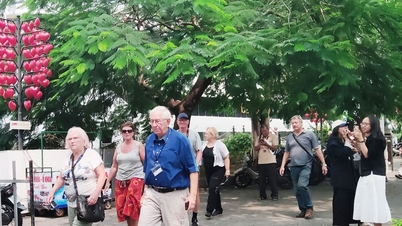
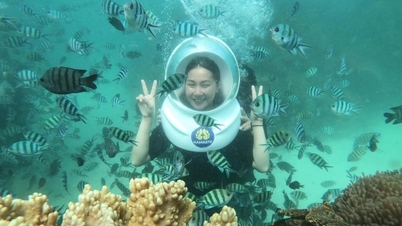
Tourists visiting Con Chim Island (Vinh Long) - Photo: THANH TRI
Many international tourists visiting Vietnam are willing to spend on food, experiences, and sightseeing, but are quite reserved when it comes to shopping.
According to experts, it is time for Vietnam's tourism industry in general, and related service businesses in particular, to improve the quality of services and experiences, avoiding the situation where tourists bring a lot of money but don't know where to spend it.
Look more than you buy, only purchase low-value items.
Speaking to Tuổi Trẻ newspaper , the director of a tourism business acknowledged that Vietnam attracts many tourists, but spending on goods, especially technology products, remains quite modest. This is due to the lack of distinctive features, sophistication, and compelling stories to enhance the value of the products. Even high-value technology products sold in Vietnam struggle to convince tourists to "spend their money."
Meanwhile, in many markets such as Singapore, Hong Kong, Japan, and the US, tourism combined with shopping for electronic devices is very popular thanks to preferential taxes, competitive prices, and transparent product sources. According to Ms. Nguyen Thi Anh Hong, Director of E-commerce at the 24hStore retail system, a common barrier comes from the mentality of "browsing, not buying on the spot."
"Tourists, especially from Europe, America, Australia, etc., tend to carefully check prices before their trip and compare prices in Vietnam, their home country, and duty-free shops. For high-value products like phones, laptops, or Apple Watches, the price difference isn't large enough to create immediate appeal," Ms. Hong said.
According to Ms. Hong, many tourists also wonder whether products purchased in Vietnam will be covered by warranty in their home country, and whether they will encounter complications with return procedures, international invoices, taxes, etc. Therefore, tourists still mainly buy low-value products such as accessories, used devices, or items for travel purposes, rather than being ready to spend money on high-value technology items.
Meanwhile, according to Mr. Pham Quy Huy, Director of Kiwi Travel Company, the main reason why tourists haven't spent much lies in the quality and class of the products themselves. Many items only reach the budget segment, not attractive enough to serve the middle and high-class groups, who are able and willing to spend more.
Typically, when visiting the Mekong Delta, tourists mainly eat, stroll around, and buy a few simple souvenirs such as conical hats costing 20,000-30,000 VND or other mass-produced, cheap products. This situation only provides immediate income for local people during peak season, but does not create long-term sustainable value for the tourism industry.
"Many products are still rudimentary, low-priced, lacking design and branding narratives, and not yet capable of touching the emotions of customers," Mr. Huy said, adding that to encourage tourists to spend more, Vietnam needs to start by elevating the quality of its local products. Only when products are refined and have a clear cultural story can Vietnam increase spending accordingly.
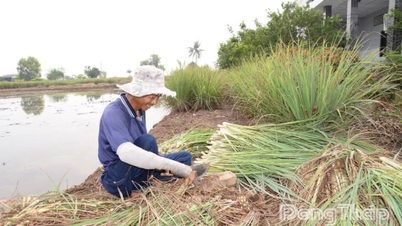
For example, instead of spreading resources too thin, focus should be placed on items that reflect local identity, especially handicrafts made from sedge, lotus, water hyacinth, etc., which are popular with international tourists. "You have to accept the long-term strategy to attract customers; otherwise, you'll have many customers but little profit," Mr. Huy emphasized.
Airports should be "money-making attractions" for tourists.
Speaking to Tuoi Tre newspaper , many airlines said that the continuous opening of new routes, increased frequency, and service competition have significantly improved the number of international tourists visiting Vietnam. However, efforts from airlines alone are not enough to retain tourists and increase their spending.
Surveys reveal that major airports have yet to fulfill their role as true "destinations." Duty-free zones lack diverse brands, offer few unique products, and have uncompetitive prices. Food and beverage services, lounges, spas, entertainment areas, and cultural experience spaces are limited. Cumbersome tax refund procedures also discourage passengers from making significant purchases.
Meanwhile, regional airports such as Changi (Singapore) and Incheon (South Korea) have developed into "airport cities," where travelers can shop, entertain, relax, and sightsee right within the airport. This is also why transit passengers at these airports spend many times more than in Vietnam.
A representative from an airline stated that upon launching the route from India to Tan Son Nhat Airport, the airline observed a very high demand from Indian passengers for connecting flights to third countries.
In fact, more than half of Indian tourists who come to Vietnam do so to connect to Bali, Thailand, Japan, or South Korea. "If we tap into the right timing, connecting to a third destination will create new experiences and increase tourists' spending on services," he said.
A representative from Tan Son Nhat Aviation Services Joint Stock Company (SASCO) stated that they have added Indian dishes to their menu, adjusted it, and redesigned the space to accommodate this influx of tourists. According to this representative, to increase spending by international tourists, the entire airport ecosystem must be upgraded, transforming the airport from a place to "pass through" into a true destination. The service system also needs to be expanded and modernized, from shopping and dining areas to entertainment spaces and high-end services.
Businesses have proposed several solutions, such as developing an "airport city" model, diversifying duty-free and F&B options, and creating cultural experience spaces within the airport. They also suggest implementing special offers for transit passengers, such as flight-based vouchers, discounts on food and beverage, or lounge services. Importantly, the tax refund process needs to be digitized to shorten processing times and encourage travelers to spend more.
Furthermore, improving transportation connections from the airport to the city center via metro, high-quality buses, or ride-hailing services is also essential. "A smooth experience from the moment you land at the airport until you travel into the city is crucial for encouraging guests to stay longer and spend more," this person emphasized.
According to many tourism experts, the Indian market is clear evidence of its still enormous potential. "If Vietnam can meet the right needs in terms of cuisine, culture, and convenience, it can absolutely become an attractive transit point for Indian tourists in the region," this expert stated.
There is a shortage of shopping malls that meet international standards.
According to many experts, on the global tourism map, shopping for designer brands, luxury fashion , jewelry, watches, high-end cosmetics, etc., is always considered a "magnet" attracting tourists to countries such as Singapore, Japan, South Korea, France, Italy, the UK, and the US.
These destinations are attractive thanks to their internationally standardized shopping malls, rich ecosystem of luxury brands, convenient tax refund policies, and high-class shopping experiences. "Therefore, Vietnam needs to address the shortage of internationally standardized shopping malls, as well as the inconveniences in tax refund policies for tourists," suggested an expert.
Furthermore, tourism businesses argue that the planning of the night-time economy needs to be systematic and distinctly characteristic, rather than just remaining a street-side economic model. Vietnamese people may stay out drinking until late and spend a considerable amount of money, but international tourists usually only have one bottle of beer, a light meal, and then leave. "Without sufficiently attractive products, it's very difficult to get tourists to 'open their wallets' when in Vietnam," one business asserted.
We need to reach the middle-class and high-end tourist groups.
Despite a significant increase in international visitors to Vietnam, spending levels have not kept pace. New data from the Yango Ads platform shows that Vietnam is attracting more tourists from Russia, Kazakhstan, Belarus, Georgia, Eastern Europe, the CIS, and Southeast Asia due to its favorable climate, reasonable costs, convenient flights, diverse cultural attractions, and easy visa procedures.
This group of tourists particularly favors beach resorts (80%), followed by nature tourism (46%) and cultural tourism (43.2%). Half travel with family and 62% stay for up to two weeks, indicating high spending potential, but the actual amount spent is not commensurate, largely because Vietnamese services have not yet attracted tourists to open their wallets. According to experts at Yangon Ads, to convert a large number of tourists into real revenue, Vietnamese businesses need to change their approach to the market.
Specifically, by launching seasonal campaigns early, optimizing digital tools and multi-channel advertising content, tourism and travel businesses can penetrate deeper into the mid-range and high-end segments—groups willing to pay for well-designed experiences, from guided tours to luxurious homestays. Half of tourists are persuaded by personalized advertising, so businesses need to leverage digital advertising tools to offer flexible deals and suitable service packages.
Vietnam-Thailand flight routes are heating up during the SEA Games season.
The 33rd SEA Games in Thailand are creating a vibrant atmosphere on international flights as the number of Vietnamese tourists traveling to Bangkok has increased sharply in the weeks leading up to the opening ceremony.
Reports from airlines and travel companies indicate that demand for flights to Thailand to attend sporting events, especially the U22 men's football tournament, is 40-60% higher than the same period last year. According to booking systems, airfares from Ho Chi Minh City and Hanoi to Bangkok during peak periods range from 1.3-2.7 million VND for a one-way ticket, with round-trip tickets commonly costing 3.5-5 million VND.

Passengers check in for international flights at Tan Son Nhat International Airport - Photo: QUANG DINH
Flights between Vietnam and Thailand are currently operating with a frequency of more than 20 flights per day from Ho Chi Minh City, Hanoi, and Da Nang to Bangkok. Airlines such as Vietnam Airlines, Vietjet, Thai Airways, and Thai AirAsia report that many flights on important competition days have seen an increase compared to normal times.
To meet the high demand, Mr. Dang Anh Tuan, Deputy General Director of Vietnam Airlines, said that the airline will increase capacity during peak hours and deploy wide-body aircraft on some routes. The airline will also continue to serve as the official carrier for the Vietnamese sports delegation at the 33rd SEA Games and the 13th ASEAN Para Games, providing 3 tons of free baggage allowance for the athletes, arranging priority check-in counters, and increasing support staff at the airport.
In the tourism market, SEA Games tours are consistently fully booked. Many travel companies report that 3-4 day Bangkok-Pattaya tours have doubled in number compared to the same period last year. Tours combining watching sporting events, city tours, and shopping are popular due to their reasonable cost and flexible itineraries.
One product attracting significant interest is the 5-day, 4-night Bangkok - Pattaya tour, flying with Vietnam Airlines, departing on December 17th, priced at 11.9 million VND per person, including tickets to the U22 men's football final. A representative from the company stated that many groups of young people, families, and fan clubs booked the package early to "experience the full SEA Games." According to the travel company, regular tour packages are selling poorly, but those bundled with football final tickets are booming.
The 33rd SEA Games took place from December 9th to 20th, with over 1,000 Vietnamese athletes competing in 38 out of 54 sports. Experts believe that this largest sporting event in the region will not only create a short-term boost but also maintain the growth momentum of Vietnam-Thailand tourism during the peak season at the end of the year.
Source: https://tuoitre.vn/du-khach-den-viet-nam-chi-tien-an-uong-tham-quan-nhung-mua-sam-de-dat-vi-thieu-thu-hay-de-mua-2025121123493553.htm
![[Photo] Closing Ceremony of the 10th Session of the 15th National Assembly](/_next/image?url=https%3A%2F%2Fvphoto.vietnam.vn%2Fthumb%2F1200x675%2Fvietnam%2Fresource%2FIMAGE%2F2025%2F12%2F11%2F1765448959967_image-1437-jpg.webp&w=3840&q=75)


![[Photo] Prime Minister Pham Minh Chinh holds a phone call with the CEO of Russia's Rosatom Corporation.](/_next/image?url=https%3A%2F%2Fvphoto.vietnam.vn%2Fthumb%2F1200x675%2Fvietnam%2Fresource%2FIMAGE%2F2025%2F12%2F11%2F1765464552365_dsc-5295-jpg.webp&w=3840&q=75)































































Comment (0)