TP - Underwater archaeologist Mensun Bound recounts some extraordinary relics he witnessed firsthand, described in detail in his new book, "Wonders of the Deep," which he co-authored.
 |
| Mensun Bound, co-author of the ocean archaeology book "Wonders of the Deep" |
Mensun Bound, who led the team that discovered Ernest Shackleton's ship, the Endurance, rewrote world maritime history through the shipwrecks he found throughout his career.
Mr. Bound revealed some of the most important and extraordinary items ever recovered from the seabed.
The cannon in the Battle of Trafalgar
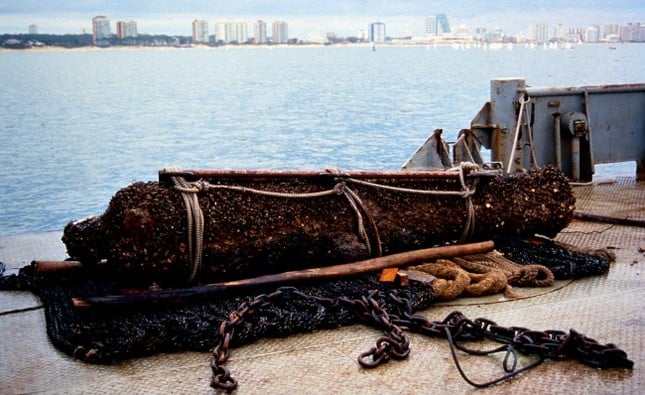 |
| The cannon of HMS Agamemnon |
HMS Agamemnon was the first and favorite ship of Admiral Horatio Nelson, the commander who helped the British Empire defeat Napoleon's army at the Battle of Trafalgar in 1805. “It was on this ship that Nelson first fought the French and also where he met the love of his life, Lady Hamilton,” Bound said.
Besides the Battle of Trafalgar, the ship was also used in the American and then the French Wars of Independence. Later, the ship ran aground off the coast of Uruguay while pursuing a French fleet and eventually became stuck in a mudflat. “They saved all the cannons except one – and the records even have a very clear description of how they accidentally dropped one into the water.”
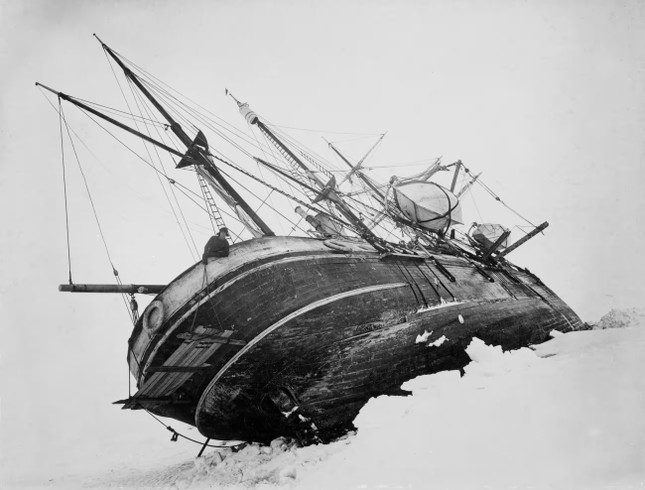 |
| The Endurance sank in October 1915. The ship was found at a depth of 3,008 meters in the Weddell Sea in March 2022. |
In 1997, he found the missing gun using sonar. “We really didn’t expect it. But it was enormous.” After stripping away the corroded casing of the cannon, he made a rare discovery : the number engraved on the gun matched records of a gun fired in the Battle of Trafalgar. Therefore, it is the only surviving cannon proven to have participated in the most famous naval battle ever fought. “That battle changed history and ended Napoleon’s dream of conquering Britain.”
The Bible from Endurance
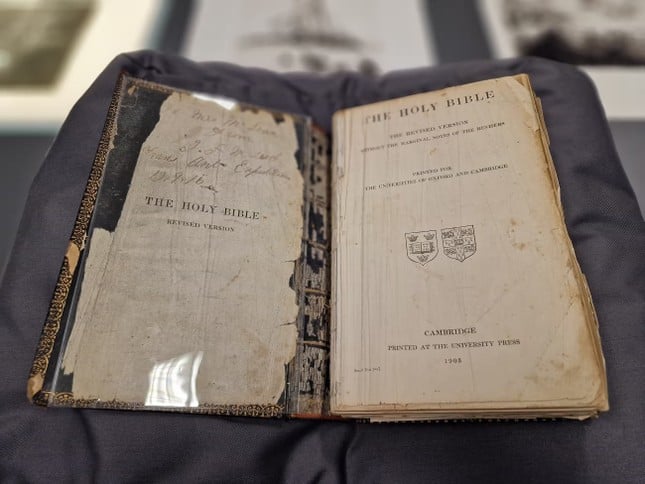 |
| The Bible of the explorer Ernest Shackleton |

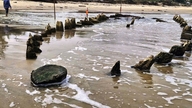
In 1914, Shackleton and his 27-member crew sailed aboard the ship Endurance to Antarctica with the goal of being the first to cross the continent. This was the final voyage of the "golden age" of Antarctic exploration.
After navigating through ice floes and encountering strong winds, the ship froze over, forcing the crew to abandon the Endurance along with most of their belongings. “To get ashore, they could only take a small amount of personal items, weighing only about 1kg,” Bound said.
Mr. Shackleton tore out some important pages from the Bible to take with him, then left the heavy book behind in the snow. “But there was a fisherman in the group named Thomas McLeod, from Scotland – a very devout man. We don’t think he could read, but he thought that leaving the Bible behind was playing with fate,” Mr. Bound said.
When no one was looking, Mr. McLeod took the Bible and hid it among his belongings. Ultimately, Mr. McLeod was saved, and the Bible was donated to the Royal Geographical Society in London.
Mr. Bound still finds it “amazing” that all 28 members of the crew survived the shipwreck, as did the Bible. “That was almost impossible,” he said.
Bronze helmet
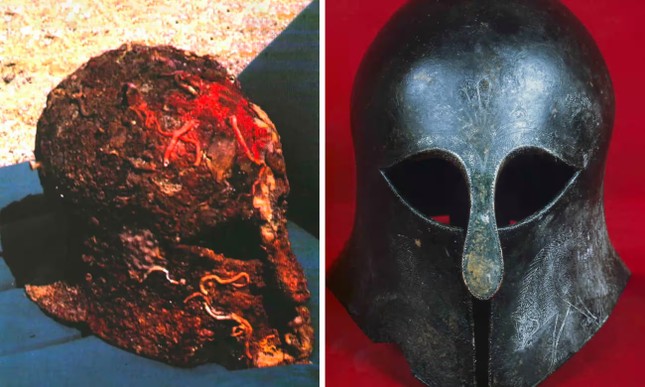 |
| Giglio's helmet, before and after restoration. |
In 1961, a German diver discovered a shipwreck off the coast of the Italian island of Giglio. One of the artifacts recovered was a Greek bronze helmet dating from around 600 BC, when the Etruscan empire was at its peak. “It was crafted with exceptional skill, which we cannot replicate today,” said Bound.
The helmet features images of wild boars and fanged vipers, depicted “with incredibly fine detail. This bronze helmet is one of the finest examples of this period,” he said. Bound sees it as a manifestation of ancient technology. “It’s a true war artifact – anyone who possessed it was sending a signal that they were important, wealthy, and powerful,” he said.
Mr. Bound was one of the few experts to have seen the helmet firsthand. The helmet was shown to him by a German diver in the 1980s, a few years before the diver's death. Since then, no one knows what happened to the helmet, although the Italian government is still searching for information about it.
Gold from a Portuguese merchant ship
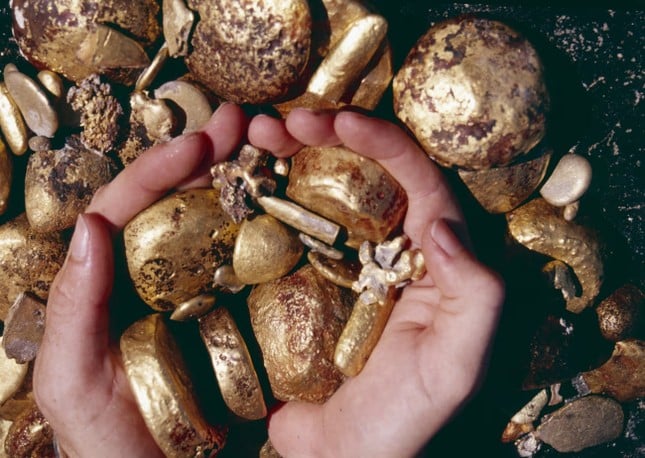 |
| Gold has been discovered in the wreck of the Spanish ship. |



In 1554, the Espaarte, a Portuguese sailing ship, was returning from a voyage to India when its mast broke and it sank near Fort Saint Sebastian on the island of Mozambique. “Portugal was an incredible seafaring nation and they lost many ships along the way,” Bound said.
In 2001, he discovered what was believed to be the Espaarte while surveying the seabed of a canal in front of the fort. The treasures they found near the shipwreck included spices, conch shells (once used as currency in some parts of Africa), 16th-century Ming Dynasty porcelain, and about 50kg of pure gold.
"I've found gold before, but never in this quantity – large gold bars, as well as gold chains and jewelry," Bound said.
There is no evidence that the ship was carrying slaves. Instead, Bound suggests that the gold on board was part of the burgeoning sea trade in spices, silk, pottery, and lacquerware.
“Gold played a key role in expanding international trade (it was the international currency at the time), and the Portuguese were among the first Europeans to travel across Africa. They were trying to find the Maritime Silk Road.” It’s possible the Portuguese cleverly traded gold for silver in the East, where silver was more valuable than gold. “We don’t know for sure. But that gold must have been incredibly powerful. Surely someone suffered a great loss when this ship sank.”
Source: https://tienphong.vn/nhung-kho-bau-duoi-day-dai-duong-post1677447.tpo