Dr. Trinh Hoang Kim Tu has 29 scientific articles published in international journals (of which she is the main author of 14 articles), 4 scientific articles published in domestic journals, and participates in many volunteer activities for the community...
Bringing her infant child, just a few months old, along to receive the 2023 Golden Globe Award for Outstanding Young Scientists, Dr. Trinh Hoang Kim Tu was happy to fulfill her role as a woman while also being honored for her research achievements.
To help more patients
Dreaming of becoming a doctor since childhood to treat her parents' illnesses, Dr. Trinh Hoang Kim Tu (currently 35 years old) dedicated herself wholeheartedly to her studies. While studying general medicine at the University of Medicine and Pharmacy in Ho Chi Minh City, during her time assisting with research projects, Dr. Tu noticed that some patients were successfully treated, but many others were unsuccessful. Why? Dr. Tu began to explore the question, and the young student realized that patients have different characteristics – risk factors that make their condition worse, factors we haven't yet identified.
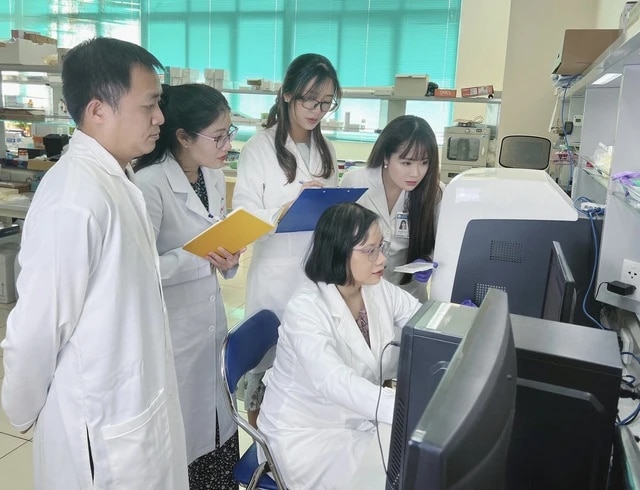
Dr. Trinh Hoang Kim Tu (seated) is passionate about research topics related to food allergies...
NVCC
"To know exactly who has risk factors, we need to understand how the disease mechanism affects each individual, and the only way is to conduct more in-depth research," the female doctor expressed. So, after graduating from university and working for a while, Ms. Tú went to South Korea to pursue a combined master's and doctoral program at the Department of Clinical Allergy and Immunology, Ajou University Hospital (South Korea). Recalling her journey into the field of allergy and immunology, the female doctor said: "While I was a student, I followed an associate professor at the university to learn how to conduct research on respiratory diseases, which include allergy and immunology. At that time, this was a very new field, research facilities were lacking, and my own knowledge was limited, so I was determined to study it and began to like research more because it could help many patients, instead of just treating one person at a time." The project that Dr. Tú was most proud of while a graduate student in South Korea was her research on late-onset asthma in older adults. Through her research, she discovered the substance OPN (Osteopontin). Elevated levels of this substance indicate a higher risk of asthma in older adults. Therefore, it has the potential to be used to predict the onset of asthma in older adults.
...and we hope to help allergy patients in Vietnam receive treatment similar to that in other parts of the world.
NVCC
In 2020, upon returning to Vietnam, Dr. Tu took a job at the Center for Molecular Biomedicine, University of Medicine and Pharmacy, Ho Chi Minh City. There, the university assigned her the task of establishing a clinical allergy and immunology research group, and she became the group leader. The young doctor said that in Korea, asthma is a major concern, but for Vietnamese people, allergies (food, medication) and atopic dermatitis are more important; therefore, upon returning to Vietnam, she shifted her research focus. This is also the topic that helped Dr. Tu win the Golden Globe Award in 2023. Dr. Tu recounted: "Initially, I read some literature and found that Vietnamese people eat a lot of seafood, so the rate of reported allergies is very high. Some allergy patients have mild symptoms, but there are also severe cases such as anaphylaxis. My question was how to better diagnose and manage people with food allergies. And my research will find an effective way to solve this problem." To accurately diagnose seafood allergies, the young female doctor said that three techniques should be used: skin prick test, cell activation assessment, and molecular allergen testing. More specifically, Dr. Tú shared: "Previously, the skin prick test used to test for allergies by applying the allergen to the patient's hand. However, in Vietnam, we cannot import allergens, so we brought the allergen generation technique from Korea. This means we extract the allergens from Vietnamese seafood ourselves and then use them to test patients." With this technique, we don't have to depend on foreign allergen sources, the cost is lower, and it's more suitable for Vietnamese people. "My research aims to isolate and produce allergens that are suitable and specific to Vietnamese people, and to develop in vitro testing techniques that increase the accuracy in diagnosing and predicting allergies and the risk of adverse reactions in patients to each type of food consumed. This will help reduce severe reactions in patients," the female doctor shared passionately.
Overcoming the fear of mice to do research.
Achieving success in allergy research was a long process of hard work and proactive acquisition of knowledge and skills by Ms. Tú while she was in South Korea. Ms. Tú recounted: "While in South Korea, I also worked on research topics about food allergies and drug allergies, but only as a side project. So, after completing a research project, I would ask my professor for additional clinical experience to observe patients with food and drug allergies. Usually, the lab would start at 8 a.m., but I would be in the department by 6 a.m. to accompany my professor to the emergency room, observing how doctors there diagnosed patients and taking notes on those techniques." Even when talking about her research, Ms. Tú was very witty. This seemed to be her way of relaxing and unwinding after hours of intense research. Recalling the difficulties, Ms. Tú couldn't help but share a humorous anecdote about the times she threw away the mouse she was holding during experiments because of her fear of these animals. Ms. Tú said: "Looking back, it's really funny. Because I used to be very afraid of mice, but to conduct research, I had to handle, play with, and experiment on these animals. There were times when I was holding one in my hand, and the mouse squirmed, so I threw it away (laughs )."
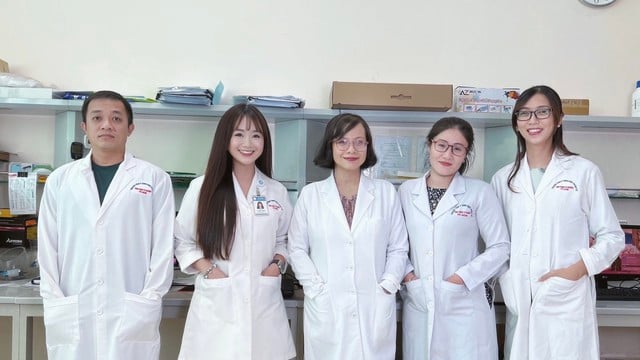
Ms. Tú is working with the clinical immunology and allergy research team at the Center for Molecular Biomedicine, University of Medicine and Pharmacy, Ho Chi Minh City.
NVCC
Being a doctor with no prior research experience and no knowledge of laboratory work, Dr. Tú faced many challenges when she went to South Korea. "The first few days were very difficult; there were times I wanted to give up and go back home. The challenge at that time was learning laboratory techniques in a relatively short period. People usually study those techniques for years, but I only had a short time to learn and then immediately put them into practice. When I first started experimenting, I failed constantly, so I had to learn on my own why things went wrong and explain the reasons to the professor to ask for permission to redo the experiment," the young doctor recalled. After years of dedicated research, Ms. Tú is happy to be on the right path: "I am striving to help ensure that the rights of Vietnamese patients are on par with those around the world. Abroad, an allergy patient will undergo about five tests for diagnosis and then receive treatment. In Vietnam, however, the situation is reversed; there is a lack of allergen sources, or if patients don't go to the right specialist, sometimes they are only given a medical history and then diagnosed, and the treatment is not effective. I sincerely hope that what I do, however small, will provide patients with a more rational diagnostic method and better disease control." Currently, Ms. Tú is both teaching and conducting research, as well as examining and treating allergies and immunology. She is happy to have established a research group specializing in allergies and immunology, and this is also one of the first groups following a clinical-laboratory collaboration model at the University of Medicine and Pharmacy in Ho Chi Minh City.






























![[Photo] Prime Minister Pham Minh Chinh holds a phone call with the CEO of Russia's Rosatom Corporation.](/_next/image?url=https%3A%2F%2Fvphoto.vietnam.vn%2Fthumb%2F1200x675%2Fvietnam%2Fresource%2FIMAGE%2F2025%2F12%2F11%2F1765464552365_dsc-5295-jpg.webp&w=3840&q=75)














































Comment (0)