

With 15 eggs stored, Ms. Thanh no longer worries about getting older and plans to return to Vietnam in a few years to have children.
At the end of April, Ms. Thanh, 39 years old, a Vietnamese expatriate living in Australia, came to the In Vitro Fertilization Center at Tam Anh General Hospital in Ho Chi Minh City (IVFTA-HCMC) to freeze her eggs.
Originally from Ba Ria - Vung Tau province, Thanh moved to Australia nine years ago to live and work as an administrative assistant at a university. She married a colleague, but their marriage ended after five years without children. For many years, she has not remarried, focusing solely on her work.
Intending to have a child and become a single mother, Ms. Thanh researched in-vitro fertilization (IVF), but the cost of this method in Australia is quite expensive, around 500 million VND per treatment cycle. Seeing a colleague who only conceived after the third cycle of IVF treatment, she became disillusioned because it was beyond her financial means.
"I was worried because I was almost 40, and if I continued to delay having children, my ovaries would be depleted. After researching many places, I found that the cost of egg freezing and IVF in Vietnam is only one-fifth of that in Australia, while the level of expertise and technology is comparable. I decided to return to Vietnam to freeze my eggs," Ms. Thanh said.
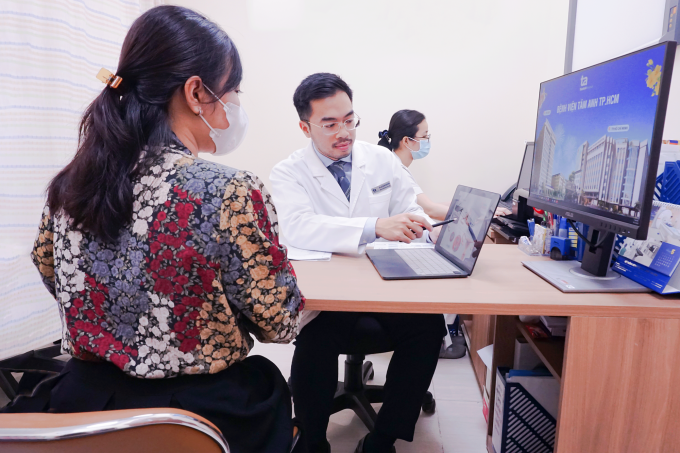
Dr. Le Xuan Nguyen examines and advises patients on egg freezing to preserve their ability to have children at IVFTA-HCMC. Photo: Hoai Thuong
Doctors successfully extracted 15 mature eggs and froze them for the woman. With this "savings," Ms. Thanh confidently returned to Australia to continue working, preparing financially for her return to Vietnam three years later to undergo IVF treatment, give birth, and raise a child.
According to Doctor Le Xuan Nguyen, the best age for women to conceive and give birth is between 20 and 30 years old. This is the period when the number and quality of eggs are at their peak, making pregnancy and childbirth easier. Over time, a woman's ovaries will gradually age, declining in both quantity and quality.
After age 40, women have difficulty conceiving naturally due to ovarian decline and an increased risk of chromosomal abnormalities that can cause birth defects. During perimenopause and menopause, the ovaries are completely depleted, leaving women with almost no fertility.
Before ovarian failure occurs, egg freezing allows women to preserve their fertility. Eggs are extracted from the ovaries, frozen, and stored at -196°C in liquid nitrogen, ensuring optimal quality until use. When women wish to have children, the eggs are thawed, fertilized in vitro with sperm to create embryos, and implanted into the uterus, leading to successful pregnancies and healthy births while reducing the risk of chromosomal abnormalities.
According to Dr. Nguyen, this method is increasingly attracting the attention and adoption of many women, especially older women who have not yet had children, and those who are focusing on their careers and have not yet determined a specific time to have children. Observations at IVFTA-HCMC show that in the past two months, the rate of women using social egg freezing has increased by approximately 20% compared to before.
Currently, the center employs two egg freezing methods: slow freezing and vitrification. The vitrification technique using the Cryotop method increases the success rate of egg freezing compared to the conventional slow freezing method.
Hoai Thuong
*Character names have been changed
Source link


























![[Photo] Prime Minister Pham Minh Chinh holds a phone call with the CEO of Russia's Rosatom Corporation.](/_next/image?url=https%3A%2F%2Fvphoto.vietnam.vn%2Fthumb%2F1200x675%2Fvietnam%2Fresource%2FIMAGE%2F2025%2F12%2F11%2F1765464552365_dsc-5295-jpg.webp&w=3840&q=75)














































Comment (0)