

In 2019, while watching television by chance, Mr. Thi, a farmer from Tang Tien Ward, Viet Yen town, Bac Giang province, saw a model of lotus cultivation combined with fish farming that yielded high economic efficiency.
Mr. Thi came up with the idea of bringing lotus plants to grow on his family's 3.5-hectare rice paddy where they were raising fish. He put his idea into action, buying lotus seeds and traveling to many places to learn about growing lotus in combination with raising freshwater fish.
Starting with 3.5 hectares of fish farming combined with lotus cultivation, Mr. Thi's family has now expanded the scale of their operation to 7 hectares, yielding high economic efficiency.
Lotus is an easy plant to grow, requiring little care; the only initial cost is for planting, after which you only need to fertilize to harvest.
At the beginning of the lotus season, lotus seeds cost around 40,000-50,000 VND/kg, while lotus flowers and young lotus pods cost 20,000-30,000 VND per bundle of 10 flowers.
Each hectare of lotus cultivation yields over 2 tons of seeds, and in addition, fish farming combined with lotus cultivation produces approximately 7-8 tons of fish per hectare annually.
With an income of 120-150 million VND/hectare, growing lotus combined with fish farming on rice fields has brought economic efficiency five times higher than conventional rice cultivation for Mr. Thi's family.
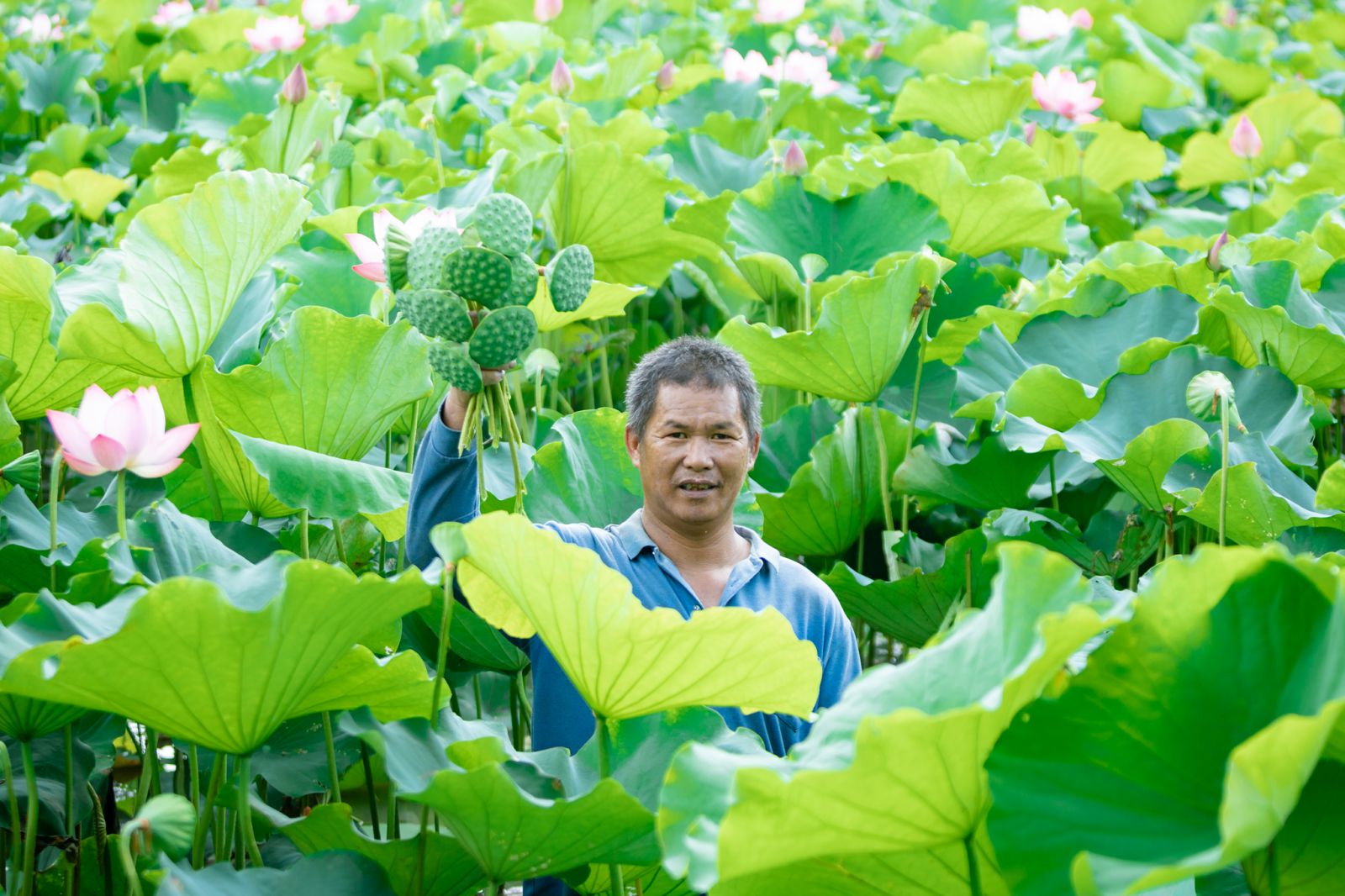
The lotus pond of Mr. Do Van Thi's family, a farmer in residential area 7, Tang Tien Ward, Viet Yen town, Bac Giang province, is entering the lotus flower and seed pod harvesting season. From a model of growing lotus combined with raising freshwater fish, Mr. Thi has earned hundreds of millions of dong each year.
To ensure a consistent and abundant lotus harvest, farmers need to pay attention to planting lotus at the right time. Lotus is grown once a year, starting in February and ready for harvest after 4-6 months.
During the care process, special attention should also be paid to removing diseased and unproductive leaves to reduce the amount of fertilizer needed and to concentrate nutrients on the development of the lotus flowers and seed pods.
Harvesting also requires timing carefully, depending on the demand for flowers, young bud, or mature seeds. This ensures that the flowers are harvested at the right time and distributed evenly across the lotus pond.
Mr. Do Van Thi shared: "When caring for lotus plants while raising fish, it's necessary to pay attention to the leaf-eating insects that appear from February after the lotus plants sprout new leaves and before the leaves reach high above the water surface, lasting for about two months."
To eradicate this pest, farmers must pay special attention and absolutely avoid using pesticides to spray on lotus plants, as this will harm the fish. If they want to eliminate it, they can use manual methods, catching the lotus leaf-eating caterpillars by hand.
In addition, local authorities, together with technical transfer units such as the Viet Yen Town Agricultural Technical Service Center and agricultural extension officers in Viet Yen Town (Bac Giang province), have strengthened the application of science and technology in production.
The center and local authorities encouraging people to grow lotus in combination with fish farming need to be cautious during implementation, and must have a firm grasp of the techniques for planting and caring for lotus plants as well as caring for the fish raised in the lotus pond.
"Currently, Viet Yen town has nearly 50 hectares of various types of lotus cultivation, concentrated mainly in the communes of Tang Tien ward and Quang Chau ward."
The area for lotus cultivation combined with fish farming is approximately 10 hectares. The fish raised in the pond are usually surface-dwelling species such as grass carp and common carp. Because the water level is shallow and the stocking density is low, the fish yield in the lotus pond is not as high as in conventional ponds and lakes.
However, combining fish farming with lotus cultivation has helped people increase the economic value per unit area of land,” shared Ms. Nguyen Thi Hue, agricultural officer of Tang Tien residential area, Viet Yen town, Bac Giang province.
The cultivation of lotus on less productive rice paddies has brought a new, green, clean, and beautiful look to the countryside in Viet Yen town.
It can be said that the lotus cultivation and freshwater fish farming model is a new direction that not only develops the household economy but also opens up many prospects towards an ecotourism model. Currently, people in the area are interested and plan to expand the model in the future.
Source: https://danviet.vn/nuoi-ca-dong-duoi-dam-sen-tot-um-he-be-hoa-bat-ca-len-la-ong-nong-dan-bac-giang-ban-het-veo-20240717200021127.htm
![[Photo] Closing Ceremony of the 10th Session of the 15th National Assembly](/_next/image?url=https%3A%2F%2Fvphoto.vietnam.vn%2Fthumb%2F1200x675%2Fvietnam%2Fresource%2FIMAGE%2F2025%2F12%2F11%2F1765448959967_image-1437-jpg.webp&w=3840&q=75)
![[Photo] Prime Minister Pham Minh Chinh holds a phone call with the CEO of Russia's Rosatom Corporation.](/_next/image?url=https%3A%2F%2Fvphoto.vietnam.vn%2Fthumb%2F1200x675%2Fvietnam%2Fresource%2FIMAGE%2F2025%2F12%2F11%2F1765464552365_dsc-5295-jpg.webp&w=3840&q=75)












































![[OFFICIAL] MISA GROUP ANNOUNCES ITS PIONEERING BRAND POSITIONING IN BUILDING AGENTIC AI FOR BUSINESSES, HOUSEHOLDS, AND THE GOVERNMENT](https://vphoto.vietnam.vn/thumb/402x226/vietnam/resource/IMAGE/2025/12/11/1765444754256_agentic-ai_postfb-scaled.png)










































Comment (0)