

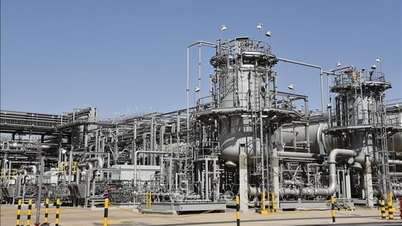
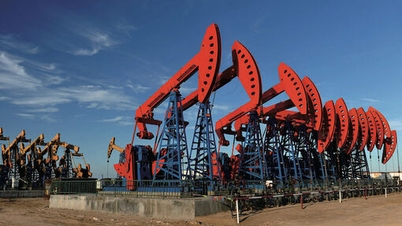
An oil facility of Saudi Arabia's national oil company Aramco. Photo: globalenergyprize.org/TTXVN
The decision was made in a series of online meetings on November 30, including a biennial ministerial meeting, to assess the global market situation and the world economic outlook. The eight OPEC+ countries also held a separate meeting on the same day and agreed to continue to suspend production increases in the first quarter of 2026, after pumping an additional 2.9 million barrels per day into the market since April 2025.
In November 2025, OPEC+ - the alliance that supplies half of the world 's oil - paused production increases in the first quarter of 2026 due to seasonal demand weakness. In a statement after the meetings, OPEC+ reaffirmed the previously agreed common production levels of OPEC and non-OPEC countries until December 31, 2026. OPEC+ also approved a mechanism to assess the maximum sustainable production capacity of member countries as a reference basis to determine production in 2027.
OPEC+ is maintaining production cuts of about 3.24 million barrels per day, equivalent to about 3% of global demand. At the meetings on November 30, OPEC+ agreed to keep these cuts unchanged, including 2 million barrels per day until the end of 2026. OPEC+ is gradually phasing out voluntary cuts of 1.65 million barrels per day, announced in April 2023. OPEC+ also approved a decision to add about 137,000 barrels per day in the months of the fourth quarter of 2025. The OPEC+ statement called on all countries in the alliance to comply with production quotas. OPEC+ is scheduled to hold its next ministerial meeting on June 7, 2026.
The oil market will remain volatile in 2025 due to geopolitical tensions, US President Donald Trump's tariff policies and OPEC+ production cuts. The US Federal Reserve's decision to cut interest rates, as well as US sanctions against Russian oil companies such as Lukoil and Rosneft, have also affected oil prices. Oil prices fell over the past week as the US stepped up efforts to end the Russia-Ukraine conflict and reintegrate Russia into the global economy by lifting sanctions. Brent crude fell 0.78% to $62.38 a barrel, while WTI crude fell 0.17% to $58.55 a barrel.
The Russia-Ukraine conflict, which began more than three years ago, has pushed oil prices up on concerns about a drop in Russian crude supplies as Moscow’s oil industry comes under Western sanctions. If sanctions against Russia end, Russian oil is expected to enter the global market, which is expected to depress oil prices. However, a prolonged conflict is expected to continue to support oil prices.
The market is also facing concerns about oversupply as OPEC+ increases production. At the recent Adipec energy conference in Abu Dhabi (United Arab Emirates), traders predicted that the surplus could reach 2 million barrels/day by 2026. In November 2025, Mr. Torbjorn Tornqvist, CEO of commodity trading company Gunvor Group, said that US and European Union (EU) sanctions on Russia's oil industry are preventing a global oversupply.
However, UAE Minister of Energy and Infrastructure Suhail Al Mazrouei insisted that there was no oversupply in the global oil market. Mr. Al Mazrouei said that global oil demand remained very strong due to the boom in data centers fueled by the use of artificial intelligence (AI).
Source: https://baotintuc.vn/kinh-te/opec-nhat-tri-giu-nguyen-muc-san-luong-dau-tho-den-het-thang-122026-20251201074922216.htm


![[Photo] Cat Ba - Green island paradise](/_next/image?url=https%3A%2F%2Fvphoto.vietnam.vn%2Fthumb%2F1200x675%2Fvietnam%2Fresource%2FIMAGE%2F2025%2F12%2F04%2F1764821844074_ndo_br_1-dcbthienduongxanh638-jpg.webp&w=3840&q=75)























































































Comment (0)