


Dr. Ngo Anh Tin, Director of Can Tho Department of Science and Technology, discussed at the seminar - Photo: VGP/LS
Digital economy : The driving force for Can Tho's competitiveness upgrade
With its central position in the Mekong Delta region, Can Tho has identified digital transformation as a key task, synchronously implementing three pillars: Digital Government, Digital Economy and Digital Society. These efforts have contributed to helping the city rise 3 places in the PCI ranking in 2024, to 11th place out of 63 provinces and cities.
Along with that, Can Tho is setting a GRDP growth target of 10-10.5%/year for the 2025-2030 period; by 2030, the digital economy will account for 30% of GRDP and by 2035, it will reach 40%. In this strategy, the digital economy is considered the main driving force to help improve sustainable competitiveness.
Many indicators improve but digital infrastructure challenges remain
According to the assessment at the seminar, digital economy (DECO) is identified as one of the three main pillars of digital transformation, playing an important role as the growth driver of a modern, green and sustainable urban economy.
Reporting at the seminar, Dr. Huynh Nguyen Bao Loan, Director of the Can Tho Center for Technical Standards, Measurement and Quality, said that there is currently no complete data on the proportion of added value of KTS in Can Tho's GRDP. However, according to the Ministry of Science and Technology, in 2024 this proportion is estimated to be in the group of 10-20% of GRDP, in the average group of the whole country.
Can Tho aims to have GRDP grow by 10% or more after merging the three provinces and cities; accordingly, the proportion of KTS in 2025 is forecast to reach 20% of GRDP.
The City's information technology (IT) industry is developing well, with an average growth rate of 20-25% per year, contributing positively to the budget.

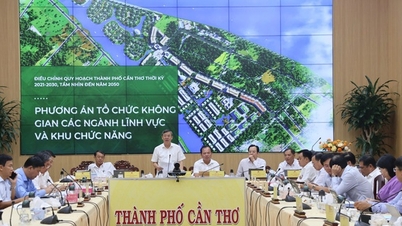
Delegates discuss at the Scientific seminar on digital economic development - Photo: VGP/LS
Can Tho's digital economy proportion: Target to increase sharply from 2025
Regarding digital enterprises, the City currently has about 670 enterprises operating in the field of IT and digital transformation, mainly small and medium-sized. Some large enterprises operating in Can Tho include: FPT Corporation with the University Branch Complex and Software Park with an area of 17 hectares, total investment capital of 2,000 billion VND , put into operation since August 2018; Can Tho University Software Technology Center with a stable growth rate; FDI enterprises such as Swiss Post Solution , Axon Active (Switzerland) , DIGI-TEXX (Germany) , IVS (Japan) .
In addition, Can Tho has built a Center for Startups and Innovation, operating a Startup Store displaying more than 110 products from 40 units, helping to connect the market and promote investment for startups.
Regarding digital payments, 100% of supermarkets, shopping malls and convenience stores have implemented cashless payments. The transaction rate at supermarkets is 35-40%, and at convenience stores is 16-20%. The “Market 4.0” model has been implemented in 43/254 markets , with the payment rate reaching 35-38% in the first 9 months of 2025.
The city is accelerating investment in the concentrated Information Technology Park, having cleared 5.3 hectares (26%). In Hau Giang (old), the 28.5-hectare Digital Technology Park with an investment capital of VND450 billion has had 9 businesses registered to operate, attracting more than 350 workers.
Dr. Bao Loan said that the added value of core KTS accounts for 87-96% of the total added value of KTS of the locality; however, Can Tho has not attracted much FDI in this field. “The locality needs to develop strong digital technology enterprises to develop digital government, digital economy and digital society,” she emphasized.
Expanding digital business ecosystem, modest FDI
Regarding the goal by 2030, Can Tho aims to become the digital transformation center of the Mekong Delta, associated with a sustainable digital economic model, applying high technology in logistics, agriculture, processing industry and trade - services.
Specific goals: The proportion of digital technology workers will reach at least 22% by 2026 and 30% by 2030 ; developing 1,000 digital technology enterprises by 2030 ; forming the Can Tho Technology - Innovation Park .
Regarding digital transformation of enterprises, the city sets the target: By 2026, 60% of small and medium enterprises will apply digital technology ; 90% of retail stores will use digital platforms ; 80% of enterprises will use electronic contracts .
By 2030, 100% of businesses will use digital platforms in business. Regarding digital payments and e-commerce, the rate of cashless transactions will reach 80% by 2026 .
E-commerce revenue accounts for 20% of total retail sales with 100% of shopping malls and 80% of food establishments implementing electronic invoices generated from cash registers by 2026.
2030 target: 1,000 digital technology enterprises and 100% of enterprises using digital platforms.
To realize the goal, a representative of the Department of Science and Technology said that Can Tho is building a specific financial mechanism and policy, focusing on three areas: Finance and investment, digital enterprise development and data assets.
Can Tho prioritizes the IT service rental model (IaaS, PaaS, SaaS) instead of spreading investment to ensure savings and flexibility. Implementation motto: "Invest once - use many times; Share - Interconnect - Connect the whole system".
The city promotes PPP in key digital infrastructure projects such as: City Cloud Infrastructure; Data Center; AI Platform; Open Data.
Along with that, the Department of Finance advises on financial incentive mechanisms to attract investment in digital infrastructure, open data and high-tech industry; at the same time, it supports loans and venture capital funds for start-up businesses.
Can Tho also continues to develop the Concentrated IT Park and Hau Giang Digital Technology Park as a center to attract AI enterprises, Data Centers, software enterprises, and cloud services.
Prioritize PPP, open data and support digital transformation of small businesses
Can Tho City is also implementing the Project on developing semiconductor and microchip technology industry by 2050, in line with the National Strategy; at the same time, actively implementing a program to support small and medium-sized enterprises (SMEs) in digital transformation.
According to the program, by 2025: 100% of SMEs will have their awareness raised about digital transformation; at least 100 businesses will be trained and consulted on digital transformation.
At the same time, the City is implementing a program to support SMEs in technology and equipment innovation until 2025, with a vision to 2030, to increase the technology content in key products and enhance the competitiveness of enterprises in integration.
Regarding e-commerce, the City promotes businesses to use electronic contracts and coordinate with major e-commerce platforms to bring OCOP products and regional specialties to digital platforms.
At the seminar, experts and businesses discussed many issues such as: Mekong Delta businesses are still slow in digital transformation; limited information security; the need to support traditional markets; human resource training requirements; and the importance of exploiting digital platforms in each field.
Le Son
Source: https://baochinhphu.vn/can-tho-thuc-day-kinh-te-so-nang-cao-nang-luc-canh-tranh-102251204182932954.htm

![[Photo] Cat Ba - Green island paradise](/_next/image?url=https%3A%2F%2Fvphoto.vietnam.vn%2Fthumb%2F1200x675%2Fvietnam%2Fresource%2FIMAGE%2F2025%2F12%2F04%2F1764821844074_ndo_br_1-dcbthienduongxanh638-jpg.webp&w=3840&q=75)










































![[VIMC 40 days of lightning speed] Da Nang Port: Unity - Lightning speed - Breakthrough to the finish line](https://vphoto.vietnam.vn/thumb/402x226/vietnam/resource/IMAGE/2025/12/04/1764833540882_cdn_4-12-25.jpeg)












































Comment (0)