

Among the ancient communal houses still existing in the Southwest region, it can be said that Binh Thuy Communal House in Can Tho is the most eye-catching, majestic and splendid architectural work.
Traveling to Can Tho, visiting Binh Thuy communal house, visitors not only admire ancient architectural art, but also have the opportunity to learn about the historical formation process of this sacred temple.
Binh Thuy Communal House was built in 1909 under the reign of King Tu Duc. This is not only a place of worship, but also a witness to important historical periods. The communal house reflects the cultural and religious life of the people of the South through many generations. Through many ups and downs, the communal house still retains the architectural features that are imbued with the identity of the land and people of the Southwest.
According to the people of the ancient village of Long Tuyen, the communal house is also known as “Long Tuyen Ancient Temple”. Since the opening of the Mekong Delta (late 17th century, early 18th century), only a few villages were formed in this vast land. Typical examples are Tan An in Can Tho canal; Thoi An in O Mon; Binh Thuy in Binh Thuy canal… The village was formed, then came the market, bridge, road and cultural and spiritual works.
In the 5th year of King Tu Duc's coronation, he conferred the title of Bon Canh Thanh Hoang (City God) on this place. Besides worshipping the god of the royal palace, the communal house also worships the tiger god, the forest god, the farmer god and national heroes. Once upon a time, the Imperial Envoy Huynh Man Dat was patrolling the Hau River when he encountered strong winds and waves. He landed here and the wind and waves were calm. He named the village Binh Thuy. Later, the villagers contributed money to repair the communal house and changed its name to Binh Thuy communal house.
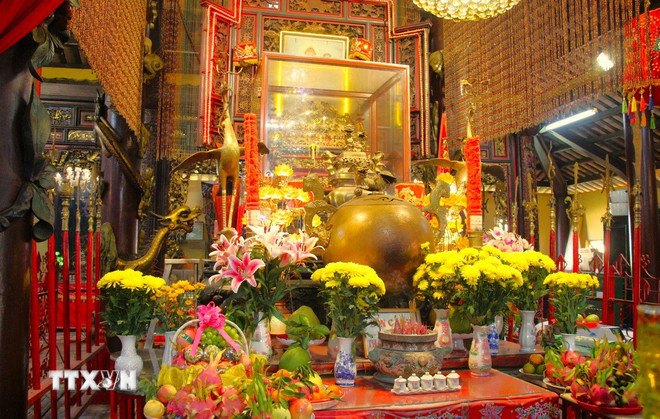
Surrounding Binh Thuy communal house is a quadrilateral fence according to ancient feng shui. The North side borders the Hau River. The East side is Binh Thuy canal with a gentle flow like a winding silk strip.
The South side is adjacent to Le Hong Phong Street, connecting with other major roads, creating convenience for trade. Finally, the West side of the communal house is a bustling residential area. With this location, the communal house converges all the feng shui elements "first near the river, second near the gate, third near the market".
The grounds of the Communal House include two areas: the main communal house area and the six hamlets. The main communal house area includes five houses (the vestibule, the main hall) and the "six hamlets" area includes a house to prepare offerings along with a theater that is arranged scientifically and neatly, creating an airy space.
Binh Thuy Communal House stands out with its Southern architecture blended with the Nguyen Dynasty's artistic style. The main structure of the communal house has unique features that only communal houses in the West have. The vestibule and main hall are square, each side has 6 rows of sturdy columns. On these columns, typical motifs such as dragons and peonies are carved meticulously and delicately.
The main hall has three overlapping roofs in the architectural style of “upper floor, lower porch”. On the roof of each area are designed a pair of winding dragons competing for a pearl or simply decorative patterns on the outside but leaving a strong impression.
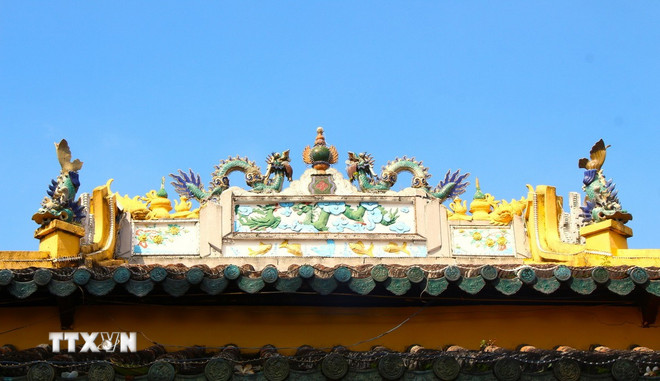
The communal house gate stands out with its yin-yang tiled roof and high fence. Inside, the communal house is solemn with an altar to the god, along with horizontal lacquered boards and parallel sentences.
The arrangement of altars in the communal house with a variety of worship methods reflects the culture, and also partly introduces the liberality, openness, and tolerance of accepting all the best of space and time.
In the past, Binh Thuy Communal House was not only a solemn place of worship but also a place for village dignitaries to meet to discuss national affairs and gather people to fight against foreign invaders.
In addition to worshiping the gods, village guardian spirits, ancestors who contributed to the founding of the land, etc., Binh Thuy Communal House also sets up altars for heroes who contributed to the country such as Nguyen Trai, Nguyen Hue, Nguyen Trung Truc, Vo Huy Tap, Dinh Cong Tru, Phan Boi Chau, Phan Chu Trinh,
Especially after the country's liberation in 1975, Binh Thuy communal house set up an altar to worship and commemorate President Ho Chi Minh.
Every year, the communal house is the venue for many important festivals such as the Ky Yen festival, the Thuong Dien festival and the Ha Dien festival. The festivals are held with the hope of favorable weather and bountiful harvests. This is also an occasion for descendants to remember the merits of their ancestors, those who contributed to the land reclamation.
Binh Thuy Communal House was ranked as a National Monument on September 5, 1989. In January 2018, the Ky Yen Festival at Binh Thuy Communal House was ranked as a National Intangible Cultural Heritage./.
Source: https://www.vietnamplus.vn/kham-pha-kien-truc-doc-dao-cua-dinh-binh-thuy-hon-tram-nam-tuoi-o-can-tho-post1079795.vnp
















![[Photo] Parade to celebrate the 50th anniversary of Laos' National Day](/_next/image?url=https%3A%2F%2Fvphoto.vietnam.vn%2Fthumb%2F1200x675%2Fvietnam%2Fresource%2FIMAGE%2F2025%2F12%2F02%2F1764691918289_ndo_br_0-jpg.webp&w=3840&q=75)









![[VIMC 40 days of lightning speed] Hai Phong Port determined to break through, reaching the target of 2 million TEUs by 2025](https://vphoto.vietnam.vn/thumb/402x226/vietnam/resource/IMAGE/2025/12/04/1764816441820_chp_4-12-25.jpeg)


































Comment (0)