

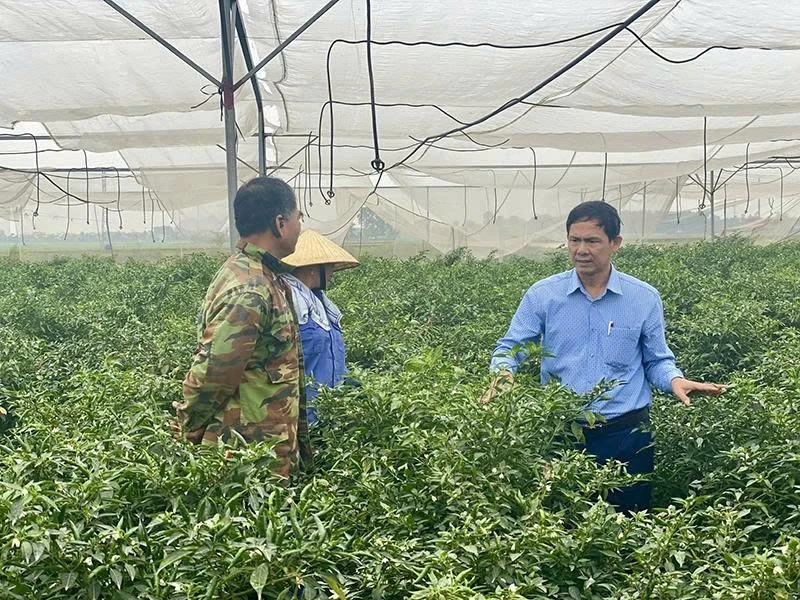
The chili pepper production area in Dinh Hoa commune has been granted an export-oriented growing area code.
As a coastal locality with approximately 300 hectares of water surface for aquaculture, Hoang Tien commune has actively encouraged organizations and individuals to invest in aquaculture over the years, gradually forming a large-scale concentrated farming area. Using state budget funds and contributions from the people, the commune has invested in building aquaculture infrastructure such as roads, electricity, and water supply and drainage systems in a synchronized and modern manner, creating favorable conditions for people to apply high-tech farming models. Accordingly, many households have consolidated land in the commune's aquaculture area to invest in intensive shrimp farming models in covered structures with significant investment, mitigating adverse weather conditions and minimizing disease outbreaks. Average yields reach 30-50 tons/hectare/crop, and three crops can be raised per year, yielding profits of 500-700 million VND/hectare/crop. Mr. Le Duy Trong, Head of the Economic Department of Hoang Tien Commune People's Committee, said: "Identifying aquaculture as an advantage, the locality has encouraged and supported the people to develop it into a concentrated, specialized production area applying high technology. Over time, the formation of concentrated production areas has brought high economic efficiency, superior to traditional production. Therefore, the Commune People's Committee will continue to review and implement the construction of concentrated production areas for other sectors in agriculture, contributing to job creation and increasing income for the people."
As a key commune for agricultural development, Dinh Hoa has proactively introduced mechanization and applied science and technology to agricultural production in a comprehensive, modern, and efficient manner. The commune has planned agricultural production areas into concentrated production zones and issued numerous mechanisms and support measures to stimulate demand for development by farmers and businesses, contributing to the formation of concentrated production areas with products meeting VietGAP, OCOP, and export standards. Many households have boldly introduced new crops and livestock with high economic value into concentrated production, built greenhouses and net houses, and promoted the application of high technology. Many types of crops and livestock have become key products of the locality, with economic value many times greater than traditional agricultural production. Mr. Ha Van Thang, Vice Chairman of the People's Committee of Dinh Hoa commune, said: "The planning of specialized production areas for crops such as rice, chili peppers, and fruit trees has created conditions for the formation of large-scale production areas. People apply synchronized mechanization and advanced modern techniques to production to create high-quality products. To date, the commune has established 7 export-oriented chili pepper growing areas and rice growing areas that have been granted planting area codes; 6 production areas meet VietGAP standards, and 3 OCOP agricultural products. In addition, the commune has also planned concentrated production areas with 13 livestock farms, many of which are linked with large enterprises such as JaFa, Phu Gia, etc."
In most localities throughout the province, concentrated production areas have gradually been formed, with crops such as: intensive rice cultivation areas, sugarcane cultivation areas, concentrated fruit tree cultivation areas, safe vegetable production areas, and areas for growing fodder crops associated with concentrated dairy farming... According to statistics from the Department of Agriculture and Environment, people in the province have formed and developed intensive, concentrated production areas certified for food safety, such as: 150,000 hectares of high-yield, high-quality intensive rice cultivation, 20,000 hectares of intensive corn cultivation, 12,000 hectares of intensive sugarcane cultivation, over 14,300 hectares of safe vegetables, and 14,000 hectares of concentrated fruit tree cultivation... contributing to increasing the overall value of the entire agricultural sector.
To develop sustainable concentrated agricultural production areas, the province has surveyed the specific characteristics of each locality, and based on that, issued many appropriate incentive and support mechanisms and policies, especially policies supporting infrastructure investment, to meet the requirements of large-scale commodity production. At the same time, it has created favorable conditions and supported businesses and people in consolidating land and investing in production. Through the development of concentrated agricultural production areas, people are gradually transforming from small-scale, outdated production methods to developing commodity agricultural production, contributing to the creation of high-quality products and increasing competitiveness, especially for products that have established brands and developed trademarks in the market. Simultaneously, it creates a solid foundation for the province to develop smart agriculture and ecological agriculture in the future.
Text and photos: Thanh Hoa
Source: https://baothanhhoa.vn/phat-trien-cac-vung-san-xuat-nong-nghiep-tap-trung-271480.htm


![[Photo] Prime Minister Pham Minh Chinh holds a phone call with the CEO of Russia's Rosatom Corporation.](/_next/image?url=https%3A%2F%2Fvphoto.vietnam.vn%2Fthumb%2F1200x675%2Fvietnam%2Fresource%2FIMAGE%2F2025%2F12%2F11%2F1765464552365_dsc-5295-jpg.webp&w=3840&q=75)





























































Comment (0)