

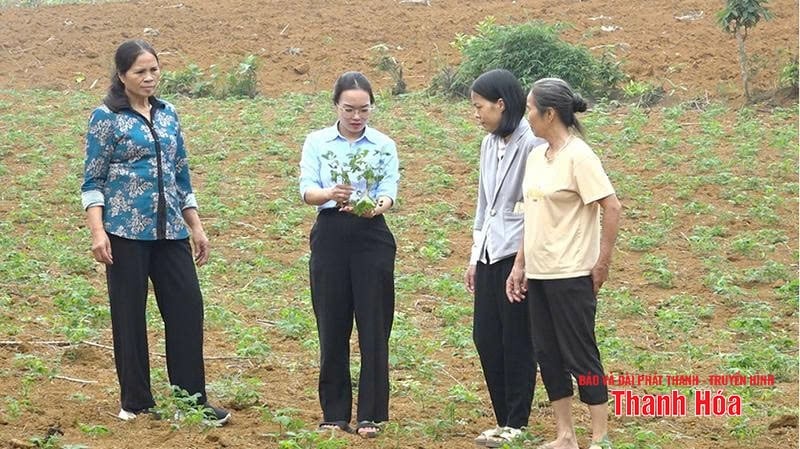
Officials from the Ngoc Lac District Agricultural Service Center are guiding residents of Kien Tho commune on how to identify and control cassava mosaic disease.
In the spring of 2025, Ngoc Lac district planted 1,690.5 hectares of cassava for raw materials, concentrated in the communes of Kien Tho, Phuc Thinh, Nguyet An, Ngoc Trung, etc. Currently, the cassava plants are in the seedling stage with about 9 to 10 leaves. However, field surveys by the Ngoc Lac District Agricultural Services Center have revealed that more than 10 hectares of cassava in these communes are infected with cassava mosaic disease. This is a viral disease with easily recognizable symptoms on the leaf blades: mottled yellow mosaics. In severe cases, the cassava leaves curl, twist, and wrinkle. Symptoms appear at all stages of cassava plant growth, from germination to maturity. Young cassava plants infected with the virus cannot grow or develop; mature cassava plants infected with the virus experience reduced yield, and in severe cases, cannot be harvested. According to Ms. Phung Thi Phuong, from Tho Phu village, Kien Tho commune (Ngoc Lac district): “In the spring of 2025, my family collaborated with Phuc Thinh Cassava Starch Processing Factory to plant nearly 10 hectares of cassava. Due to using old seeds from the previous season, nearly half of the area was infected with cassava mosaic disease, ranging from mild to severe.”
In response to this situation, the Ngoc Lac District Agricultural Service Center is coordinating with communes and towns to compile statistics on cassava acreage, planting time, crop structure, and origin of cassava varieties. Simultaneously, they are guiding farmers on spraying insecticides to control whiteflies and uprooting and destroying severely infected areas according to technical procedures for controlling cassava mosaic disease. According to Mr. Nguyen Duc Thai, Director of the Ngoc Lac District Agricultural Service Center: For areas with cassava mosaic disease infection levels from 25% to less than 70%, the center is guiding farmers to thoroughly uproot and destroy diseased plants and spray insecticide twice, 7-10 days apart, to control whiteflies. They are also guiding farmers on how to care for unaffected plants by supplementing fertilizer and watering to maintain soil moisture. In cases where more than 70% of the cassava plants and leaves are severely affected, the entire field must be completely destroyed and replaced with other crops. In addition, the center regularly sends staff to visit fields, inspect, and detect cassava mosaic disease early so that preventive measures can be taken from the outset, preventing widespread outbreaks. At the same time, they educate and guide producers on the harmful effects of cassava mosaic disease, prevention methods, and minimizing losses caused by the disease.
For the 2025-2026 cassava crop season, the entire province planted nearly 15,000 hectares of cassava for processing, concentrated in the districts of Muong Lat, Ba Thuoc, Ngoc Lac, Thuong Xuan, Nhu Thanh, Thach Thanh, Nhu Xuan, Cam Thuy, Tho Xuan, and Trieu Son. From the beginning of the season, the agricultural sector advised farmers to choose cassava mosaic disease-resistant varieties, healthy, disease-free varieties with clear origins, and to avoid planting varieties that had been identified as infected in the previous season. In addition, farmers cleaned their fields, removed cassava plant residues from the previous season, and cleared weeds along the edges and surrounding areas of the planting zone. Simultaneously, they applied effective crop rotation between cassava and other crops such as sugarcane, soybeans, jicama, and peanuts to break the transmission chain of cassava mosaic disease. Nevertheless, as of June 12, 2025, investigations by the Department of Crop Production and Plant Protection have revealed that 558.9 hectares of cassava in the districts of Ba Thuoc, Ngoc Lac, Thuong Xuan, Nhu Thanh, Thach Thanh, Nhu Xuan, Cam Thuy, Tho Xuan, and Trieu Son are infected with cassava mosaic disease, causing localized damage to the KM94 and KM140 varieties.
To proactively prevent and control cassava mosaic disease, the Department of Crop Production and Plant Protection is coordinating with local authorities to regularly update information and closely monitor the disease situation on cassava plants in order to promptly warn the people. At the same time, they are sending specialized staff to regularly visit fields, investigate, and detect cassava mosaic disease early, so that they can promptly guide people in applying control measures to prevent the disease from spreading widely.
Text and photos: Le Hoi
Source: https://baothanhhoa.vn/phong-chong-benh-kham-la-san-252592.htm

![[Photo] Solemn bathing ceremony and Buddha procession in Hue](https://vphoto.vietnam.vn/thumb/1200x675/vietnam/resource/IMAGE/2026/05/31/1780228263543_1-jpg.webp)
![[Photo] Admire the coral "masterpiece" amidst the million-year-old heritage of Dak Lak province.](https://vphoto.vietnam.vn/thumb/1200x675/vietnam/resource/IMAGE/2026/05/31/1780221235105_anh-man-hinh-2026-05-31-luc-16-53-27.png)
![[Photo] The General Secretary, President and his wife begin their state visit to the Philippines.](https://vphoto.vietnam.vn/thumb/1200x675/vietnam/resource/IMAGE/2026/05/31/1780230559452_anh-man-hinh-2026-05-31-luc-19-28-11.png)























![[Video] Sunset at Lap An Lagoon – Where the sun sets over the fishing nets](https://vphoto.vietnam.vn/thumb/340x192/vietnam/resource/IMAGE/2026/05/31/1780192137701_beach-landscape-sea-water-nature-grass-745871-pxhere-com.jpeg)









































![[Photo] Admire the coral "masterpiece" amidst the million-year-old heritage of Dak Lak province.](https://vphoto.vietnam.vn/thumb/402x226/vietnam/resource/IMAGE/2026/05/31/1780221235105_anh-man-hinh-2026-05-31-luc-16-53-27.png)































Comment (0)