

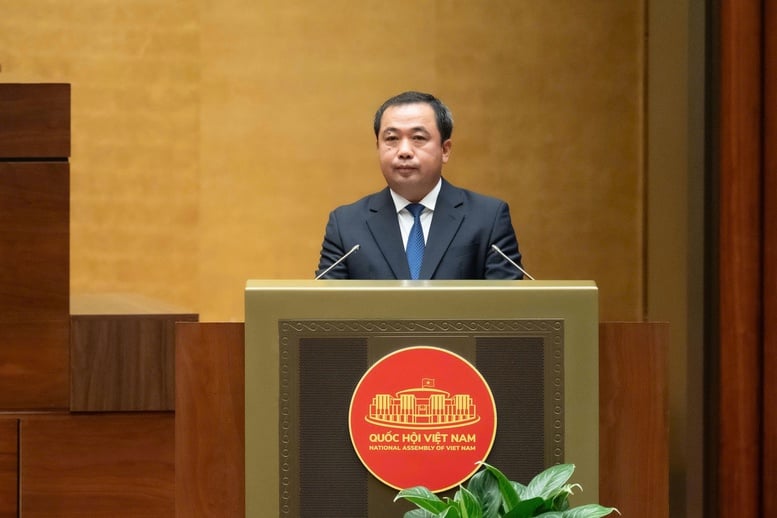
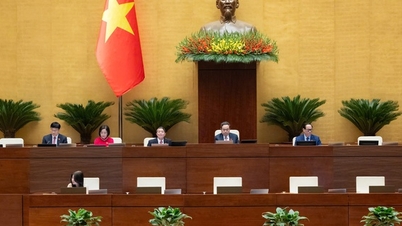
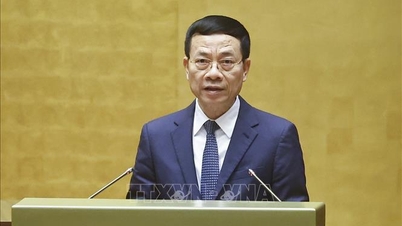
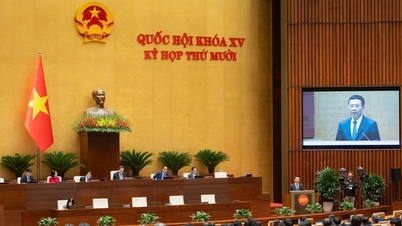
Minister of Agriculture and Environment Tran Duc Thang presented the report explaining, receiving feedback, and revising the draft Law amending and supplementing a number of articles of 15 laws in the field of agriculture and environment.
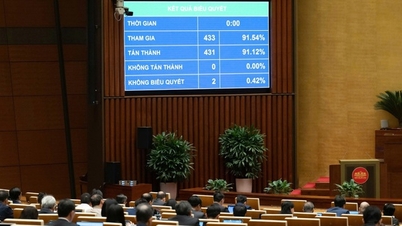
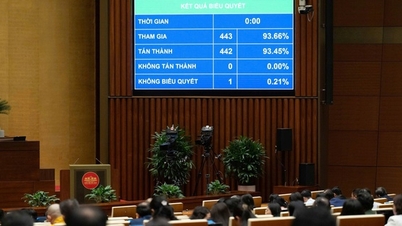
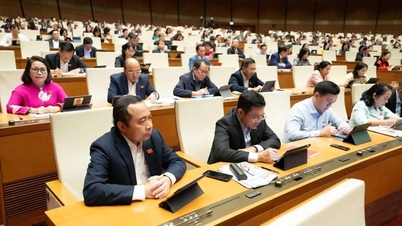
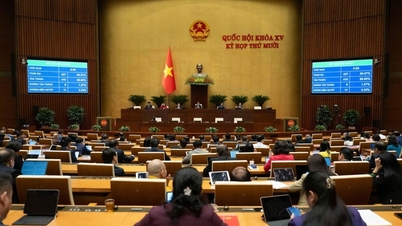
The Law amending and supplementing a number of articles of 15 laws in the fields of agriculture and environment, comprising 17 articles, was passed at the session with a majority of participating delegates voting in favor, demonstrating high consensus. The law was enacted to institutionalize and promptly implement the Party's policy on reforming and reorganizing the two-tiered government apparatus; decentralization and delegation of power; simplifying administrative procedures and reducing investment and business conditions; and promptly addressing inadequacies and bottlenecks arising from legal regulations and issues arising from the practical management of the state in the fields of agriculture and environment, in line with practical requirements and freeing up resources for socio -economic development.
In his report explaining, receiving feedback, and revising the draft Law amending and supplementing a number of articles of 15 laws in the fields of agriculture and environment at the National Assembly, Minister of Agriculture and Environment Tran Duc Thang stated that the drafting of this Law project focuses only on adjusting and addressing three main groups of contents: organizational restructuring, administrative procedure reform, investment and business conditions, and resolving bottlenecks that are already well-established and clear.
Regarding other obstacles and shortcomings, the Government believes that time is needed to summarize practical experiences, fully assess the impact, and will propose amendments in the 2026-2030 period. According to the plan, the Ministry of Agriculture and Environment will propose comprehensive amendments to 14 draft laws during the 16th National Assembly term, from 2026 to 2030. This includes amendments to the Law on Environmental Protection and the Law on Marine and Island Resources and Environment in 2026.
Some delegates suggested considering removing the environmental sensitivity factor from the criteria for land specifically used for rice cultivation with two or more harvests per year and for resettlement in the Environmental Protection Law. The Government has accepted the delegates' opinions and will continue to maintain the resettlement criteria as stipulated in the current Environmental Protection Law.
Regarding the criterion of land specifically used for rice cultivation with two or more harvests per year, the Government believes it is unnecessary to include this criterion in the Environmental Protection Law. Removing this criterion from the draft law aims to address existing obstacles and significantly reform administrative procedures without affecting food security or creating conflicts or inconsistencies with related laws.
Regarding the protection and utilization of topsoil in rice-growing land under the Law on Crop Production, some opinions suggested considering the repeal of Article 57 concerning the use of topsoil in rice-growing land. The Minister stated that in the past, the implementation of regulations on the use of topsoil in rice-growing land has faced many difficulties and obstacles, especially in the implementation of projects. Based on this practical experience, 30 out of 34 localities proposed removing the content of Article 57 in the Law on Crop Production. Repealing the regulation on the use of topsoil in rice-growing land will not affect the protection of rice-growing land. The protection of rice-growing land is already strictly regulated in the Land Law, the Investment Law, and other relevant laws.
Regarding the regulation waiving the procedures for converting forest land to other uses as stipulated in the Forestry Law, some delegates suggested reconsidering the provision that while these procedures are waived, a payment for reforestation must be made for the area of forest replanted after clear-cutting.
The Minister emphasized that, according to regulations, the area of planted forest after clear-cutting or planted forest that does not yet meet the criteria for forest status is not included in the forest status statistics but is counted similarly to vacant land planned for agricultural land. Therefore, this area currently does not require a decision to change the purpose of forest land use, but only a decision to change the purpose of agricultural land use to other purposes.
However, to enhance the responsibility of investors, the draft Law stipulates that they must fulfill the obligation to pay for reforestation to ensure the continued maintenance of forest area and forest cover rate, replacing agricultural land that has been converted to other purposes.
In addition, the Government has reviewed the draft Law, ensuring the consistency and uniformity of the legal system, especially the laws and resolutions considered by the National Assembly at this session.
Nguyen Hoang
Source: https://baochinhphu.vn/quoc-hoi-thong-qua-luat-sua-doi-bo-sung-15-luat-trong-linh-vuc-nong-nghiep-va-moi-truong-102251211105225637.htm















































































Comment (0)