

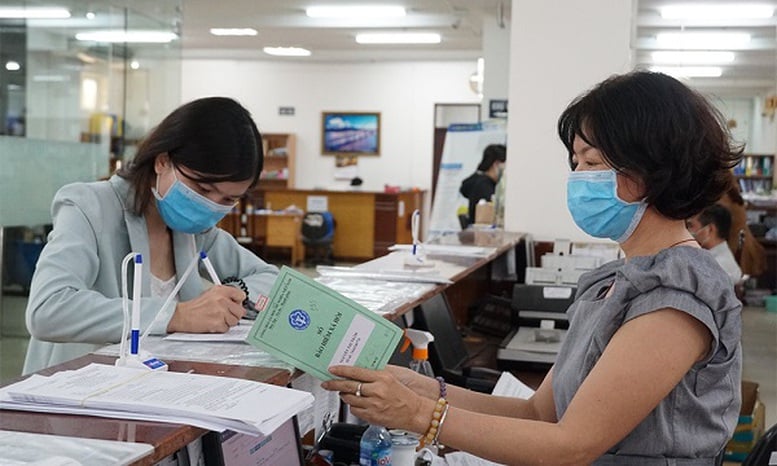
Circular No. 12/2025/TT-BNV provides detailed regulations on some articles of the Law on Social Insurance regarding compulsory social insurance.
Circular 12/2025/TT-BNV provides detailed regulations on several articles of the Law on Social Insurance regarding compulsory social insurance, including: conditions for receiving monthly pension or survivor's benefits; settlement of sickness benefits; conditions for rest and recovery after illness; maternity benefits; conditions for rest and recovery after maternity; retirement benefits; survivor's benefits, etc.
Sick leave
Regarding eligibility for sick leave benefits.
According to the Circular, the cases considered for sick leave benefits include:
1. Cases as stipulated in Clause 1, Article 42 of the Social Insurance Law.
2. Female workers who return to work before the end of their maternity leave period as prescribed in Clause 1, Article 53 of the Social Insurance Law; fathers or caregivers who do not take leave as prescribed in Clause 6, Article 53 of the Social Insurance Law; female workers who use surrogacy, their husbands or caregivers who do not take leave as prescribed in Article 55 of the Social Insurance Law; and workers who are temporarily exempt from contributing to the retirement and death benefit fund as prescribed in Clause 37 of the Social Insurance Law, and fall under one of the cases prescribed in Clause 1, Article 42 of the Social Insurance Law.
Regarding the duration of sick leave benefits.
The maximum duration of sick leave benefits in 2025, as stipulated in Clause 1, Article 43 of the Social Insurance Law, does not include the time already taken off work for sick leave benefits in cases where sick leave due to an illness on the list of diseases requiring long-term treatment began before July 1, 2025.
The maximum duration for receiving sick leave benefits in a year, as stipulated in Clause 1, Article 43 of the Social Insurance Law, does not depend on the date the employee began participating in social insurance.
The maximum duration of sick leave benefits in a year for workers engaged in strenuous, hazardous, or particularly strenuous, hazardous, or dangerous occupations or working in areas with particularly difficult socio -economic conditions, is based on the worker's occupation, job, or workplace at the time the worker takes sick leave.
In cases where an employee takes leave under the circumstances stipulated in Clause 1, Article 42 of the Social Insurance Law, and the leave period coincides with leave prescribed by labor law, or leave with full pay as prescribed by other specialized laws, or leave for maternity or convalescence as prescribed by social insurance law, the overlapping period will not be counted towards sick leave benefits; the leave period that does not coincide with leave prescribed by labor law, or leave with full pay as prescribed by other specialized laws, or leave for maternity or convalescence as prescribed by social insurance law will be counted towards sick leave benefits as prescribed.
If an employee's sick leave extends from the end of the previous year into the beginning of the following year, the sick leave from the previous year will be counted towards the sick leave entitlement for that year.
Regarding how sickness benefits are calculated.
1. The sickness benefit entitlement for employees as stipulated in Clause 1 of Article 43 and Article 44 of the Social Insurance Law is calculated as follows:
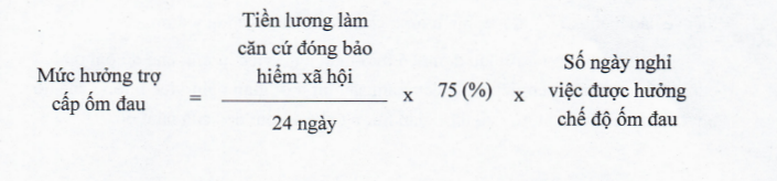
In there:
a) The salary used as the basis for social insurance contributions is regulated by Clause 1, Article 45 of the Social Insurance Law.
The month of re-enrollment as stipulated in point b, clause 1, Article 45 of the Social Insurance Law is the month of re-enrollment in social insurance after the employee terminates their labor contract, employment contract, or resigns in accordance with the law.
b) The number of sick leave days eligible for sick leave benefits is calculated based on working days, excluding public holidays, Tet holidays, weekly days off, and does not include periods overlapping with leave stipulated by labor laws, or paid leave under other specialized laws, or maternity leave or convalescence leave under social insurance laws.
2. The sickness benefit for employees, as stipulated in Clause 2, Article 43 of the Social Insurance Law, is calculated as follows:
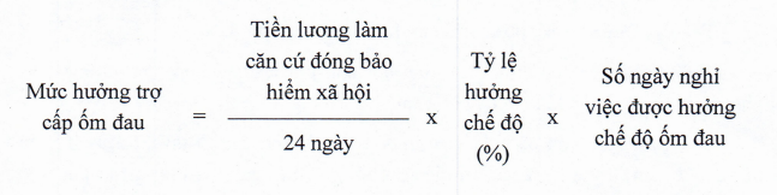
In there:
a) The salary used as the basis for social insurance contributions is regulated in Clause 1, Article 45 of the Social Insurance Law.
b) The benefit rate (%) is calculated as 65% if mandatory social insurance contributions have been paid for 30 years or more; 55% if mandatory social insurance contributions have been paid for 15 years to less than 30 years; and 50% if mandatory social insurance contributions have been paid for less than 15 years.
c) The number of sick leave days eligible for sick leave benefits is calculated based on working days, excluding public holidays, Tet holidays, weekly days off, and does not include periods overlapping with leave stipulated by labor laws, or paid leave under other specialized laws, or maternity leave or convalescence leave under social insurance laws.
3. The sickness benefit level for employees currently receiving sickness benefits will not be adjusted when the Government adjusts the base salary, reference salary, or regional minimum wage.
4. The working day used to determine the duration of sick leave benefits for employees is the normal working hours in a day that the employee is required to work for the employer according to the labor contract and labor regulations or legal provisions. Specifically for the subjects specified in Clause 2, Article 3 of Decree 158/2025/ND-CP and Point n, Clause 1, Article 2 of the Social Insurance Law, the working day used to determine the duration of sick leave benefits is the normal working hours in a day as registered by the employee with the social insurance agency when registering for compulsory social insurance, but not exceeding 8 hours.
Retirement
Regarding eligibility requirements for pension
1. The time spent working in strenuous, hazardous, or particularly strenuous, hazardous, or dangerous occupations or jobs, or working in areas with particularly difficult socio-economic conditions, including time working in areas with a regional allowance coefficient of 0.7 or higher before January 1, 2021, or working in underground coal mining (hereinafter referred to as working in occupations, jobs, or jobs in areas with particularly difficult socio-economic conditions) as stipulated in points b, c of clause 1, point b of clause 2 of Article 64 and point c of clause 1, point b of clause 2 of Article 65 of the Social Insurance Law, to be used as a basis for considering eligibility for retirement benefits, is determined as follows:
a) For workers employed in occupations, jobs, or working in areas with particularly difficult socio-economic conditions who have to take time off work for treatment or rehabilitation due to work-related accidents or occupational diseases (with full wages paid and mandatory social insurance contributions made by the employer), this period shall be counted as time spent working in occupations, jobs, or working in areas with particularly difficult socio-economic conditions.
b) For employees working in occupations, jobs, or in areas with particularly difficult socio-economic conditions who take maternity leave and the maternity leave period is counted as time contributing to compulsory social insurance, this period shall be counted as time working in occupations, jobs, or in areas with particularly difficult socio-economic conditions.
c) For workers who are employed in occupations, jobs, or work in areas with particularly difficult socio-economic conditions and are sent to work, study, or participate in labor cooperation programs but do not work in occupations, jobs, or work in areas with particularly difficult socio-economic conditions, this period shall not be counted as time spent working in occupations, jobs, or work in areas with particularly difficult socio-economic conditions.
d) For workers currently employed in occupations, jobs, or working in areas with particularly difficult socio-economic conditions, if they make a one-time payment for the remaining months (up to a maximum of 6 months) needed to qualify for a pension, this period will not be counted as time spent in occupations, jobs, or working in areas with particularly difficult socio-economic conditions.
2. Employees who meet the age requirements for receiving a pension but lack up to 6 months of mandatory social insurance contributions to qualify for a pension may make a one-time payment for the remaining months. The monthly contribution amount will be equal to the total contribution of the employee and employer before the employee retires, paid into the pension and death benefit fund as stipulated in Clause 7, Article 33 of the Social Insurance Law, and is detailed as follows:
a) Individuals who meet the age requirements for receiving a pension as stipulated in points a and d of clause 1, and points a and c of clause 2 of Article 64 of the Social Insurance Law must have contributed to compulsory social insurance for a period of at least 14 years and 6 months but less than 15 years;
b) Individuals who meet the age requirements for receiving a pension as stipulated in Article 65 of the Social Insurance Law must have contributed to compulsory social insurance for a period of at least 19 years and 6 months but less than 20 years;
c) The earliest time to make a lump-sum payment for the remaining months is the month immediately preceding the month in which the pension eligibility requirements are met.
Calculate the one-time retirement benefit.
In cases where an employee has met the eligibility requirements for a pension but continues to contribute to social insurance, the lump-sum retirement benefit for periods exceeding 35 years for men and 30 years for women is calculated as follows:
1. For each year of social insurance contributions exceeding 35 years for men and 30 years for women before reaching the prescribed retirement age, the benefit is calculated as 0.5 times the average salary used as the basis for social insurance contributions.
2. For each year of social insurance contributions exceeding 35 years for men and 30 years for women since reaching the prescribed retirement age, the amount is calculated as twice the average salary used as the basis for social insurance contributions.
Regarding the timing of pension payments.
1. The time of entitlement to a pension for employees who retire and meet the social insurance contribution requirements is calculated from the month immediately following the month in which they reach the prescribed retirement age. If an employee continues to work and contribute to mandatory social insurance after reaching the prescribed retirement age and meeting the contribution requirements, the time of entitlement to a pension is calculated from the month immediately following the month in which their employment contract is terminated or they cease working.
a) In the case of employees receiving a pension due to reduced working capacity who meet the age and social insurance contribution requirements, the pension entitlement date is calculated from the month immediately following the month in which the disability is determined. If the disability is determined before the month in which the employee reaches the prescribed retirement age, the pension entitlement date is calculated from the month immediately following the month in which the employee reaches the prescribed retirement age.
b) In cases where the exact date and month of birth cannot be determined (only the year or month and year of birth are recorded), the time of entitlement to pension benefits shall be calculated from the month immediately following the month in which the employee reaches the prescribed retirement age. The determination of the employee's age shall be carried out in accordance with the provisions of Clause 2, Article 12 of Decree No. 158/2025/ND-CP.
c) The earliest time for receiving a pension for employees entitled to a pension under Article 64 of the Social Insurance Law and with a social insurance contribution period of 15 to less than 20 years is from the date the Social Insurance Law comes into effect.
2. The time of entitlement to pension benefits in the case stipulated in Clause 7, Article 33 of the Social Insurance Law is calculated from the month immediately following the month in which the full amount for the remaining months of contributions has been paid.
3. For cases where original documents proving employment in the public sector before January 1, 1995, are no longer available, the pension entitlement date is the date stated in the social insurance agency's settlement document.
Snow Letter
Source: https://baochinhphu.vn/quy-dinh-moi-nhat-ve-bao-hiem-xa-hoi-bat-buoc-102250704194218536.htm
![[Photo] General Secretary and President To Lam presides over a meeting on the implementation of Directive No. 34-CT/TW of the Party Central Committee.](https://vphoto.vietnam.vn/thumb/1200x675/vietnam/resource/IMAGE/2026/05/19/1779187768672_a1-bnd-2350-631-jpg.webp)
![[Photo] Capturing the moment the tide recedes at Yen Binh Son rapids - a million-year-old scenic spot in Quang Ngai.](https://vphoto.vietnam.vn/thumb/1200x675/vietnam/resource/IMAGE/2026/05/19/1779175463885_yen9-1199-jpg.webp)
![[Photo] National Assembly Chairman Tran Thanh Man attends the groundbreaking ceremony for the National Highway 1A spatial axis project.](https://vphoto.vietnam.vn/thumb/1200x675/vietnam/resource/IMAGE/2026/05/19/1779161360398_ndo_br_bnd-1412-jpg.webp)































































![[Photo] General Secretary and President To Lam receives Indian Defense Minister Rajnath Singh](https://vphoto.vietnam.vn/thumb/402x226/vietnam/resource/IMAGE/2026/05/19/1779184046302_anh-man-hinh-2026-05-19-luc-16-46-58.png)



























Comment (0)