

According to the new Social Insurance Law of 2024, which will take effect from July 1, 2025, employees working under normal conditions are entitled to a pension if they meet two conditions: having contributed to social insurance for 15 years or more (a reduction of 5 years compared to before) and reaching retirement age.
Retirement age is the point at which employees participating in social insurance meet the eligibility requirements to retire and receive a monthly pension. The retirement age for employees is stipulated in Article 169 of the 2019 Labor Code. Accordingly, the retirement age for employees under normal working conditions is adjusted gradually, increasing from 60 to 62 for men and from 55 to 60 for women.
Specifically, starting in 2021, the age limit will increase by 3 months each year for men and 4 months each year for women until men reach 62 years old in 2028 and women reach 60 years old in 2035.
According to this roadmap, by 2026, the retirement age for male workers will be 61 years and 6 months, and for female workers will be 57 years. Workers who meet the social insurance contribution requirements will receive their pension from the first day of the month immediately following their retirement.
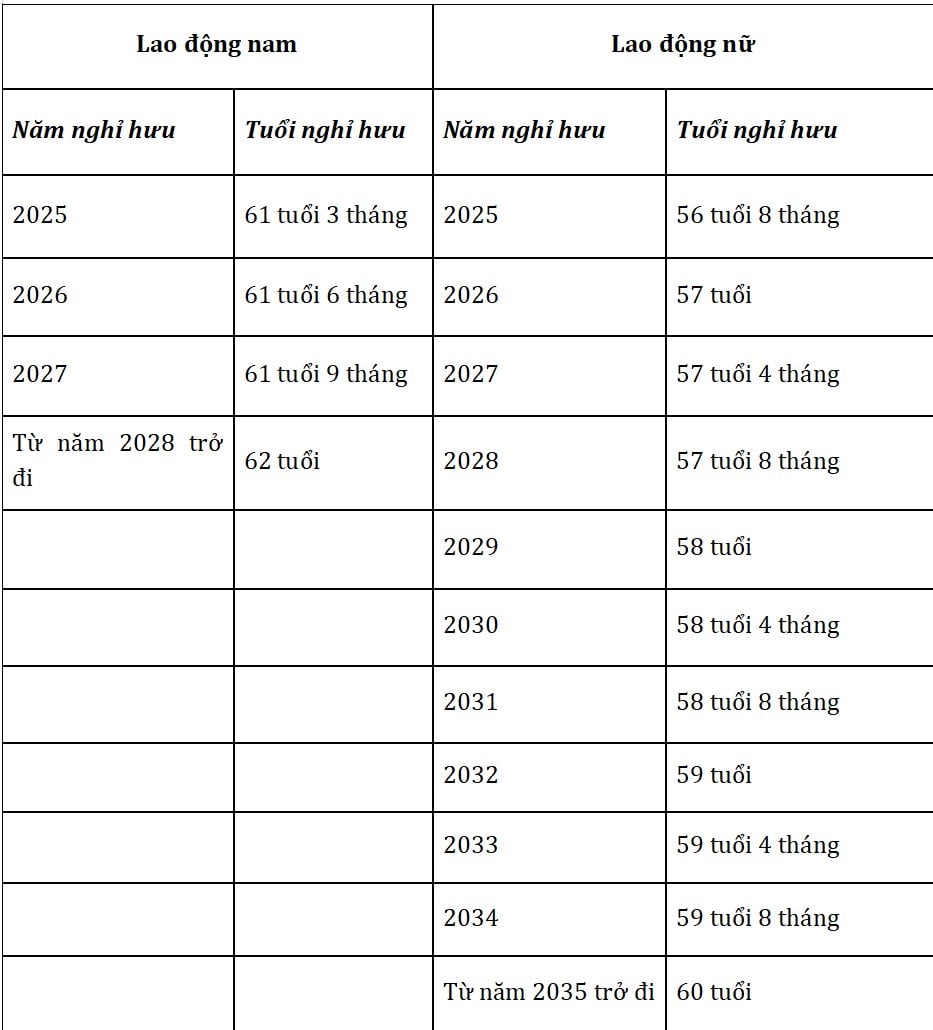
The roadmap for increasing the retirement age under normal working conditions.
In addition, the monthly pension amount is stipulated in Article 66 of the 2024 Social Insurance Law. For female workers, the pension is equal to 45% of the average salary used as the basis for social insurance contributions, corresponding to 15 years of contributions. For male workers, the pension is equal to 45% of the average salary used as the basis for social insurance contributions, corresponding to 20 years of contributions (if contributing for 15 years, it is calculated at 40%, with an additional 1% for each additional year of contribution).
However, the law also stipulates certain cases where early retirement is permitted. Accordingly, workers engaged in strenuous, hazardous, or dangerous work, or working in areas with particularly difficult socio -economic conditions, if they have contributed to compulsory social insurance for at least 15 years, may retire up to 5 years earlier than the normal retirement age.
Coal miners working underground can retire up to 10 years earlier. Officers, professional soldiers, and police officers can retire up to 5 years earlier if they have contributed to social insurance for 15 years. Individuals infected with HIV due to occupational accidents who have contributed to social insurance for 15 years are also entitled to a pension regardless of age.
Tuan Thanh
Source: https://baolongan.vn/quy-dinh-tuoi-nghi-huu-va-ty-le-luong-huu-nam-2026-a208153.html


![[Photo] Prime Minister Pham Minh Chinh holds a phone call with the CEO of Russia's Rosatom Corporation.](/_next/image?url=https%3A%2F%2Fvphoto.vietnam.vn%2Fthumb%2F1200x675%2Fvietnam%2Fresource%2FIMAGE%2F2025%2F12%2F11%2F1765464552365_dsc-5295-jpg.webp&w=3840&q=75)
![[Photo] Closing Ceremony of the 10th Session of the 15th National Assembly](/_next/image?url=https%3A%2F%2Fvphoto.vietnam.vn%2Fthumb%2F1200x675%2Fvietnam%2Fresource%2FIMAGE%2F2025%2F12%2F11%2F1765448959967_image-1437-jpg.webp&w=3840&q=75)













![[Infographic] Preventing students from making their own firecrackers: 7 things parents need to know](https://vphoto.vietnam.vn/thumb/402x226/vietnam/resource/IMAGE/2025/12/11/1765466656703_img_0320_20251211183542.jpeg)



































![[OFFICIAL] MISA GROUP ANNOUNCES ITS PIONEERING BRAND POSITIONING IN BUILDING AGENTIC AI FOR BUSINESSES, HOUSEHOLDS, AND THE GOVERNMENT](https://vphoto.vietnam.vn/thumb/402x226/vietnam/resource/IMAGE/2025/12/11/1765444754256_agentic-ai_postfb-scaled.png)
















































Comment (0)