

Supporting farmers in increasing the value of their products.
According to Deputy Director of the Department of Agriculture and Environment Nguyen Dinh Xuan, digital transformation is an important tool for the agricultural sector to support farmers and cooperatives in improving productivity and product quality, while ensuring clarity of origin and meeting the requirements of modern domestic and international markets. Looking at the reality, the steps the sector has taken in recent times are demonstrating the practical effectiveness of digital transformation.
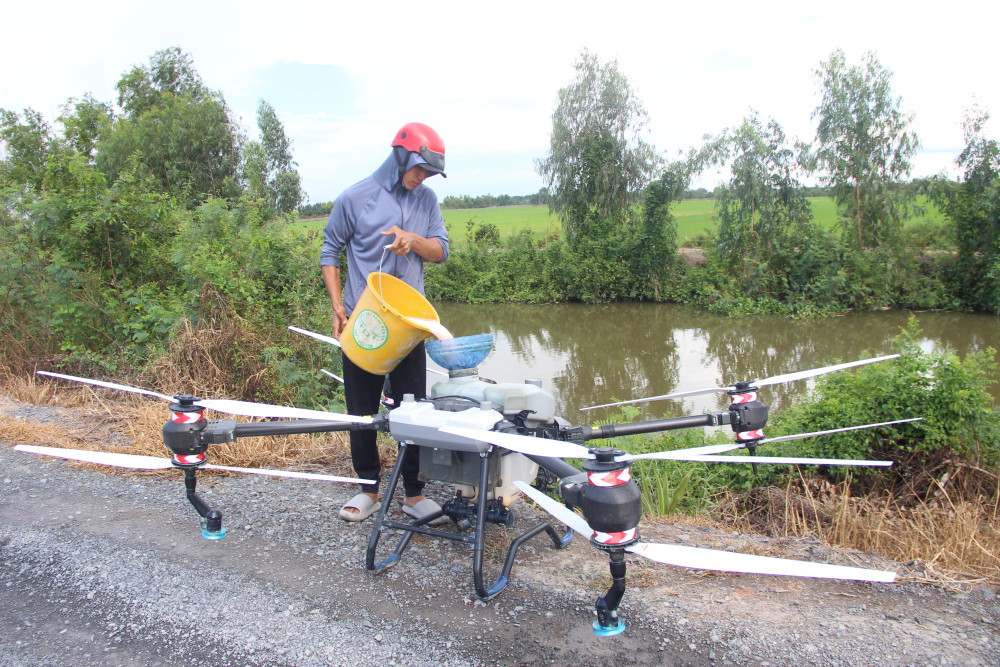
Applying modern technology in production helps farmers save costs, increase productivity, and protect their health.
On nearly 90 hectares of key fruit crops in Tay Ninh province, from durian, longan, pomelo, pineapple, cantaloupe, jackfruit, dragon fruit to coconut, rambutan and lemon, the Kipus traceability software has been applied to 247 establishments, helping farmers and businesses easily track the entire production process, from cultivation to harvesting. 42 businesses and cooperatives have used more than 3.2 million electronic labels, enabling accurate traceability of information for each batch, ensuring product safety and authenticity for customers.
Agricultural, forestry, and aquatic product processing and trading establishments are also gradually adopting advanced quality management standards such as ISO 22000, HACCP, and BRC, enhancing the reputation of Tay Ninh agricultural products in domestic and international markets.
Mr. Nguyen Thanh Dung, a durian farmer in Nhon Hoa Lap commune, shared: “Since being guided on registering planting area codes and QR codes, durian products have attracted the attention of many traders and supermarkets. Customers can scan the QR code to find out the origin, planting area, and cultivation methods, which makes me feel more secure and proud of my agricultural product brand.”
Not only farmers, but also cooperatives like My Thanh Agricultural Cooperative (My Thanh commune) have seen direct benefits. Le Thi Hang, Deputy Director of Business at My Thanh Agricultural Cooperative, said: “The application of digital transformation has opened up many new opportunities for the cooperative, especially in connecting with customers and managing products. When we started implementing it in 2021, the cooperative only sold goods through simple channels like Zalo, then expanded to the website and other e-commerce platforms. As a result, the cooperative's revenue has increased steadily year after year.”
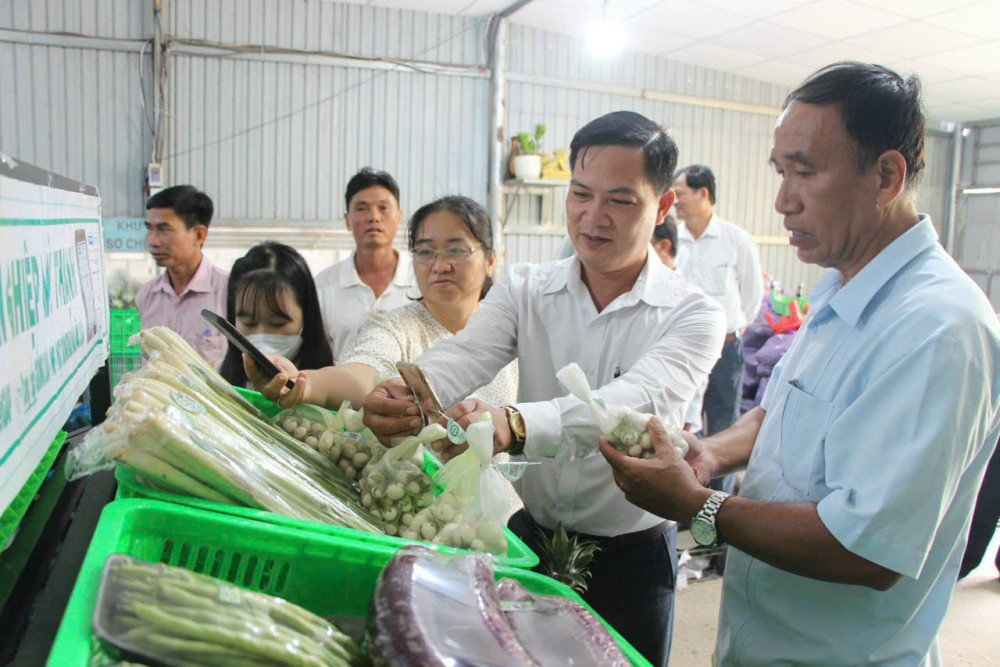
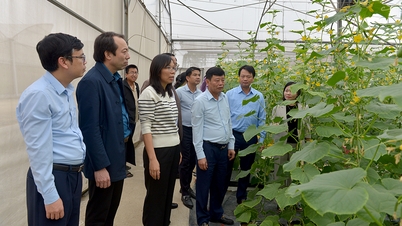
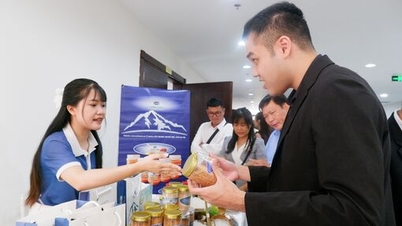
The visiting delegation experienced the traceability technology using QR codes on products at My Thanh Agricultural Cooperative to learn about the management process of the growing area and product quality.
Along with traceability, registering codes for growing areas and packaging facilities has become a crucial foundation for regulatory agencies and businesses to transparently control the quality of agricultural products.
To date, the province has supported 422 registrations of planting area codes and 179 packaging facility codes on the National Database System, while also connecting product consumption with supermarkets, large stores, and e-commerce platforms. The industry also encourages the formation of concentrated production areas to meet export and domestic consumption requirements, where products have planting area codes, QR codes, and adhere to safe production processes.
Technological solutions extend beyond traceability to directly support production. For rice and fruit crops, 17 intelligent pest and disease monitoring systems provide timely forecasts of pests, enabling farmers to proactively control them, reduce losses, and increase productivity. Drones are also used in sowing, fertilizing, and spraying pesticides, saving labor, reducing costs, and protecting the health of workers.
Currently, the Department of Agriculture and Environment is seeking approval to develop a Farm Household Diary, which will record all production activities, create a database of growing areas, manage livestock diseases, and integrate digital traceability. Once completed, this platform will help farmers, cooperatives, and businesses make accurate decisions, increase productivity, improve product quality, and enhance the brand value of Tay Ninh's agricultural products.
Resource management, environment and sustainable development
Digital transformation not only supports the management of agricultural production and consumption but also becomes an important tool in resource and environmental management and climate change monitoring. The province has implemented automated monitoring systems to track surface water, air, industrial emissions, and greenhouse gas emissions. Nine continuous surface water monitoring stations and five air monitoring stations have been installed, transmitting data directly to the Department, enabling real-time monitoring.
For industrial parks and clusters, 31 out of 34 industrial parks and 11 out of 23 industrial clusters have installed automatic wastewater monitoring systems.
In addition to monitoring industrial emissions, the Ministry of Agriculture and Environment is applying digital transformation to agricultural resource management. Measures include controlling soil and irrigation water quality, as well as monitoring the use of fertilizers and pesticides.
Digital data systems enable experts and farmers to monitor environmental changes in specific areas, thereby developing safe and sustainable farming solutions. This helps reduce negative environmental impacts, limit pollution, and improve agricultural production efficiency.
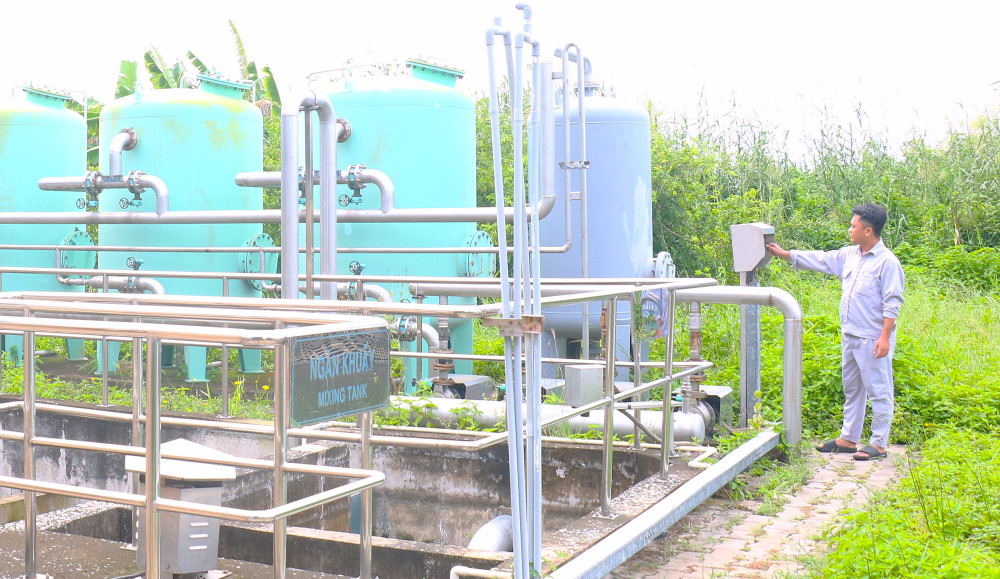
Automated monitoring systems help the Agriculture and Environment sector monitor the environment in real time, supporting sustainable agricultural development.
Furthermore, the application of digital technology is combined with forecasting and early warning models for natural disasters, droughts, heavy rains, or pests. This data helps farmers proactively adjust their production plans, protect crops and assets, and supports local authorities in developing scientific and effective policies for disaster prevention and climate change adaptation.
The review and updating of the database of greenhouse gas emission sources has also been implemented, increasing the total number of units to be inventoried from 99 to 133. These figures not only serve for assessment and monitoring but also provide a basis for the province to propose green development policies, reduce emissions, and adapt to climate change.
Mr. Nguyen Dinh Xuan informed that in the coming time, the sector will focus on completing the digital data platform on resources and environment, expanding the automated monitoring network, and strengthening data sharing with the province's IOC Center. Simultaneously, administrative management and environmental monitoring processes will continue to be digitized, especially in the areas of environmental licensing, waste management, online monitoring of emission sources, and handling violations. The sector will also apply modern technology to forecast extreme weather events, analyze climate data, and propose adaptation solutions for each ecological zone, thereby shifting from reactive management to forecasting and prevention, aiming for sustainable development and improving the efficiency of resource and environmental management.
Digital transformation is becoming a crucial driving force, creating a smart, modern agricultural ecosystem where farmers, cooperatives, and businesses are all supported. Agricultural products not only have clear origins and higher value but are also highly appreciated by the market. Simultaneously, resource and environmental management and climate change monitoring are becoming more effective, moving towards a green, sustainable, and comprehensive agricultural development in the future.
Minh Tue
Source: https://baolongan.vn/chuyen-doi-so-nganh-nong-nghiep-minh-bach-nguon-goc-ket-noi-thi-truong-a208140.html



![[Photo] Closing Ceremony of the 10th Session of the 15th National Assembly](/_next/image?url=https%3A%2F%2Fvphoto.vietnam.vn%2Fthumb%2F1200x675%2Fvietnam%2Fresource%2FIMAGE%2F2025%2F12%2F11%2F1765448959967_image-1437-jpg.webp&w=3840&q=75)




































![[OFFICIAL] MISA GROUP ANNOUNCES ITS PIONEERING BRAND POSITIONING IN BUILDING AGENTIC AI FOR BUSINESSES, HOUSEHOLDS, AND THE GOVERNMENT](https://vphoto.vietnam.vn/thumb/402x226/vietnam/resource/IMAGE/2025/12/11/1765444754256_agentic-ai_postfb-scaled.png)








































Comment (0)