

 |
The yen showed signs of weakness this morning, following yesterday's unexpected sharp decline, as the wide interest rate differential between Japan and the rest of the world continued to put pressure on the currency, even though the Bank of Japan (BoJ) is widely expected to tighten policy next week.
The US dollar was generally stable and other currencies showed relatively little volatility as markets awaited a key policy decision from the Federal Reserve (Fed) later in the day, with investors betting on an interest rate cut, likely to be one of the most divisive meetings in years.
The yen traded at 156.82 JPY/USD, little changed after falling 0.6% to near 157 in the previous session, although there were no clear factors causing volatility. Against the euro, the yen also fell to a record low in the previous session and remained around that level on Wednesday. The Australian dollar continued its 0.8% gain against the yen achieved on Tuesday.
“Right now, the yen is practically becoming a target for market pressure,” said Alex Hill, CEO of Electus Financial. He explained that the rise in long-term yields in the US, coupled with concerns about Japan’s fiscal situation and economic growth, is putting pressure on the yen.
“We are seeing the possibility of the yen continuing to weaken in the early part of the new year. And I think the kiwi/yen, AUD/yen pairs and most Southern Hemisphere currencies are well-positioned to appreciate against the yen,” he added.
The Bank of Japan (BoJ) will meet next week and is expected to raise interest rates, but investors will also be paying attention to signals from Governor Kazuo Ueda regarding the future policy path.
Expectations of larger fiscal stimulus packages in Japan are complicating the Bank of Japan's monetary policy outlook, while interest rates in Japan remain among the lowest in the world, a stark contrast to other major economies.
Meanwhile, in Australia, the central bank warned on Tuesday that it may have to raise interest rates if inflationary pressures do not ease.
Bart Wakabayashi, head of the State Street branch in Tokyo, said their trading lines show a fairly neutral stance on the USD/JPY pair, but a stronger buying trend for euro/yen and AUD/JPY.
In the broader market, all attention is focused on the Fed's decision, which is expected to cut interest rates by 25 basis points – a scenario that has almost been fully priced in by the market.
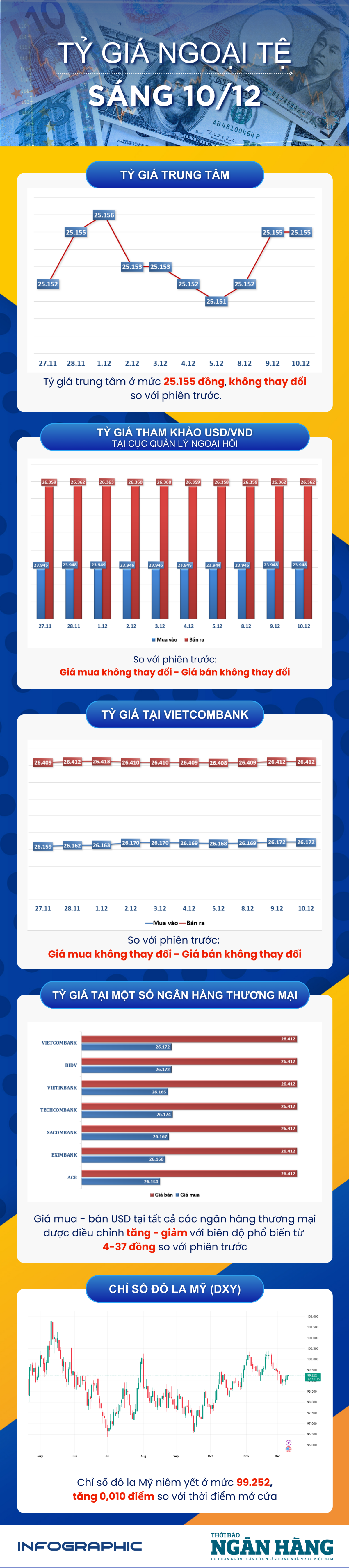
Ahead of the Fed meeting, the euro was virtually unchanged at $1.1625, while the British pound edged up 0.03% to $1.3301. The US dollar index held firm around 99.23 points, reflecting the relative stability of the greenback ahead of the crucial event.
In addition to the rate decision, markets will also focus on Chairman Jerome Powell's comments and the number of rate cuts the chart predicts for 2026.
"The press conference following the decision, as is often the case, can become an unpredictable variable," commented John Velis, macro strategist for the Americas at Bank of New York Mellon (BNY).
According to the expert, in recent meetings, Powell's tone has sometimes differed from the policy actions or official statements that accompanied them. While it's not ruled out that the Fed will cut interest rates or issue dovish forecasts, Powell has often used a more cautious or hawkish tone in press conferences.
Investors have recently scaled back expectations for interest rate cuts in 2026, due to concerns that inflation remains high and that the US economy may be more resilient than anticipated.
Data released on Tuesday showed that the number of job openings in the U.S. rose slightly in October, following a sharp increase in September, a sign that the labor market remains relatively strong.
White House economic adviser Kevin Hassett, considered a leading candidate for the next Fed chairman, said at the WSJ CEO Council event on Tuesday that there is still “plenty of room” for further interest rate cuts, but he also noted that if inflation rises again, this view may have to be adjusted.
In other currency markets, the Australian dollar traded at 0.6643 USD, after rising to near a three-month high in the previous session following hawkish remarks from RBA Governor Michele Bullock.
The New Zealand dollar edged lower by 0.05% to $0.5776.
Source: https://thoibaonganhang.vn/sang-1012-ty-gia-trung-tam-on-dinh-174897.html




![[Infographic] Cross-calculated exchange rates to determine taxable value from December 4-10](https://vphoto.vietnam.vn/thumb/402x226/vietnam/resource/IMAGE/2025/12/04/1764832340841_infographic-ty-gia-tinh-cheo-de-xac-dinh-tri-gia-tinh-thue-tu-4-1012-20251204120447.jpeg)























![[Video] The craft of making Dong Ho folk paintings has been inscribed by UNESCO on the List of Crafts in Need of Urgent Safeguarding.](https://vphoto.vietnam.vn/thumb/402x226/vietnam/resource/IMAGE/2025/12/10/1765350246533_tranh-dong-ho-734-jpg.webp)
































































Comment (0)