

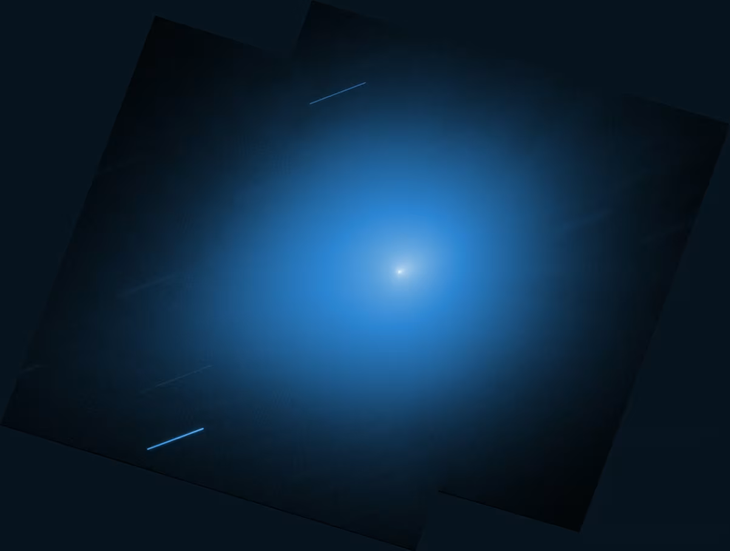
The Hubble Space Telescope recorded the interstellar comet 3I/ATLAS for the second time on November 30 - Photo: NASA
This event is eagerly awaited by astronomers because 3I/ATLAS has many interesting features that could help study the composition and evolution of exoplanets, as well as the early history of star formation.
The third object to ever fly into the Solar System.
According to CNN, the Hubble Space Telescope and the Jupiter Icy Moons Explorer (JUICE) probe recently captured a new series of images of the interstellar comet 3I/ATLAS as the celestial body prepared to make its closest approach to Earth in late November.
3I/ATLAS first attracted attention in July when it was discovered moving in the vicinity of Earth's atmosphere, despite originating from outside the Solar System. It is also the third interstellar object ever observed by humans while transiting the Solar System, prompting astronomers to deploy numerous missions focused on tracking and studying it.
The data collected helps to more accurately determine the orbit of 3I/ATLAS, and also provides clues about the structure and composition of matter to trace the origin of this celestial body.
Hubble was one of the first instruments to observe 3I/ATLAS shortly after its discovery, at a distance of approximately 420 million miles, revealing a teardrop-like image.
By November 30th, the telescope continued to capture clearer images using its Wide Field Camera 3 as the comet approached to within 178 million miles (286 million km).
Meanwhile, the European Space Agency's JUICE probe also recorded interesting activity around the comet, adding an important perspective to the ongoing analyses.
Two comet tails discovered.
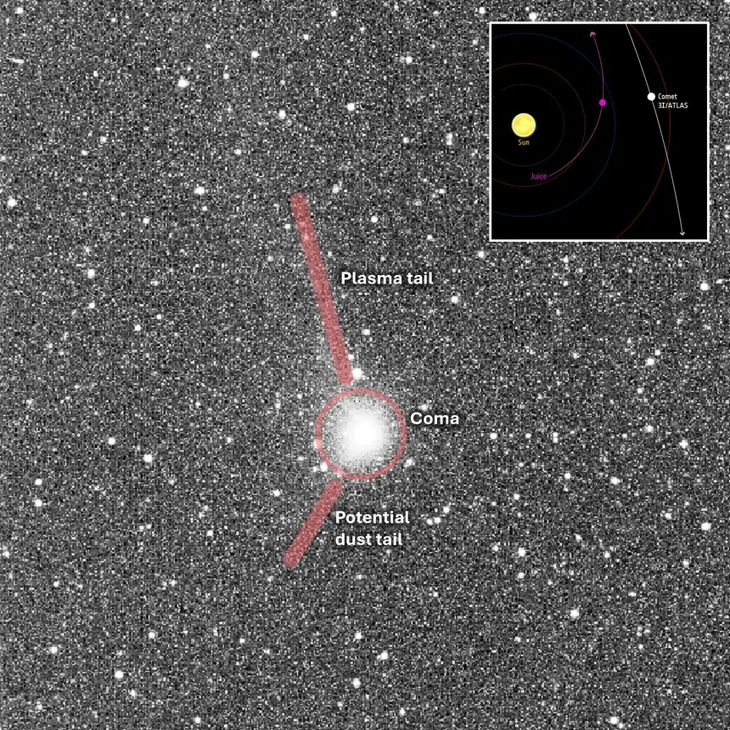
The Jupiter Icy Moons Explorer's navigation camera (NavCam) captured two tails extending from the comet on November 2nd - Photo: ESA
At a distance of 66 million kilometers, the European Space Agency's (ESA) JUICE spacecraft – on its way to Jupiter to study three icy moons that may contain subsurface oceans – also took the opportunity to record thermal activity on the comet as it flew close to the Sun.
Because the spacecraft was using its main antenna as a heat shield while flying near the sun, resulting in very slow data transmission, the control team downloaded some of the NavCam (navigation camera) images for early analysis.
Newly released images reveal a coma – the glowing gas layer surrounding the comet – along with two tails: a plasma tail of ionized gas and a faint dust tail of solid particles escaping from the comet.
According to NASA, telescopes and spacecraft may continue to monitor the comet for several more months before it leaves the Solar System.
3I/ATLAS will approach within 167 million miles (270 million km) of Earth on December 19, but it will be on the other side of the sun and will not pose a risk to Earth.
Full data from JUICE regarding this comet's flyby is expected to be transmitted between February 18 and 20, 2026, including high-resolution images from the spacecraft's optical cameras, along with data on the composition and particles of matter, providing further clues about the origin of this interstellar object.
Source: https://tuoitre.vn/sao-choi-hai-duoi-3i-atlas-sap-ap-sat-trai-dat-20251211104653771.htm



































































































Comment (0)