

The medical history revealed that child Q. had a continuous high fever for 3 days. On the 4th day, the fever subsided, but the child vomited brownish, had abdominal distension, and developed petechiae (small hemorrhagic spots) on the skin, so the family took the child to the local hospital. There, the child was noted to be restless, crying, with mottled purple skin, a weak radial pulse, cold extremities, and unmeasurable blood pressure...
Test results showed the child had blood concentration. The child was immediately diagnosed with severe dengue shock and treated for shock according to the protocol. Noticing the child's overweight and obese condition, and the difficulty in accessing intravenous fluids, the doctors consulted and transferred the child to the City Children's Hospital.
On July 31st, Dr. Nguyen Minh Tien, a specialist at the City Children's Hospital, stated that after receiving intensive treatment, the child's medication was switched to a high-molecular-weight dextran solution, adjusted according to weight to combat shock. The child's condition was very complex, exhibiting prolonged fever, respiratory failure, liver damage, severe coagulation disorders, gastrointestinal bleeding, bruising at injection sites, metabolic acidosis, and hypoglycemia.
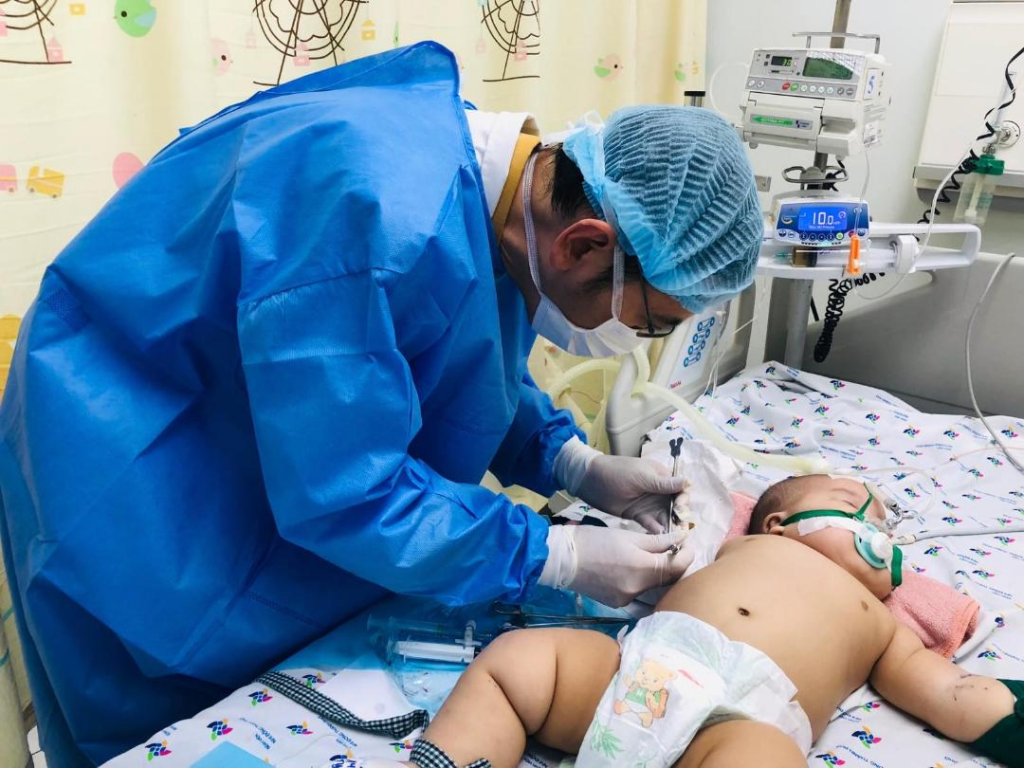
The doctor had to expose the vein and insert a small catheter to create an IV line for the child.
The child received intensive treatment including continuous positive airway pressure, shock management with high molecular weight solutions and vasopressors, liver support treatment such as correction of blood glucose, electrolytes, acid-base balance, vitamin K1 injection, and treatment of coagulation disorders with transfusion of fresh frozen plasma, cryoprecipitate, and concentrated platelets.
After nearly two weeks of treatment, the child's condition gradually improved, the fever subsided, oxygen support was discontinued, and the child was feeding well.
Dr. Tien assessed this as a severe case of dengue shock, complicated by blood clotting disorders and multi-organ damage, making it difficult for doctors to make appropriate treatment decisions.
Dr. Tien advises that the heavy rains during this time create favorable conditions for the breeding of Aedes mosquitoes, spreading dengue fever. Therefore, everyone needs to actively kill mosquitoes and mosquito larvae, and sleep under mosquito nets to avoid mosquito bites. Parents need to monitor and detect early signs of the disease to take their children to medical facilities promptly. If a child has a high fever for more than two days and exhibits any of the following signs, they should be taken to the hospital immediately: crying, restlessness, irritability or lethargy, abdominal pain, nosebleeds, bleeding gums or vomiting blood, black stools, cold hands and feet, lying still and not playing, refusing to breastfeed or eat...
Source link



















![[Photo] Prime Minister Pham Minh Chinh holds a phone call with the CEO of Russia's Rosatom Corporation.](/_next/image?url=https%3A%2F%2Fvphoto.vietnam.vn%2Fthumb%2F1200x675%2Fvietnam%2Fresource%2FIMAGE%2F2025%2F12%2F11%2F1765464552365_dsc-5295-jpg.webp&w=3840&q=75)
















































Comment (0)