

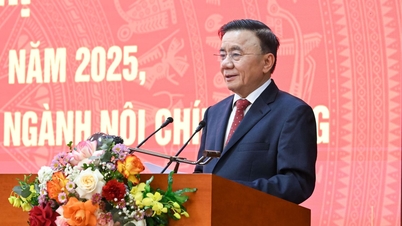
Speaking at the workshop, Ms. Ha Thi Nga, Vice Chairwoman of the Central Committee of the Vietnam Fatherland Front, emphasized that at the Party Congress of the Fatherland Front and central mass organizations, General Secretary To Lam requested that the Fatherland Front develop a set of indicators to measure the level of social trust at the provincial level.

Ms. Ha Thi Nga speaks at the workshop.
PHOTO: GIA HAN
According to Ms. Nga, this is a new requirement, a task that must be completed urgently, and "this is also a pressing need in the current period."
Ms. Nga informed that currently, within the Fatherland Front system, leading officials have begun implementing the assessment of task completion levels. Similarly, assessing the level of social trust at the provincial level also requires tools for implementation.
Ms. Nga hopes that the workshop will provide insights into how to implement the assessment of social trust levels at the provincial level, thereby demonstrating the role of the Vietnam Fatherland Front in promoting national unity.
"We want to listen to feedback and suggestions so that we can find a suitable implementation method. The goal is to ensure that this set of indicators truly becomes an important, transparent, objective, and comprehensive channel that helps localities raise awareness and propose solutions for development," Ms. Nga said.
The set of indicators must be worthy of the people's trust.
At the workshop, Dr. Bui Phuong Dinh, Deputy Director of the Academy of Public Administration (Ho Chi Minh National Academy of Politics ), emphasized that building a set of social trust indicators "is not just simply necessary, but urgent."
Mr. Dinh analyzed that this clearly demonstrates the two dialectical aspects: "The Party is for the people and the people trust the Party." "This means that for many years, our Party has strived, led, and organized the implementation of tasks to gain the trust of the people," Mr. Dinh stated.
Secondly, according to Mr. Dinh, in his speech at the recent 13th Central Committee Conference, General Secretary To Lam spoke about "3 key points, 3 transparency measures, and 1 benchmark," in which the benchmark is "the living standards and trust of the people."

Dr. Bui Phuong Dinh presented a paper at the conference.
PHOTO: GIA HAN
Therefore, Mr. Dinh pointed out that, along with the issue of living standards, the second aspect is trust. "Have we done all of that enough to win the people's trust? Are we worthy of the people's trust?" Mr. Dinh asked, and argued that the social trust index needs to return to three fundamental questions: First, what do we trust? Second, who do we trust? Third, how can we build a trustworthy index?
From there, Mr. Dinh presented the scientific basis and proposed a structure for a provincial-level social trust index, including: trust in the government and public institutions. This index encompasses government transparency; integrity and anti-corruption; service capacity and accountability; and the effectiveness of public service delivery.
Trust in social relationships includes the level of confidence between members of society; community cohesion; and a sense of security in life.
Confidence in the socio-economic environment, including the business environment and economic opportunities; income, living standards and social stability; long-term security and access to services.
These beliefs guide the future, encompassing the province's development prospects; opportunities for the younger generation; and personal futures.
After spending time analyzing the factors in the index, Mr. Dinh concluded that the index must be worthy of the people's trust. "We measure trust, but our index must also be worthy of the people's trust when they have responded. Since they have responded, we have a responsibility to that response and to make the index worthy of the people's trust," Mr. Dinh stated.
Source: https://thanhnien.vn/xay-dung-bo-chi-so-do-luong-niem-tin-xa-hoi-cap-tinh-185251212155656381.htm








































































Comment (0)